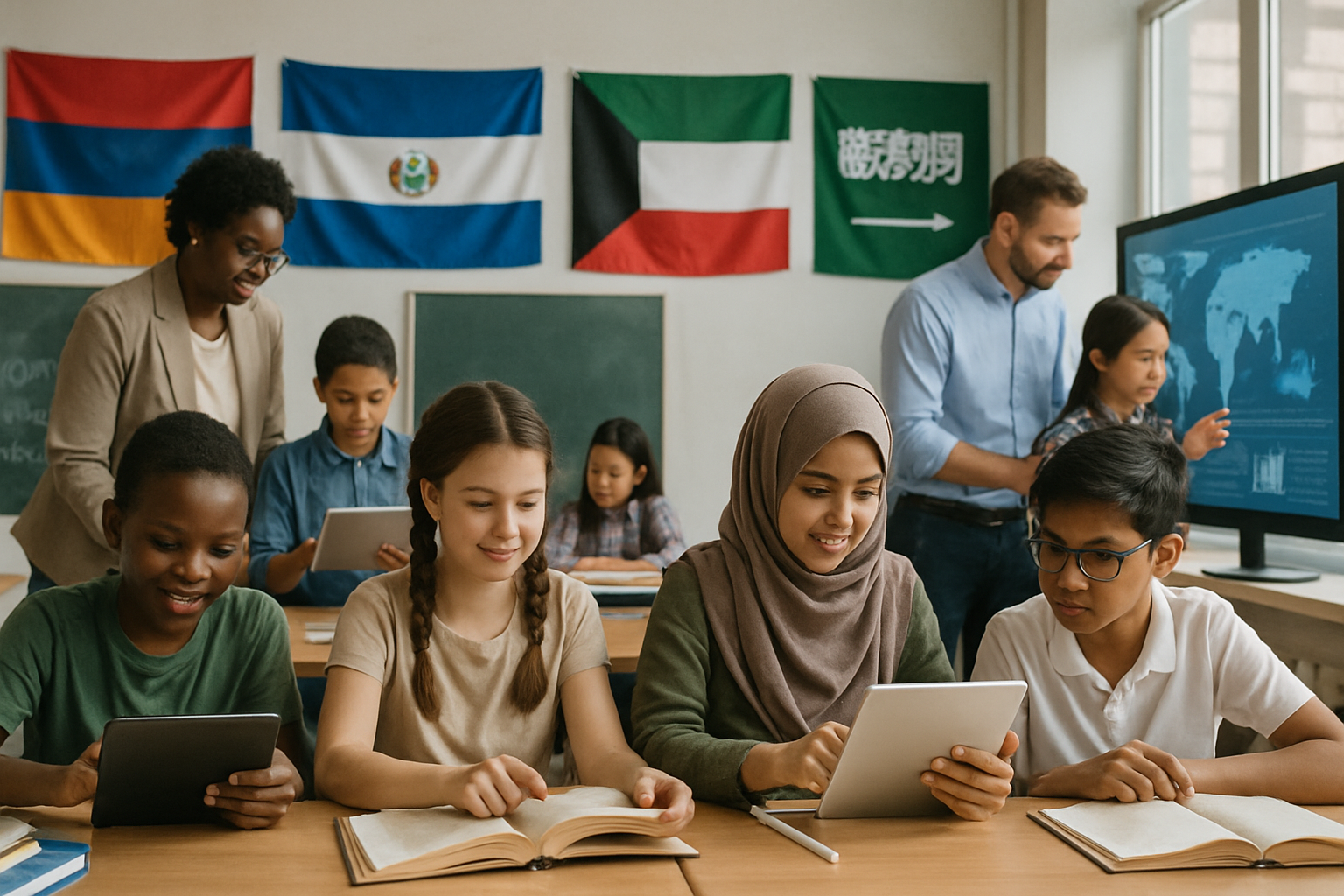
From Armenian Genocide remembrance scholarships in California to emergency educational support for Gaza's children, a new wave of international educational initiatives demonstrates the peak effectiveness of the ongoing "2026 Educational Technology Renaissance" - the most significant transformation in global education since the post-WWII expansion.
As Planet News investigates educational developments across Armenia, El Salvador, Kuwait, and Saudi Arabia, a clear pattern emerges: coordinated international cooperation that balances cutting-edge technology with human-centered learning approaches, addressing both immediate crises and long-term capacity building.
Armenia: Preserving Memory Through Educational Excellence
The California Armenian Legislative Caucus Foundation announced its 2026 Armenian Genocide Remembrance Scholarship winners, recognizing California high school students for outstanding submissions addressing the theme "Reimagining California through the lens of Armenian American experiences." The program highlights cultural resilience and civic contributions while ensuring the 111th anniversary of the Armenian Genocide remains in educational consciousness.
This initiative exemplifies a sophisticated diaspora-homeland educational investment model that has gained international attention for systematic cultural preservation through strategic educational pathways. The scholarship program represents more than simple financial support - it creates structured opportunities for young people to engage with complex historical narratives while developing critical thinking skills essential for democratic citizenship.
El Salvador: Digital Innovation Meets Community Development
Two groundbreaking initiatives position El Salvador at the forefront of educational innovation in Central America. Vice President Félix Ulloa's meeting with University of Bologna Rector Giovanni Molari focuses on strengthening academic, scientific, and cooperative ties between El Salvador and Italy, including student mobility programs and joint research initiatives.
Simultaneously, the Central Bank of El Salvador continues its transformative "Mi Viaje Financiero" (My Financial Journey) program, an itinerant initiative delivering economic education to students across the nation through interactive experiences aboard specially equipped buses. This program exemplifies the shift toward dynamic, practical learning methodologies that connect academic knowledge with real-world financial literacy skills.
The innovative approach addresses a critical gap in traditional education by making complex economic concepts accessible through hands-on learning experiences. Students receive guidance on budget creation, savings strategies, and investment principles - skills essential for navigating an increasingly complex global economy.
Kuwait: Strengthening International Educational Partnerships
Education Minister Eng. Sayed Jalal Al-Tabtabaie welcomed Italian Ambassador Lorenzo Morini and the Head of Cultural Affairs to explore expanded educational cooperation between Kuwait and Italy. While details remain preliminary, this diplomatic engagement reflects the broader trend of bilateral partnerships proving more effective than traditional multilateral approaches in educational development.
Such partnerships enable flexible, culturally responsive strategies while maintaining evidence-based standards - a model that has proven particularly valuable during the global semiconductor crisis that has driven memory chip prices up sixfold, creating infrastructure bottlenecks for technology-dependent programs until 2027.
Saudi Arabia: Emergency Response and Humanitarian Education
In perhaps the most urgent initiative documented, Saudi Arabia has signed a comprehensive joint executive program to support educational continuity in crisis zones. The King Salman Humanitarian Aid and Relief Center (KSrelief), working with the Saudi Center for Culture and Heritage, will establish safe learning environments and provide psychological support for 1,000 male and female students affected by educational disruption in the Gaza Strip.
This program represents a significant evolution in humanitarian response, moving beyond emergency aid to systematic educational infrastructure support. The initiative includes field schools designed to maintain learning continuity during crisis while providing crucial psychological and social support services for trauma-affected children.
Assistant Supervisor General of KSrelief for Operations and Programs Eng. Ahmed Al-Baiz emphasized the program's goal of mitigating the impact of conflict on educational processes - recognizing education as essential for community resilience and post-crisis recovery.
Global Context: The 2026 Educational Technology Renaissance
These developments occur within the broader context of the "2026 Educational Technology Renaissance," a coordinated international movement characterized by thoughtful digital tool integration with traditional educational values. Unlike previous waves focused primarily on access and infrastructure, this transformation addresses technological integration, teacher development, student welfare, and fiscal sustainability simultaneously.
Success models globally include Malaysia's remarkable 97.82% teacher placement rate alongside the world's first AI-integrated Islamic school, Singapore's WonderBot 2.0 heritage education system, and Canada's responsible AI teaching assistants that maintain critical thinking standards while leveraging technological advancement.
Challenges and Adaptations
The global memory crisis, driven by semiconductor price surges of up to 600% due to AI development demands, has paradoxically driven innovation toward more efficient and sustainable technology integration approaches. Educational systems are learning that effective technology integration requires emphasis on enhancement rather than replacement of fundamental human learning relationships.
Research by Dr. Ran Barzilay at the University of Pennsylvania shows that early smartphone exposure before age 5 causes persistent sleep disorders, cognitive decline, and weight problems extending into adulthood. With 96% of children aged 10-15 using social media and 70% experiencing harmful content exposure, educational systems must carefully balance technological tools with human development priorities.
Success Factors for Global Implementation
Analysis of successful educational initiatives reveals universal success factors that transcend cultural and economic contexts:
- Sustained Political Commitment: Programs that survive beyond electoral cycles demonstrate the most significant long-term impact
- Comprehensive Stakeholder Engagement: Success requires active participation from educators, students, families, and communities
- Innovation-Tradition Balance: Effective programs enhance rather than replace fundamental educational values
- Cultural Sensitivity: Local adaptation proves superior to standardized solutions
- International Cooperation: Knowledge sharing accelerates innovation while preventing duplication of failed approaches
Economic and Strategic Implications
Educational investments are increasingly viewed as strategic 21st-century infrastructure rather than cost centers. Countries implementing comprehensive prevention-first educational approaches demonstrate superior economic outcomes through reduced crisis intervention costs, decreased unemployment, and improved workforce productivity.
The economic multiplier effects include enhanced community resilience, reduced long-term social service demands, and improved international competitiveness through strategic human capital development. These create self-reinforcing cycles where educational excellence supports economic development, enabling further educational investment.
Looking Forward: Critical Juncture
Educational policy experts identify April 2026 as a critical juncture determining educational trajectories for the coming decade. The success or failure of current reform initiatives will significantly affect global capacity for addressing climate change, technological disruption, and social cohesion through quality educational systems.
The challenge is preparing students for an AI-integrated global economy while preserving human creativity, critical thinking, and cultural knowledge that define authentic educational excellence. The window for effective coordinated action is narrowing, requiring unprecedented coordination between governments, educational institutions, private sector partners, and international organizations.
International Cooperation Evolution
Traditional educational cooperation is evolving beyond financial assistance toward comprehensive support including cultural integration, language acquisition, and ongoing development systems. Regional frameworks are enabling smaller nations to access expertise while contributing innovations to global knowledge bases.
Bilateral partnerships and peer-to-peer knowledge sharing networks are proving more resilient than traditional multilateral approaches, allowing flexible, culturally responsive strategies while maintaining evidence-based standards. The distributed cooperation model respects educational sovereignty while facilitating the sharing of successful approaches.
The initiatives in Armenia, El Salvador, Kuwait, and Saudi Arabia demonstrate that effective educational transformation requires thoughtful technological adaptation serving specific cultural, economic, and social needs rather than wholesale replacement of human relationships. Success depends on maintaining human creativity, critical thinking, and cultural knowledge while preparing students for an interconnected global economy requiring both technical competence and cultural authenticity.
As the world navigates this critical period of educational transformation, the evidence suggests that the future belongs to educational systems that successfully integrate advanced technologies while preserving the fundamental human relationships, critical thinking skills, and cultural authenticity that make education meaningful and transformative for diverse populations.