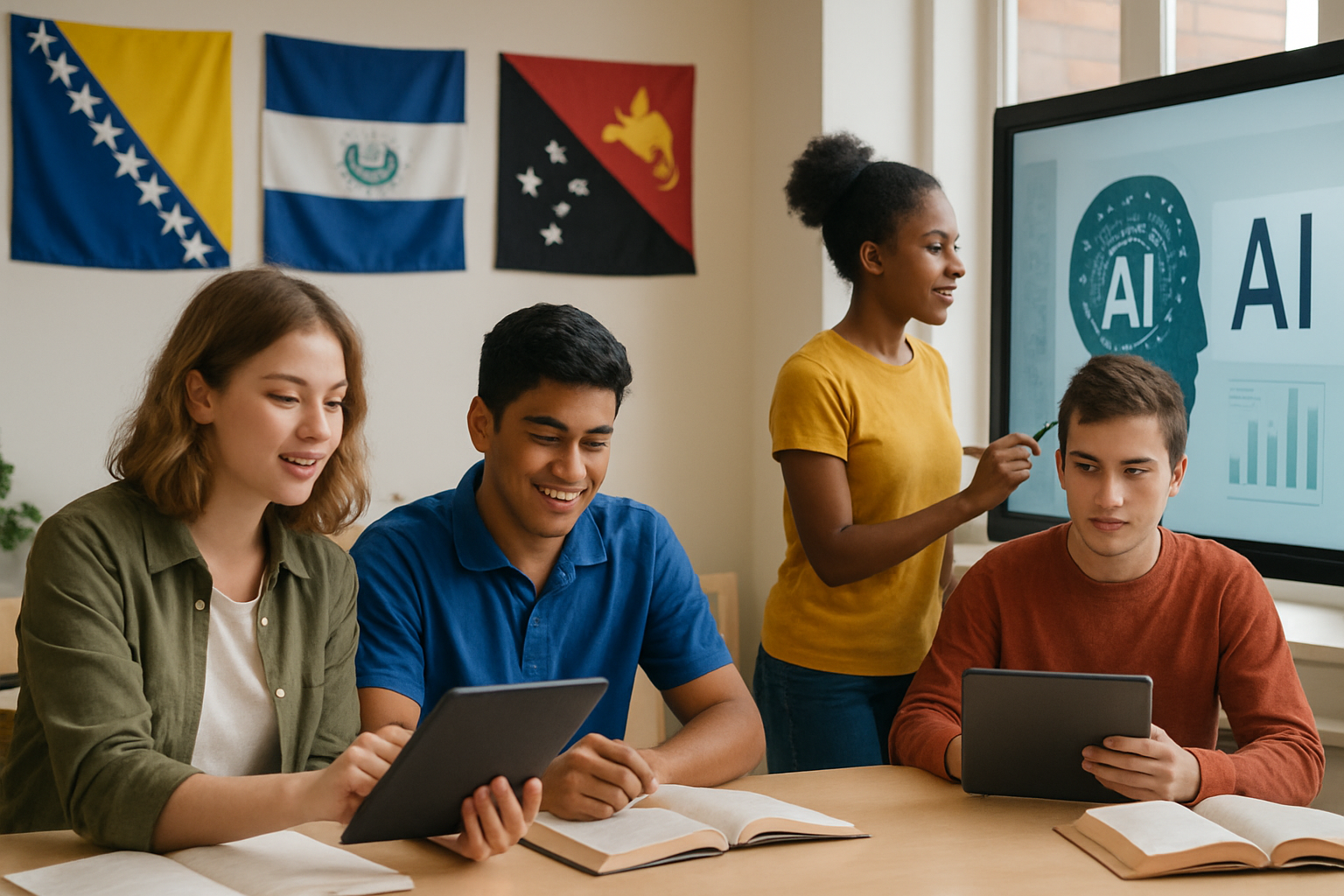
March 2026 has witnessed unprecedented educational innovations spanning four continents, with Bosnia and Herzegovina, El Salvador, Papua New Guinea, and Slovakia demonstrating diverse yet complementary approaches to 21st-century learning challenges that are reshaping global education paradigms.
From the digitalization of traditional classrooms in Eastern Europe to groundbreaking financial literacy programs in the Pacific, these nations are contributing to what educational policy experts have termed the "2026 Educational Technology Renaissance" – the most significant transformation in learning methodologies since the post-World War II educational expansion.
Bosnia and Herzegovina: Digital Transformation in Traditional Education
Bosnia and Herzegovina has emerged as a significant contributor to the global educational digitalization movement, with schools increasingly incorporating advanced digital tools into their curricula. The transformation has produced measurable improvements in student learning outcomes, with teachers reporting that students are absorbing curriculum material more rapidly when modern technology is thoughtfully integrated into traditional pedagogical approaches.
The Bosnian model emphasizes what educational researchers call "human-centered digital integration" – using technology to enhance rather than replace fundamental teacher-student relationships. This approach has garnered international attention as schools demonstrate significant improvements in student engagement and learning speed through interactive software, smart classroom technologies, and digital learning platforms.
"We are seeing students respond differently to learning when technology serves educational goals rather than simply replacing traditional methods,"
— Educational Technology Specialist, Bosnia and Herzegovina Ministry of Education
The transformation faces challenges including the need for comprehensive teacher training programs and improved technical infrastructure. However, Bosnia's systematic approach to balancing innovation with educational tradition provides a template that other nations in similar transition phases can adapt to their cultural contexts.
El Salvador: Revolutionary Tourism Education Initiative
El Salvador has taken a bold step in aligning educational offerings with economic opportunities through the introduction of a specialized tourism bachillerato program at Complejo Educativo Caserío La Estufa in La Unión department. Education Minister Karla Trigueros announced this initiative as part of the government's broader strategy to prepare local youth for the booming tourism sector.
The program represents a sophisticated understanding of educational-economic alignment, with the curriculum designed to provide students with competencies necessary for rapid insertion into the labor market. This initiative capitalizes on significant tourism growth in eastern El Salvador, driven by new hotel construction, restaurant development, travel agencies, and the upcoming operation of La Unión airport.
Minister Trigueros emphasized that the program aligns education with real opportunities generated by tourism development promoted under President Nayib Bukele's administration. This model demonstrates how educational institutions can respond dynamically to regional economic transformations while maintaining academic rigor.
Papua New Guinea: Empowering Financial Literacy for Youth
Papua New Guinea has launched one of the most comprehensive youth financial literacy initiatives documented in the Pacific region, with the "Young Minds Savings Campaign" reaching over 8,000 students across Western Highlands Province. This groundbreaking program combines traditional financial education with cultural sensitivity, recognizing PNG's unique linguistic diversity across more than 800 languages.
The program's success lies in its community-centered approach, working within existing cultural frameworks while introducing modern financial concepts. Students participating in the campaign have demonstrated improved understanding of savings, investment principles, and entrepreneurial thinking – skills crucial for PNG's developing economy.
The initiative forms part of PNG's broader educational transformation, which includes a $12 million international partnership program representing the most ambitious educational initiative in the nation's recent history. This comprehensive approach addresses infrastructure improvements, teacher training, and curriculum modernization while maintaining cultural authenticity.
Slovakia: Scientific Innovation Through Interactive Education
Slovakia continues to build upon its successful "Vedecký ambasádor" (Scientific Ambassador) project, which has returned for a second year with an enhanced program targeting students in grades 8 and 9. The initiative, coordinated by the Center for Scientific and Technical Information of the Slovak Republic, focuses on developing programming skills, creativity, and digital competencies among young learners.
The program's expansion includes improved collaboration with expert lecturers and extended reach to additional Slovak cities. Students engage with hands-on learning experiences that deepen their interest in science and technology while maintaining strong connections to traditional educational values.
The Scientific Ambassador project exemplifies Slovakia's commitment to preparing students for an AI-integrated economy while preserving critical thinking skills and cultural knowledge. This balance has made the program a model for other European nations seeking to enhance STEM education without compromising educational heritage.
Global Context: The 2026 Educational Technology Renaissance
These four nations' initiatives occur within the broader framework of the "2026 Educational Technology Renaissance," a coordinated international movement toward thoughtful digital tool integration with traditional educational values. Unlike previous technological adoption waves focused primarily on access and infrastructure, this transformation addresses multiple challenges simultaneously: technological integration, teacher development, student welfare, and fiscal sustainability.
The global movement has produced remarkable successes, including Malaysia's achievement of a 97.82% teacher placement rate with the world's first AI-integrated Islamic school, Singapore's WonderBot 2.0 heritage education system, and Canada's responsible AI teaching assistants that maintain critical thinking standards.
Implementation Challenges and Solutions
Despite these successes, the educational transformation faces significant challenges. The global semiconductor crisis has driven memory chip prices up sixfold, creating infrastructure bottlenecks for technology-dependent programs until 2027, when new manufacturing facilities come online. This constraint has paradoxically driven innovation toward more efficient and sustainable technology integration approaches.
Educational systems worldwide have learned to emphasize technology as enhancement tools for human potential rather than wholesale replacements for traditional educational relationships. The most successful implementations preserve creativity, cultural understanding, and emotional depth that define meaningful education while leveraging technological advantages.
Economic and Strategic Implications
The educational reforms documented across these four nations represent more than academic improvements – they constitute strategic infrastructure investments for 21st-century economic competitiveness. Countries implementing comprehensive prevention-first educational approaches report superior economic outcomes through reduced crisis intervention costs, decreased unemployment rates, and improved workforce productivity.
Educational investments are increasingly viewed as strategic infrastructure rather than cost centers, creating self-reinforcing cycles where educational excellence supports economic development, which enables further educational investment. This pattern is particularly evident in El Salvador's tourism-aligned education and PNG's community-based financial literacy initiatives.
International Cooperation and Knowledge Sharing
The success of these diverse educational initiatives demonstrates the importance of international cooperation in educational transformation. Bilateral partnerships, multilateral frameworks, and peer-to-peer knowledge sharing networks are accelerating innovation while preventing the duplication of failed approaches.
Regional frameworks are enabling smaller nations to access expertise while contributing innovations to global knowledge bases. This distributed cooperation model has proven more resilient than traditional multilateral approaches, allowing flexible, culturally responsive strategies while maintaining evidence-based standards.
Future Implications and Scaling Potential
March 2026 represents a critical juncture in global educational policy development. The success or failure of current reform initiatives will determine educational trajectories for the coming decade, affecting global capacity to address climate change, technological disruption, and social cohesion through quality educational systems.
The diverse approaches demonstrated by Bosnia and Herzegovina, El Salvador, Papua New Guinea, and Slovakia provide valuable templates for worldwide educational modernization. Their experiences suggest that effective transformation requires thoughtful adaptation to specific cultural, economic, and social contexts rather than standardized solutions.
Educational systems must prepare students for an AI-integrated global economy while preserving human creativity, critical thinking, and cultural knowledge that define authentic educational excellence. The balance between technological advancement and human development, global competencies and local identity, and innovation and tradition preservation will determine which nations successfully navigate the educational challenges ahead.
Lessons for Global Educational Policy
The success factors identified across these four diverse educational contexts include sustained political commitment beyond electoral cycles, comprehensive stakeholder engagement involving educators, students, families, and communities, and adequate resource allocation for long-term sustainability.
Most importantly, these nations demonstrate that educational modernization requires technological tools to serve educational goals rather than replace the fundamental human relationships that define authentic learning. The future belongs to educational systems that successfully integrate advanced technologies while preserving the teacher-student-community relationships that make education meaningful and culturally relevant.
As the 2026 Educational Technology Renaissance continues to evolve, the experiences of Bosnia and Herzegovina, El Salvador, Papua New Guinea, and Slovakia offer hope that educational transformation can honor diversity while achieving excellence, balancing innovation with wisdom, and preparing students for global challenges while preserving local cultural authenticity.