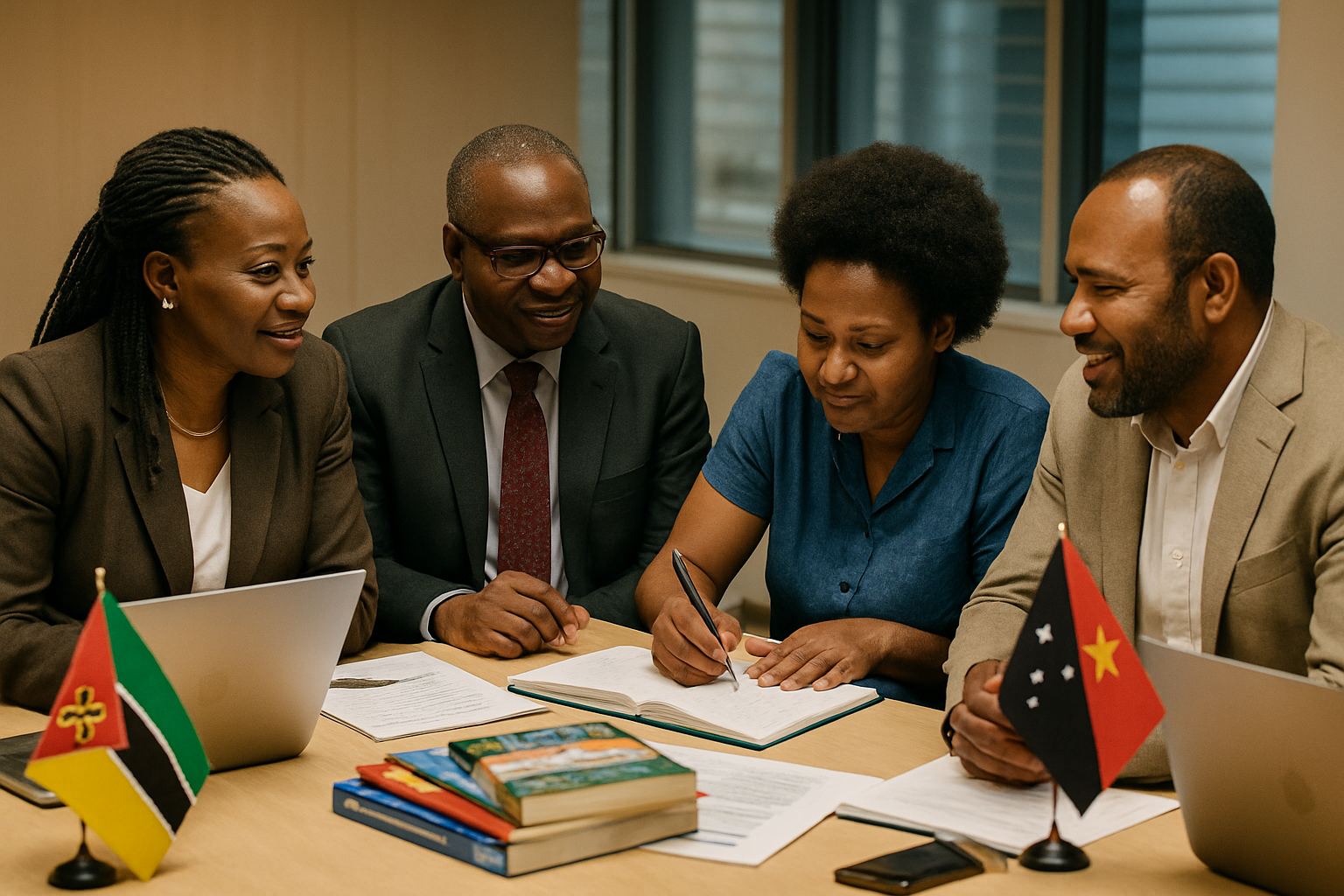
Educational systems worldwide are experiencing unprecedented transformation through strategic international partnerships, as evidenced by groundbreaking initiatives spanning from Mozambique's parliamentary capacity building to Papua New Guinea's multi-million dollar education reform program, highlighting the global commitment to educational excellence and institutional development.
In a significant development for legislative education, Mozambique's ruling Frelimo party has forged a pioneering partnership with Eduardo Mondlane University's Faculty of Law to provide comprehensive training for parliamentary deputies. This initiative represents a sophisticated approach to strengthening democratic institutions through targeted educational programs, addressing the critical need for enhanced legislative capacity in emerging democracies.
The program focuses specifically on legislative production techniques and parliamentary procedures, providing deputies with essential skills for effective governance. This collaboration between political institutions and higher education demonstrates the evolving relationship between academia and government, where universities serve as centers for continuous professional development for public servants.
Papua New Guinea's Educational Renaissance
Simultaneously, Papua New Guinea is implementing what officials describe as the most ambitious educational transformation in the nation's recent history. The country has secured significant international partnerships, including collaborative workshops with Queensland University of Technology (QUT) that have brought together academics from five PNG higher education institutions.
These intensive five-day review and training workshops in Port Moresby represent a comprehensive approach to educational capacity building, focusing on early education expertise and pedagogical innovation. The program demonstrates how international cooperation can address specific regional educational challenges while building long-term institutional capacity.
"This collaborative approach drives quality education reform by empowering our lecturers with contemporary methodologies and international best practices."
— Educational Official, Papua New Guinea
The Australian government has reinforced its commitment to PNG's educational development through the TOGETHER program, launched by Australian High Commission officials Kate Fuller and Michael Coffey. This initiative represents a significant expansion of bilateral educational cooperation, providing sustained support for curriculum development, teacher training, and institutional capacity building.
Global Context of Educational Transformation
These developments occur within what educational researchers are terming the "2026 Educational Technology Renaissance" - a global phenomenon characterized by thoughtful integration of digital tools with traditional educational values. Unlike previous waves of educational technology adoption, current reforms emphasize human-centered approaches that enhance rather than replace fundamental educational relationships.
The transformation spans multiple continents, with Malaysia achieving remarkable success through its 97.82% teacher placement rate and the world's first AI-integrated Islamic school. Singapore's WonderBot 2.0 conversational learning systems and Canada's responsible AI teaching assistants demonstrate how technology can serve educational goals while preserving critical thinking standards.
However, implementation faces significant challenges, including a global memory crisis where semiconductor prices have surged sixfold, affecting technology-dependent programs until new manufacturing facilities come online in 2027. This constraint has forced educational systems toward more efficient, sustainable approaches to technology integration.
Success Factors and Implementation Strategies
Analysis of successful educational partnerships reveals several critical success factors. Sustained political commitment emerges as the most crucial element, with effective programs demonstrating long-term vision that survives electoral cycles and administrative changes.
Comprehensive stakeholder engagement represents another universal requirement, incorporating input from educators, students, families, and community members. The most effective initiatives demonstrate careful balance between innovation and tradition, enhancing rather than replacing fundamental educational values.
International cooperation has proven essential through knowledge sharing, technical assistance, and coordinated development efforts. The partnerships between Mozambique and its university system, and between Papua New Guinea and Australian institutions, exemplify how bilateral cooperation can address specific national needs while contributing to global educational knowledge.
Economic and Social Implications
Educational investments demonstrate significant multiplier effects extending beyond immediate costs. Countries implementing comprehensive educational support programs report improved community resilience, reduced long-term social service demands, and enhanced international competitiveness through strategic human capital development.
Prevention-first approaches generate measurable benefits, including reduced crisis intervention costs, decreased unemployment, and improved workforce productivity. These outcomes justify educational investment as strategic national infrastructure rather than mere government expenditure.
The economic implications are particularly significant for developing nations, where educational partnerships can accelerate modernization while maintaining cultural authenticity. Papua New Guinea's approach demonstrates how international cooperation can support indigenous educational models rather than imposing external standards.
Regional Leadership and Innovation Models
The initiatives in Mozambique and Papua New Guinea represent distinct approaches to educational modernization that could influence international policy discussions. Mozambique's parliamentary education model provides insights for other democratic transitions seeking to strengthen institutional capacity through higher education partnerships.
Papua New Guinea's comprehensive reform program, backed by significant international funding, offers a template for Pacific Island nations pursuing educational transformation while preserving cultural identity. The integration of traditional knowledge systems with contemporary pedagogical approaches demonstrates sophisticated cultural adaptation.
These diverse approaches contribute valuable insights to global educational policy, providing practical templates that can be adapted across different cultural and economic contexts. The emphasis on local ownership combined with international expertise offers a sustainable model for educational development.
Challenges and Future Directions
Despite significant progress, implementation challenges remain substantial. Infrastructure limitations, funding sustainability, and teacher training requirements affect programs across all contexts. The global semiconductor crisis has created additional bottlenecks for technology-dependent initiatives.
Successful educational transformation requires careful technological tool adaptation serving specific cultural, economic, and social needs rather than standardized solutions. The evidence suggests that effective reform requires maintaining human creativity, critical thinking, and cultural knowledge while preparing students for an interconnected global economy.
Climate change adds another layer of complexity, with environmental pressures disrupting traditional academic calendars and requiring adaptive management approaches. Educational systems must demonstrate resilience while maintaining quality and accessibility.
Strategic Significance for Global Development
February 2026 represents a critical juncture in global educational policy development. The success or failure of current reform initiatives will likely determine educational trajectories for the coming decade, affecting global capacity to address climate change, technological disruption, and social cohesion.
The stakes extend beyond individual national education systems to encompass global knowledge production, democratic development, and economic competitiveness. Quality educational systems serve as strategic infrastructure for 21st-century prosperity, requiring proactive investment and systematic transformation.
International cooperation through knowledge sharing, technical assistance, and coordinated development efforts has become essential as nations face similar challenges with different resources and cultural contexts. The partnerships documented in Mozambique and Papua New Guinea provide models for this cooperation.
Success depends on balancing technological advancement with human development, global competencies with local identity, and innovation with tradition. Educational systems that successfully navigate these requirements position themselves as leaders in preparing citizens for complex future challenges while preserving the cultural wisdom essential for human flourishing.
The convergence of parliamentary capacity building in Mozambique and comprehensive educational reform in Papua New Guinea demonstrates that educational transformation requires coordination across institutional boundaries, from legislative chambers to university classrooms, creating integrated approaches to human capital development that serve both immediate needs and long-term prosperity.