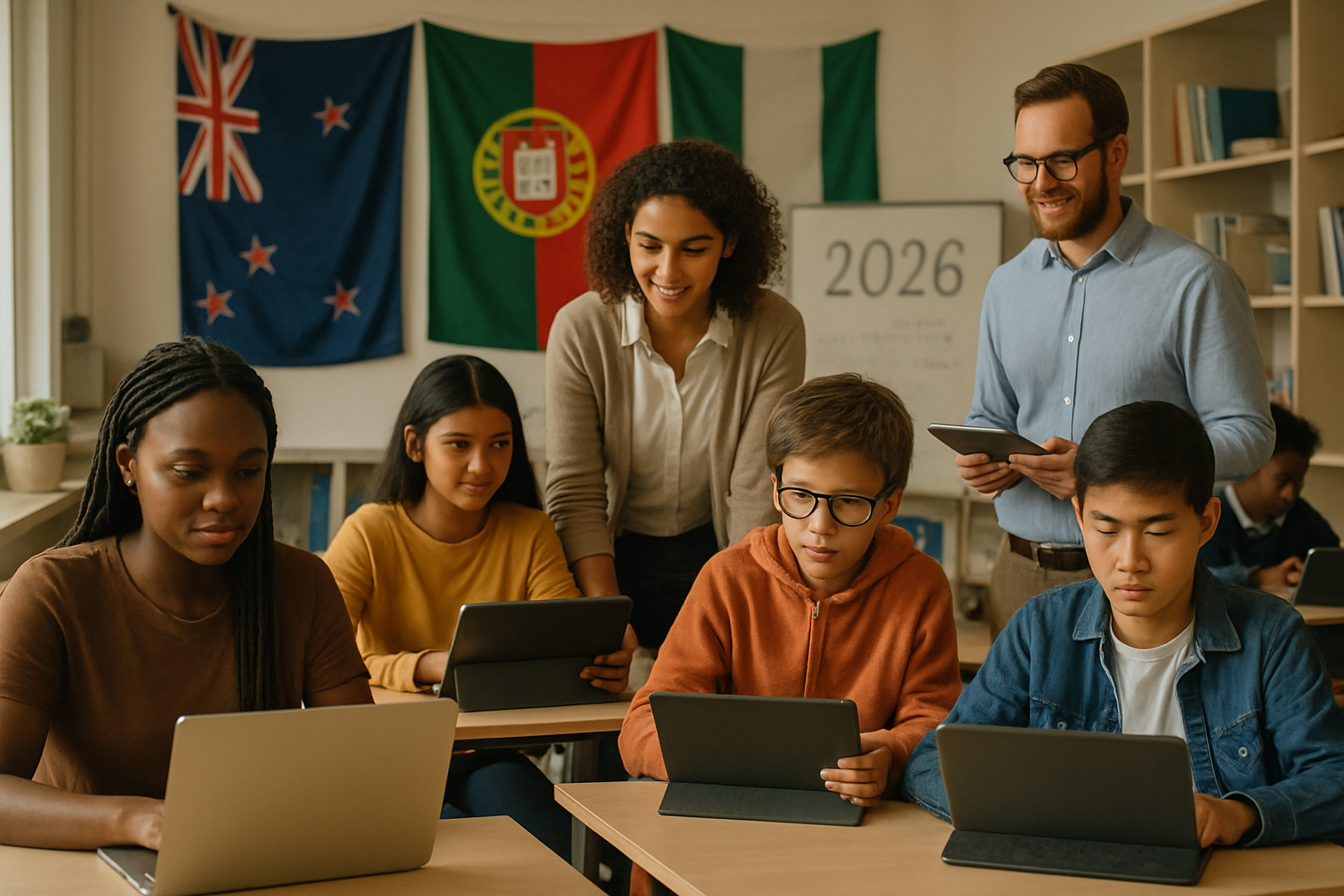
Educational systems across three continents are experiencing a profound transformation crisis as traditional learning models collide with technological advancement and institutional reform demands, creating an unprecedented global challenge for the future of education.
From New Zealand's fierce curriculum debates to Portugal's surprising teacher excellence findings and Italy's bold integration of artificial intelligence into high school programs, April 2026 has emerged as a critical juncture in what experts are calling the "2026 Educational Technology Renaissance" - a coordinated international movement attempting to balance digital innovation with traditional educational values.
New Zealand: Curriculum Controversy Sparks Educational Democracy Crisis
New Zealand's educational landscape has been thrown into turmoil as dozens of principal and teacher associations have united in unprecedented opposition to the government's proposed curriculum changes. The controversy centers on six draft curricula for Years 0-8, which critics argue are fundamentally "not fit for purpose."
The resistance represents more than a simple policy disagreement - it signals a deeper crisis in educational governance and stakeholder engagement. Teachers' associations, typically fragmented across different interests, have found common ground in their opposition to reforms they believe lack adequate consultation and pedagogical foundation.
"This level of coordinated opposition from education professionals is highly unusual and suggests fundamental problems with the government's reform approach,"
— Dr. Sarah Mitchell, Education Policy Expert at University of Auckland
The controversy occurs within a broader context of educational challenges in New Zealand, including teacher shortage crises significantly more severe than previously forecasted and systematic failures in education oversight that have drawn criticism from multiple quarters.
Portugal's Pedagogical Paradox: Excellence Amid Expectations
In a surprising development, a comprehensive study by the Organisation for Economic Co-operation and Development (OECD) has revealed that Portuguese teachers rank among the world's best-trained educators. The findings have caught even Portugal's Education Minister off guard, who expressed surprise not just at the high quality levels but at the "homogeneous" distribution of excellence across the country.
This revelation comes amid Portugal's own educational transformation challenges, including controversial university entrance literacy and numeracy requirements and persistent teacher recruitment controversies. The Portuguese model demonstrates that teacher excellence can coexist with systemic reform pressures, providing valuable lessons for other nations struggling to maintain quality while modernizing their educational systems.
Portugal's success appears rooted in comprehensive teacher preparation programs that emphasize both theoretical knowledge and practical pedagogical skills. The OECD study highlighted Portugal's systematic approach to professional development and continuous learning support for educators throughout their careers.
Italy's Technological Leap: AI Enters the Classroom
Italy has taken perhaps the boldest step in educational modernization by introducing artificial intelligence as a formal subject in high school curricula while simultaneously removing traditional subjects like geostoria (geography-history). The new guidelines, subject to integration and critique from the educational community, represent a significant shift toward technology-focused learning.
The Italian reforms reflect a growing international recognition that students must be prepared for an AI-integrated economy while maintaining essential human capabilities like creativity, critical thinking, and cultural knowledge. However, the decision to replace traditional subjects with AI courses has sparked debate about whether educational systems are moving too quickly toward technological solutions without adequate consideration of cultural and historical knowledge preservation.
"We're witnessing a fundamental reimagining of what students need to know for the 21st century, but we must ensure we don't lose essential human elements that define meaningful education,"
— Professor Marco Rossi, Educational Technology Institute, University of Rome
The Global Context: Educational Renaissance or Revolution?
These developments across New Zealand, Portugal, and Italy are part of a broader international phenomenon experts have termed the "2026 Educational Technology Renaissance." This coordinated global movement represents the most significant educational transformation since the post-World War II expansion of public education systems.
The renaissance is characterized by thoughtful digital tool integration with traditional educational values, addressing technological integration, teacher development, student welfare, and fiscal sustainability simultaneously. However, as the three case studies demonstrate, the implementation approaches vary dramatically based on cultural, economic, and political contexts.
Success models from other countries provide valuable insights. Malaysia has achieved remarkable results with a 97.82% teacher placement rate while pioneering the world's first AI-integrated Islamic school that successfully combines artificial intelligence with traditional religious and academic learning. Singapore's WonderBot 2.0 heritage education system and Canada's responsible AI teaching assistants demonstrate that technology can enhance rather than replace fundamental educational relationships.
Infrastructure Challenges and Semiconductor Crisis Impact
The global educational transformation is occurring against the backdrop of significant infrastructure challenges. The worldwide semiconductor crisis has driven memory chip prices up sixfold, creating bottlenecks for technology-dependent educational programs until new manufacturing facilities come online in 2027.
Paradoxically, these constraints are driving innovation toward more efficient and sustainable technology integration approaches. Educational systems are learning to treat technology as amplification tools that serve educational goals rather than wholesale replacements for human learning relationships.
This forced efficiency has led to creative solutions that may actually prove more pedagogically sound than unlimited technology deployment. Schools are discovering that thoughtful, limited technology integration often produces better learning outcomes than saturating classrooms with devices.
Economic Implications and Prevention-First Approaches
Countries implementing comprehensive, prevention-focused educational approaches are demonstrating superior economic outcomes through reduced crisis intervention costs, decreased unemployment, improved workforce productivity, and enhanced international competitiveness. Educational investments are increasingly viewed as strategic 21st-century infrastructure rather than simple cost centers.
The economic data shows that educational excellence creates self-reinforcing cycles where quality education supports economic development, which in turn enables further educational investment. Countries like Finland, which have maintained focus on educational achievement alongside psychological wellbeing, continue to demonstrate superior outcomes across multiple metrics.
International Cooperation in Educational Reform
The challenges facing New Zealand, Portugal, and Italy highlight the importance of international cooperation in educational transformation. Educational cooperation is evolving beyond traditional financial assistance toward comprehensive support including cultural integration, language acquisition, and ongoing development systems.
Bilateral partnerships and peer-to-peer knowledge sharing networks are proving more resilient than multilateral approaches, allowing for flexible, culturally responsive strategies while maintaining evidence-based standards. The distributed cooperation model enables smaller nations to access expertise while contributing innovations to global knowledge bases.
Critical Success Factors for Educational Transformation
Analysis of successful educational reforms worldwide reveals several critical success factors that apply across diverse contexts:
- Sustained political commitment beyond electoral cycles
- Comprehensive stakeholder engagement involving educators, students, families, and communities
- Innovation-tradition balance that enhances rather than replaces fundamental educational values
- Cultural sensitivity and local adaptation versus standardized solutions
- Adequate resource allocation for long-term sustainability
- International cooperation through knowledge sharing and technical assistance
Looking Forward: The April 2026 Critical Juncture
Educational policy experts identify April 2026 as a critical moment determining educational trajectories for the coming decade. The success or failure of current reform initiatives will significantly affect global capacity for addressing climate change, technological disruption, and social cohesion through quality educational systems.
The stakes include preparing students for an AI-integrated global economy while preserving human creativity, critical thinking, and cultural knowledge that define authentic educational excellence. The window for effective coordinated action is narrowing as technological change accelerates and global challenges intensify.
The Human Element in Educational Modernization
Despite technological advances, the experiences in New Zealand, Portugal, and Italy underscore that human relationships remain central to meaningful education. New Zealand's curriculum debates highlight how policy affects real educators and students. Portugal's teacher excellence demonstrates the irreplaceable value of well-prepared human educators. Italy's AI integration raises fundamental questions about preserving human elements while embracing technological advancement.
The most successful educational transformations maintain human creativity, critical thinking, and cultural knowledge while preparing students for an interconnected global economy that demands both technical competence and cultural authenticity.
Conclusions: Navigating the Educational Transformation
The educational challenges facing New Zealand, Portugal, and Italy represent different aspects of a global transformation that requires sophisticated approaches treating education as strategic infrastructure for social progress, economic development, and human flourishing.
Evidence suggests that effective educational modernization in the AI age requires thoughtful technological tool adaptation serving specific cultural, economic, and social needs versus wholesale replacement of human relationships that define authentic education. The future belongs to educational systems that successfully integrate advanced technologies while preserving fundamental human relationships, critical thinking skills, and cultural authenticity that make education meaningful and culturally relevant.
As these three nations navigate their unique educational challenges, they provide valuable lessons for the global community about balancing innovation with tradition, efficiency with equity, and global competitiveness with local identity. Their experiences will likely influence international educational policy discussions as the 2026 Educational Technology Renaissance continues to unfold.
The path forward requires unprecedented coordination between governments, educational institutions, private sector partners, and international organizations to ensure that schools become environments for human flourishing rather than sources of psychological stress or exclusion. The choices made in 2026 will determine whether the current generation develops the resilience, creativity, and collaborative capacity needed to address the complex challenges of the coming decades.