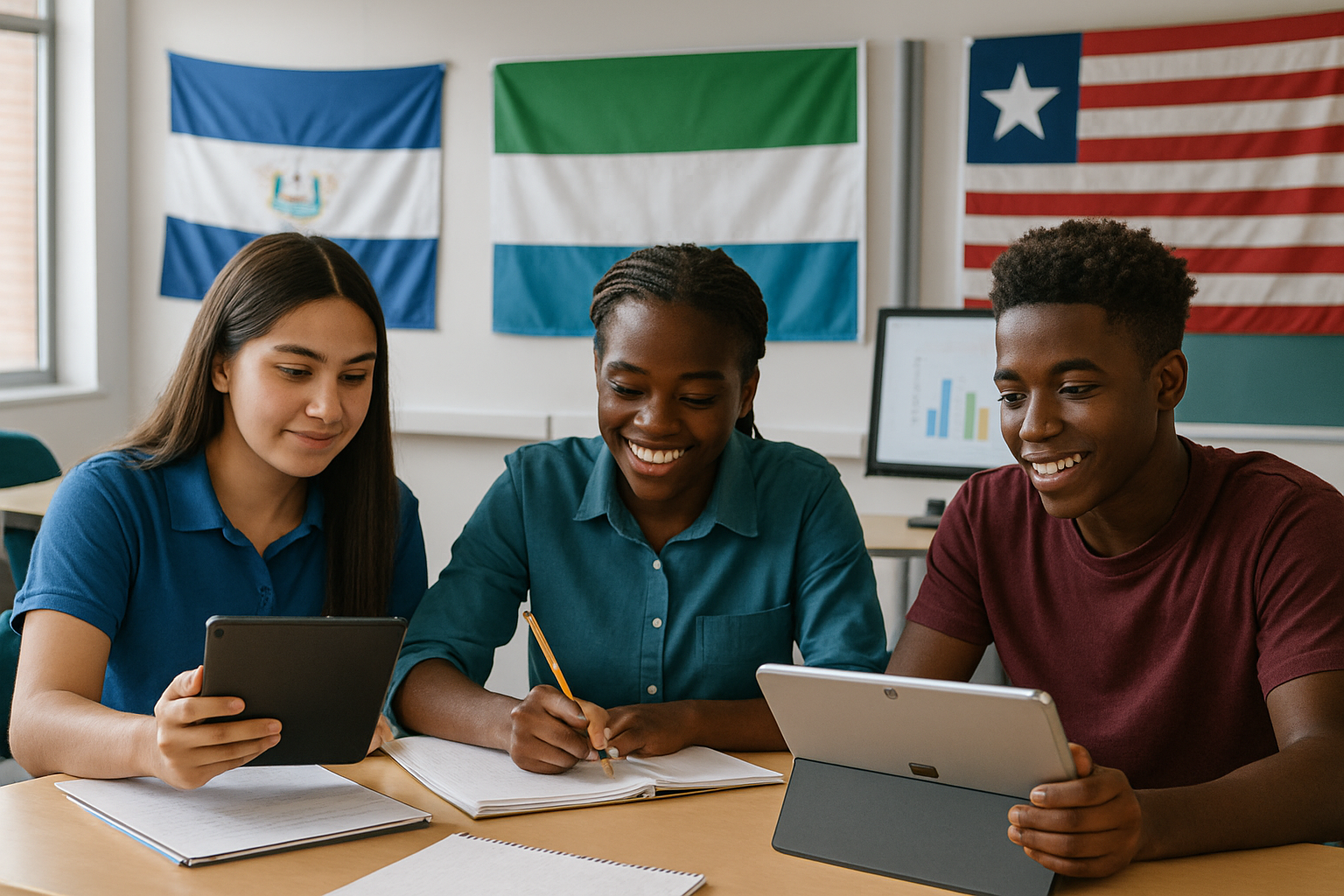
Educational reform initiatives across three nations are demonstrating the complex interplay between infrastructure development, institutional partnerships, and affordability challenges that characterize the global transformation of learning systems in 2026.
From El Salvador's ambitious school renovation program to Sierra Leone's groundbreaking maritime education partnerships and Liberia's confrontation with rising university costs, these developments reflect broader trends in the international "2026 Educational Technology Renaissance" while highlighting persistent challenges in making quality education accessible to all.
El Salvador's Infrastructure Revolution
El Salvador has reached a significant milestone in its educational infrastructure transformation, with the #DosEscuelasXDía program achieving its 559th school intervention through the renovation of Centro Escolar Caserío San Miguel in Izalco's Canton San Isidro. This achievement brings the initiative tantalizingly close to its target of 600 schools nationwide.
The government-sponsored program represents a comprehensive approach to educational modernization, focusing on the integral transformation of both educational and recreational areas within school centers. The initiative aims to provide dignified and appropriate spaces for both students and teachers, addressing fundamental infrastructure deficits that have historically hampered educational outcomes.
According to official sources, these interventions form part of a broader national strategy designed to strengthen educational infrastructure and improve learning conditions. The program's success has generated measurable benefits for school communities, with renovated facilities demonstrating improved student engagement and teacher satisfaction.
"These actions form part of a national strategy oriented toward strengthening educational infrastructure and improving learning conditions, benefiting directly the student community and teaching staff."
— El Salvador Government Officials
Sierra Leone's Maritime Education Innovation
Sierra Leone is pioneering a new model of specialized higher education through Njala University's Bonthe Campus partnership with the Sierra Leone Maritime Administration. This Memorandum of Understanding represents a strategic investment in maritime education, research, and professional training that could transform the nation's relationship with its coastal resources.
The agreement, formalized at the university's Njala Campus Secretariat under the chairmanship of Emmanuel J. Momoh Esq., Director of Higher Education at the Ministry of Technical and Higher Education, establishes a comprehensive framework for collaboration across multiple dimensions of maritime education.
Key components of the partnership include structured internships and sea-time placements for students, providing practical experience essential for maritime careers. The collaboration also encompasses industrial attachments that bridge academic learning with real-world applications in port administration, shipping operations, and marine environmental management.
Perhaps most significantly, the partnership creates opportunities for joint research initiatives focusing on maritime safety, port administration, marine environmental protection, and marine governance. These research collaborations position Sierra Leone to contribute meaningfully to regional maritime knowledge while addressing local challenges in coastal management and marine resource utilization.
Professional Development and Certification
The agreement establishes continuous professional development programs and certification systems for maritime personnel, ensuring that Sierra Leone can meet international standards in maritime operations while building indigenous expertise. This approach reflects a growing recognition that sustainable development requires not just infrastructure investment but also comprehensive human capital development.
The partnership model demonstrates how smaller nations can leverage targeted collaborations to develop specialized educational capabilities that serve both national development needs and regional leadership aspirations. By focusing on maritime excellence, Sierra Leone is positioning itself as a potential hub for West African maritime education and research.
Liberia's Affordability Crisis
In stark contrast to infrastructure successes elsewhere, Liberia's University of Liberia faces severe criticism over what lawmakers describe as "very exorbitant" graduation fees that threaten to exclude qualified students from completing their education. The House of Representatives' decision to summon university authorities highlights growing concerns about educational accessibility in the face of rising costs.
The controversy centers on graduation fees that many consider prohibitively expensive for students from moderate and low-income families. With over 150 practicing attorneys available in the country, questions arise about whether such fees serve any educational purpose beyond revenue generation, particularly given the university's status as a state institution.
The legislative intervention reflects broader international concerns about the commercialization of higher education and its impact on social mobility. Similar debates are occurring globally as universities struggle to balance financial sustainability with their public service missions.
Implications for Educational Equity
The Liberian situation illustrates a critical challenge facing educational systems worldwide: ensuring that financial barriers do not undermine merit-based advancement. The controversy comes at a particularly sensitive time as global educational reforms emphasize inclusion and accessibility while grappling with resource constraints.
Legislative oversight of educational institutions represents an important accountability mechanism, particularly for public universities that receive taxpayer funding. The House leadership's intervention demonstrates how democratic institutions can address concerns about educational access and institutional responsibility.
Global Context and Emerging Patterns
These three case studies reflect broader patterns emerging within the global educational transformation of 2026. Infrastructure investment, innovative partnerships, and affordability challenges represent interconnected aspects of educational modernization that require coordinated attention rather than isolated solutions.
The contrast between El Salvador's systematic infrastructure development and Liberia's affordability crisis demonstrates how different aspects of educational development can advance at varying speeds within individual countries and across regions. Meanwhile, Sierra Leone's maritime partnership model suggests that targeted sectoral collaborations may offer sustainable pathways for educational advancement in specialized fields.
Technology Integration and Human Development
These developments occur within the context of the broader "2026 Educational Technology Renaissance," which emphasizes thoughtful integration of digital tools with traditional educational values. The success of infrastructure programs like El Salvador's #DosEscuelasXDía demonstrates that technological enhancement requires stable physical foundations and adequate learning environments.
Similarly, Sierra Leone's maritime partnership shows how technology and traditional knowledge can be combined effectively when supported by appropriate institutional frameworks and professional development systems. The emphasis on research collaboration and continuous professional development reflects understanding that educational modernization must serve both immediate practical needs and long-term knowledge development goals.
Regional and International Implications
The educational reforms in these three nations contribute to important regional and international conversations about sustainable development, educational equity, and institutional innovation. El Salvador's infrastructure program offers a template for systematic educational facility modernization that other Central American nations are monitoring closely.
Sierra Leone's maritime education initiative positions the country as a potential regional leader in specialized higher education, with implications for West African maritime development and regional cooperation in coastal resource management. The partnership model demonstrates how smaller nations can achieve educational excellence in targeted areas through strategic collaborations.
Liberia's affordability challenges reflect global concerns about higher education accessibility and the role of public institutions in promoting social mobility. The legislative response provides a model for democratic oversight of educational institutions and public accountability in educational governance.
Lessons for Global Educational Development
Several key lessons emerge from these diverse national experiences. First, successful educational reform requires sustained political commitment and adequate resource allocation across multiple dimensions simultaneously - infrastructure, human resources, and accessibility.
Second, innovative partnerships can enable smaller nations to achieve specialized educational excellence that serves both national development needs and regional leadership aspirations. Sierra Leone's maritime focus demonstrates how targeted sectoral approaches can generate outsized impacts.
Third, democratic oversight and public accountability remain essential for ensuring that educational institutions serve their intended public purposes. Liberia's legislative intervention illustrates how democratic institutions can address concerns about educational access and institutional responsibility.
Future Trajectories and Challenges
Looking ahead, these three nations face both opportunities and challenges in sustaining their educational development trajectories. El Salvador's infrastructure program must transition from renovation to maintenance and continuous improvement, requiring ongoing political and financial commitment.
Sierra Leone's maritime partnership must demonstrate concrete outcomes in terms of graduate employment, research contributions, and maritime sector development to justify continued investment and potential expansion to other specialized fields.
Liberia must resolve its affordability crisis through dialogue between legislative oversight, university administration, and student representatives to ensure that cost structures serve educational rather than purely financial objectives.
Broader Global Context
These developments contribute to the evolving understanding of educational development as strategic infrastructure requiring proactive investment and systematic reform rather than reactive crisis management. The diversity of approaches demonstrates that effective educational modernization requires adaptation to specific cultural, economic, and social contexts rather than standardized solutions.
The successes and challenges documented across these three nations provide valuable insights for international educational development efforts, demonstrating both the potential for rapid progress and the persistence of fundamental challenges in making quality education accessible to all.
Conclusion
The educational reforms unfolding across El Salvador, Sierra Leone, and Liberia in early 2026 represent microcosms of broader global educational transformation efforts. While each nation faces distinct challenges and opportunities, their experiences collectively illustrate the complex interplay between infrastructure development, institutional innovation, and accessibility concerns that characterize contemporary educational modernization.
El Salvador's systematic infrastructure development demonstrates the potential for comprehensive educational facility modernization when supported by sustained political commitment and adequate resources. Sierra Leone's maritime education partnership shows how targeted sectoral collaborations can enable smaller nations to achieve specialized excellence while serving regional development needs.
Liberia's affordability challenges highlight persistent concerns about educational accessibility and the importance of democratic oversight in ensuring that educational institutions serve their intended public purposes.
Together, these experiences contribute valuable insights to global conversations about sustainable educational development, demonstrating both the potential for rapid progress and the need for comprehensive approaches that address infrastructure, partnerships, and accessibility simultaneously rather than in isolation.