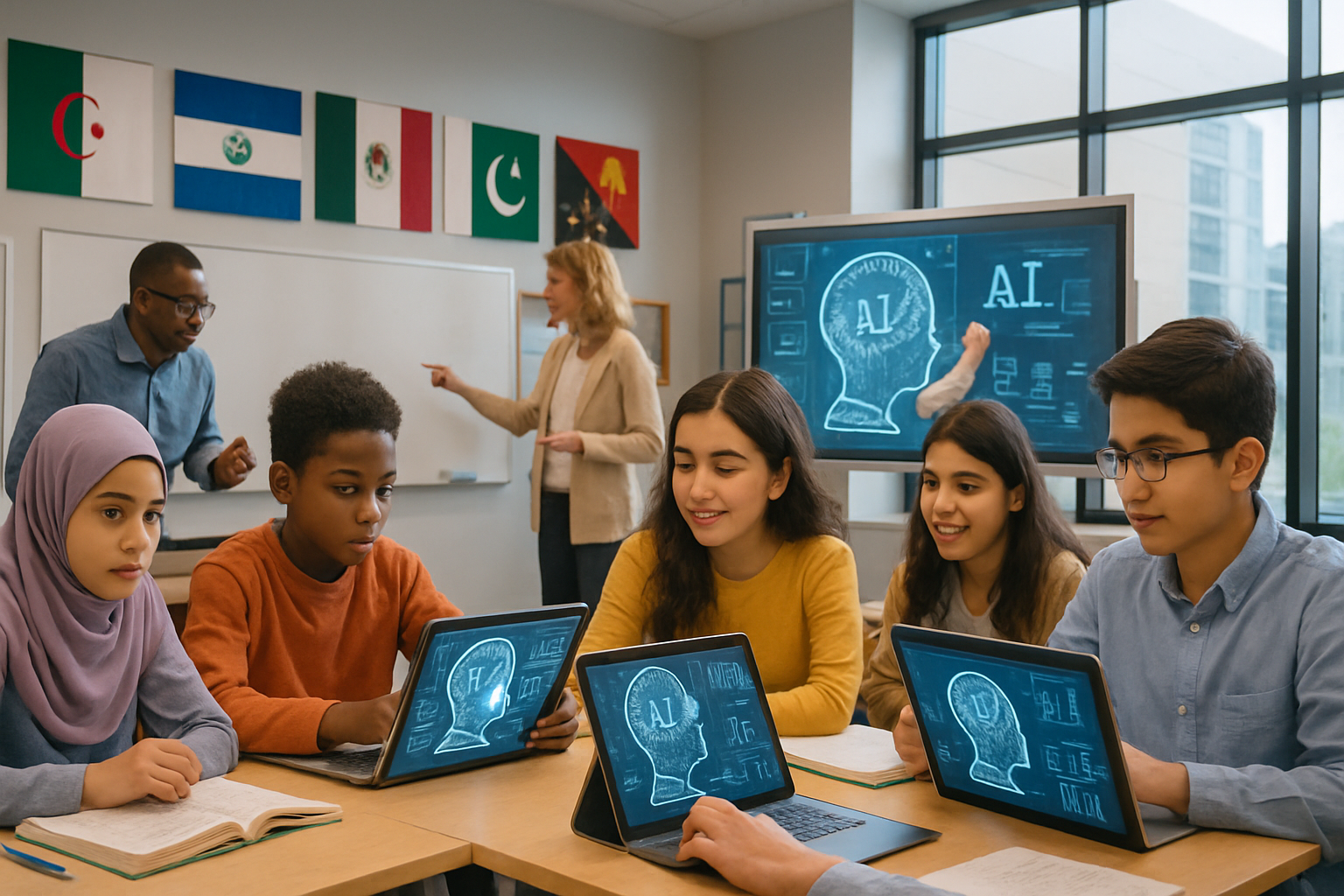
Educational institutions across five continents are implementing groundbreaking reform programs that represent the most significant transformation in global education since the post-World War II expansion, with Algeria, El Salvador, Mexico, Pakistan, and Papua New Guinea leading innovative approaches to 21st-century learning challenges.
Algeria Advances National Educational Assessment Framework
Algeria's Ministry of National Education has issued critical directives for the completion of the 2025-2026 academic year, with Education Minister Mohamed Saghir Saadaoui conducting a comprehensive national conference via remote video conferencing technology. The virtual summit brought together central administration officials, the National Office of Examinations and Competitions director, and educational directors from across the nation's provinces.
The conference focused on managing the remaining academic calendar, including second-semester completion operations and preparations for the crucial third semester, which represents a decisive phase for student advancement. This systematic approach demonstrates Algeria's commitment to maintaining rigorous educational standards while adapting to modern administrative technologies.
Algeria's initiative builds on the country's establishment of the International Journal of Educational Innovation, positioning the nation as a potential North African leader in educational research and policy development. The comprehensive approach addresses both immediate academic needs and long-term strategic educational infrastructure improvements.
El Salvador's Infrastructure Renaissance Continues
El Salvador's groundbreaking educational transformation continues with ongoing renovations at the National School of Agriculture (ENA), as confirmed by the Ministry of Public Works (MOP). The comprehensive modernization project focuses on providing students with dignified infrastructure that enhances both academic and practical learning experiences.
Construction teams are executing extensive renovations across classrooms, laboratories, and common areas as part of an integrated project designed to modernize the institution's facilities. This initiative represents part of El Salvador's sustained effort to strengthen agricultural education in the country while positioning the nation as a regional leader in comprehensive educational reform.
"The objective is to offer students dignified infrastructure that favors their academic and practical formation."
— Ministry of Public Works statement
The ENA renovations complement El Salvador's broader "#DosEscuelasXDía" program, which has reached over 586 school interventions nationwide, demonstrating systematic commitment to educational infrastructure development that serves as a template for other Central American nations.
Mexico Eliminates University Entrance Examinations
Mexico has implemented a revolutionary transformation of higher education access through the "Mi derecho, mi lugar" (My Right, My Place) program, eliminating traditional entrance examinations for preparatory school admission in the Metropolitan Zone of Mexico Valley for the second consecutive year.
The program represents a fundamental departure from competitive examination systems, instead emphasizing universal access to secondary education through online registration, school selection processes, and guaranteed placement assignments. This innovative approach addresses educational equity concerns while maintaining quality standards through alternative assessment methods.
The registration process includes multiple phases designed to accommodate diverse student needs and circumstances. The system allows students to select preferred institutions while ensuring no qualified applicant is denied educational opportunities due to examination performance alone. This approach has generated significant international interest as other nations examine alternatives to traditional competitive entrance systems.
Pakistan Launches Comprehensive University Mentoring Initiative
Pakistan's Higher Education Commission (HEC) has launched the ambitious Mentoring Programme for Universities (MPU), a nationwide initiative designed to strengthen leadership capacity and professional development within higher education institutions across the country.
Initiated through the National Academy of Higher Education (NAHE), the program represents an expanded version of HEC's successful Women Empowerment and Mentoring Programme, which was launched in November 2024 for 18 women's universities. The current initiative takes a gender-inclusive approach, supporting faculty members and academic leaders from both public and private sector universities.
The program seeks to foster a culture of mentorship, collaboration, and knowledge sharing across Pakistan's higher education landscape. HEC Chairman Professor Dr. Niaz Ahmad emphasizes the initiative's role in building sustainable academic communities that can address contemporary educational challenges while maintaining Pakistan's cultural and educational traditions.
"This program represents our commitment to developing academic leadership that can navigate the complexities of modern higher education while preserving our institutional values."
— HEC Chairman Professor Dr. Niaz Ahmad
Papua New Guinea Establishes Landmark Governance Partnership
The Transparency International Papua New Guinea (TIPNG) and the University of Papua New Guinea (UPNG) have signed a historic five-year Memorandum of Understanding designed to strengthen governance pathways for accounting students. This landmark agreement represents a significant advancement in professional education and ethical business practices in the Pacific region.
The partnership was formalized with assistance from UPNG Head of Accounting Mr. Panditha Bandara and Doctor of Education Academic Dr. Ponussamy Manohar, demonstrating institutional commitment to comprehensive professional development. The collaboration integrates academic learning with practical governance experience, providing students with real-world exposure to transparency and accountability principles.
This initiative positions Papua New Guinea as a leader in integrated professional education, combining theoretical academic knowledge with practical governance skills essential for modern business environments. The five-year commitment ensures sustained development of ethical business leadership in the Pacific region.
The 2026 Educational Technology Renaissance Context
These developments occur within what educational experts have termed the "2026 Educational Technology Renaissance" – a coordinated international movement toward thoughtful digital tool integration with traditional educational values. Unlike previous waves of educational reform focused primarily on access and infrastructure, this transformation addresses multiple challenges simultaneously: technological integration, teacher development, student welfare, and fiscal sustainability.
Malaysia has achieved remarkable success with 97.82% teacher placement rates while operating the world's first AI-integrated Islamic school, demonstrating that technological advancement can coexist with cultural preservation. Singapore's WonderBot 2.0 heritage education system and Canada's responsible AI teaching assistants provide additional models for balanced human-technology collaboration in educational settings.

Implementation Challenges and Solutions
The global memory crisis, driven by a sixfold surge in semiconductor prices affecting major manufacturers including Samsung, SK Hynix, and Micron, has created infrastructure bottlenecks for technology-dependent educational programs. These constraints are expected to persist until 2027 when new manufacturing facilities come online.
However, this challenge has paradoxically driven innovation toward more efficient and sustainable technology integration approaches. Educational systems are learning to treat technology as amplification tools serving educational goals rather than ends in themselves, emphasizing enhancement of human learning relationships rather than replacement.
Success Factors and International Cooperation
Analysis of successful educational transformation initiatives reveals consistent patterns across diverse cultural and economic contexts. The most critical factor is sustained political commitment that survives electoral cycles, coupled with comprehensive stakeholder engagement involving educators, students, families, and communities.
International cooperation has evolved beyond traditional financial assistance toward comprehensive support systems including cultural integration, language acquisition, and ongoing development programs. Regional frameworks enable smaller nations to access expertise while contributing innovations to global knowledge bases, creating mutually beneficial partnerships that respect local autonomy while fostering international collaboration.
Economic Implications and Prevention-First Approaches
Countries implementing comprehensive, prevention-focused educational approaches are demonstrating superior economic outcomes through reduced crisis intervention costs, decreased unemployment rates, and improved workforce productivity. Educational investments are increasingly viewed as strategic infrastructure for 21st-century competitiveness rather than simple cost centers.
The economic multiplier effects of educational excellence create self-reinforcing cycles where improved educational outcomes support economic development, which in turn enables further educational investment. This pattern is evident across all five nations examined, regardless of their current economic development levels.
Future Trajectory and Global Significance
March 2026 represents a critical juncture in global educational policy development, where the success or failure of current reform initiatives will significantly influence educational trajectories for the coming decade. The stakes include global capacity for addressing climate change, technological disruption, and social cohesion through quality educational systems that serve as strategic infrastructure for human prosperity.
The evidence suggests that effective educational modernization requires maintaining human creativity, critical thinking, and cultural knowledge while preparing students for an AI-integrated global economy that demands both technical competence and cultural authenticity. The future belongs to educational systems that successfully integrate advanced technologies while preserving the fundamental human relationships that define meaningful education.
"Educational transformation requires thoughtful adaptation of technological tools to serve specific cultural, economic, and social needs rather than wholesale replacement of human relationships."
— International education policy analysts
Templates for Global Educational Transformation
The five-nation analysis provides valuable templates for worldwide implementation, demonstrating that effective transformation requires cultural sensitivity and local adaptation rather than standardized solutions. Algeria's systematic assessment framework, El Salvador's infrastructure focus, Mexico's access innovations, Pakistan's mentorship approach, and Papua New Guinea's governance integration offer complementary models that can be adapted across diverse contexts.
These approaches collectively demonstrate that educational modernization demands both technological advancement and fundamental attention to infrastructure, equity, cultural preservation, and human development. Nations successfully navigating these complex requirements position themselves as leaders in preparing citizens for an interconnected world's challenges and opportunities.
The window for effective coordinated action is narrowing as technological change accelerates and global challenges intensify. However, the March 2026 developments provide evidence that comprehensive educational transformation is achievable when political will, community engagement, and international cooperation align with adequate resources and clear vision for human-centered educational excellence.