Educational institutions across the globe are grappling with unprecedented challenges as technical failures, funding crises, and policy shifts converge to create one of the most significant disruptions to learning systems since the post-WWII educational expansion.
The latest wave of challenges has struck systems from developed nations to emerging economies, highlighting the fragile state of global educational infrastructure during what experts have termed the "2026 Educational Technology Renaissance."
Australia Faces Massive NAPLAN Disruption
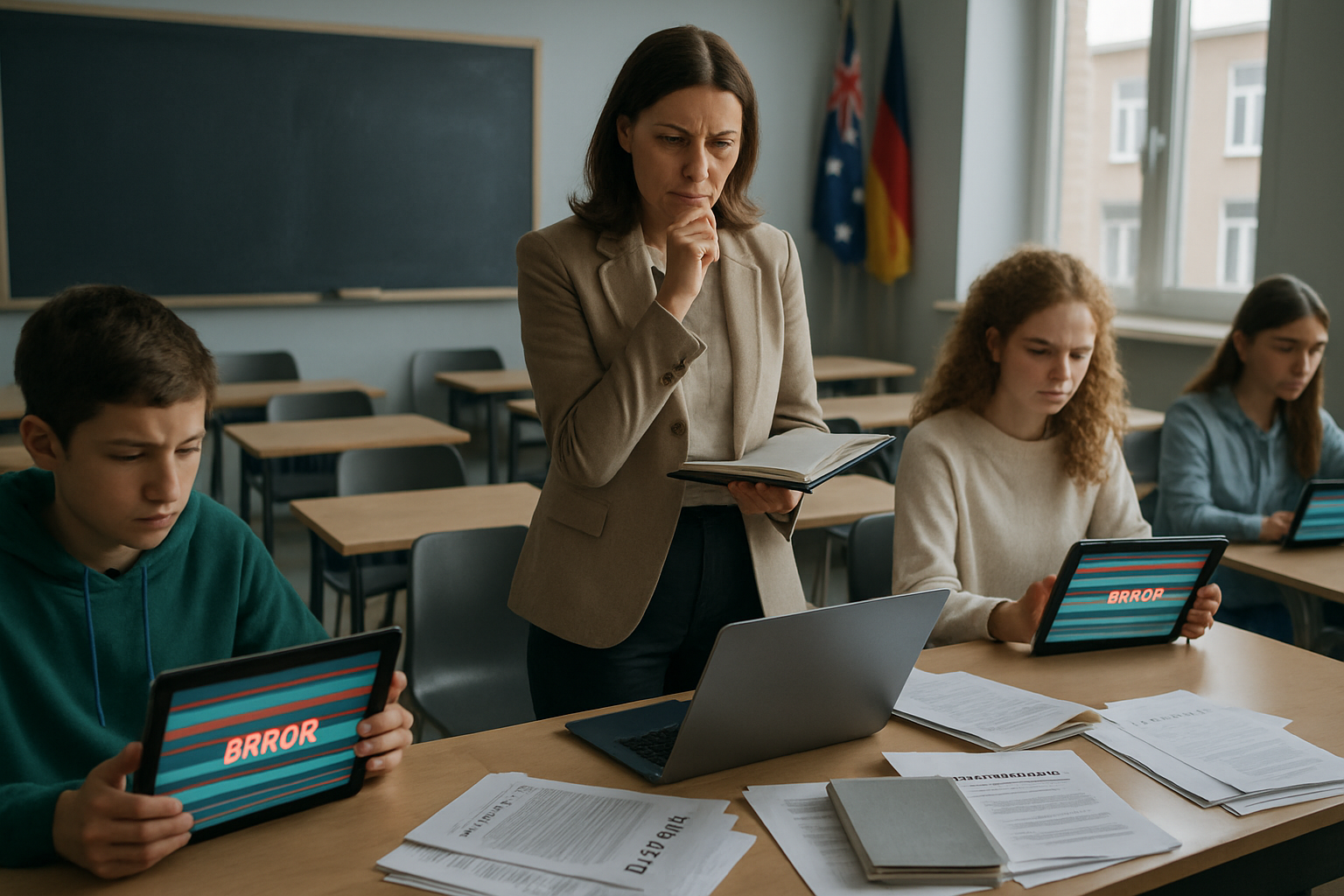
Australia's educational system experienced a catastrophic technical failure when approximately one million school students had their first NAPLAN test disrupted by a system crash. The technical glitch affected students across the nation, creating widespread disruption to standardized testing procedures that form a cornerstone of Australian educational assessment.
The incident exposed critical vulnerabilities in the country's digital educational infrastructure, raising serious questions about the reliability of technology-dependent assessment systems. Educational authorities scrambled to implement contingency measures as frustrated students, teachers, and parents dealt with the fallout from the system failure.
"This massive disruption affects not just test scores, but student confidence and the integrity of our national assessment system."
— Educational Technology Expert
The NAPLAN crisis comes at a particularly challenging time for Australia's education sector, which has been investing heavily in digital transformation while struggling with teacher shortages and post-pandemic recovery efforts.
Germany's Higher Education Budget Crisis
Meanwhile, German universities are facing severe financial constraints as Berlin's higher education institutions confront mandatory budget cuts. A specially appointed commission has been tasked with developing recommendations for the "future-oriented development" of the capital's university system, signaling potential major restructuring ahead.
The budget pressures represent a significant challenge to Germany's traditionally well-funded higher education sector, which has long been considered a model for other European nations. Universities across Berlin are being forced to examine their operations and potentially make difficult decisions about program offerings and staffing levels.
Simultaneously, Germany is experiencing heated debates over educational priorities, particularly around the selection of Excellence Universities. The competitive process, designed to identify 15 top institutions by 2027 through federal and state funding, has drawn criticism from education stakeholders who argue the system creates unhealthy competition rather than fostering collaborative improvement.
The Global Context: Educational System Strain
These developments occur within the broader framework of what researchers have identified as the "2026 Educational Technology Renaissance" – a worldwide phenomenon characterized by the thoughtful integration of digital tools with traditional educational values. However, this transformation is proving more challenging than initially anticipated.
Historical analysis reveals this period represents the most significant global educational transformation since the post-World War II expansion. Unlike previous educational reforms that focused primarily on access and infrastructure, the current wave must simultaneously address technological integration, teacher development, student welfare, and fiscal sustainability.
The semiconductor crisis has added another layer of complexity, with memory chip prices surging sixfold due to unprecedented AI development demands. This has created infrastructure bottlenecks for technology-dependent educational programs, forcing institutions to delay implementations until new manufacturing facilities come online in 2027.
International Success Models and Failures
Despite the challenges, some nations have demonstrated remarkable success in balancing innovation with stability. Malaysia achieved a 97.82% teacher placement rate while pioneering the world's first AI-integrated Islamic school, combining artificial intelligence with traditional religious and academic learning approaches.
Singapore's WonderBot 2.0 heritage education program and Canada's responsible AI teaching assistants have shown how technology can enhance rather than replace fundamental educational relationships while maintaining critical thinking standards.
However, failures like Estonia's SAIS3 high school admissions system collapse and various technical disruptions across multiple countries demonstrate the risks of rushing technological implementations without adequate testing and backup systems.
The Prevention-First Economics Revolution
Educational experts increasingly advocate for "prevention-first" approaches that demonstrate superior economic outcomes compared to crisis-response models. Countries implementing comprehensive prevention programs report improved community resilience, reduced long-term social service demands, and enhanced international competitiveness through strategic human capital development.
These approaches recognize education as strategic infrastructure for 21st-century prosperity rather than a cost center, emphasizing proactive investment over reactive crisis management. The economic implications extend far beyond immediate educational costs, affecting workforce productivity, innovation capacity, and social cohesion for generations.
Teacher Shortages and Workforce Challenges
The global teacher shortage has emerged as a universal phenomenon requiring coordinated international responses. Countries across diverse economic and cultural contexts report similar challenges in recruiting, training, and retaining qualified educators.
The shortage is particularly acute in specialized areas like STEM education, special needs support, and technology integration. This has forced many systems to rely on contract teachers or alternative certification pathways, raising questions about long-term educational quality and professional standards.
Innovative professional development approaches are emerging, with successful models emphasizing ongoing support, cultural sensitivity, and recognition of teaching as both art and science requiring sophisticated skill sets.
Cultural Preservation Amid Technological Change
One of the most significant challenges facing educational systems globally is maintaining cultural authenticity while embracing necessary technological advancement. Successful reform models demonstrate that effective transformation requires thoughtful adaptation to specific cultural, economic, and social contexts rather than standardized solutions.
The most successful educational modernization efforts preserve human creativity, critical thinking, and cultural knowledge while preparing students for an interconnected global economy that demands both technical competence and cultural understanding.
International Cooperation and Knowledge Sharing
Despite funding challenges affecting traditional multilateral organizations, innovative cooperation models are emerging through bilateral partnerships and peer-to-peer knowledge sharing networks. Smaller nations contribute research methodologies and innovative approaches while larger countries offer technological resources and implementation support.
This distributed cooperation model represents a potentially more resilient approach to international educational coordination, allowing for flexible, culturally responsive strategies while maintaining evidence-based standards.
Looking Forward: Critical Decisions Ahead
March 2026 represents a critical juncture in global educational policy development. The success or failure of current reform initiatives will determine educational trajectories for the coming decade, affecting global capacity to address climate change, technological disruption, and social cohesion challenges.
The stakes extend beyond individual national interests to encompass humanity's collective ability to develop quality educational systems that serve as strategic infrastructure for addressing complex 21st-century challenges. The window for effective coordinated action continues to narrow as the pace of technological change accelerates and global challenges intensify.
Educational leaders worldwide face the daunting task of balancing innovation with stability, efficiency with equity, and global competitiveness with local identity. Success will require unprecedented coordination between governments, educational institutions, private sector partners, and international organizations.
The current crisis, while challenging, also presents opportunities for fundamental improvements in how societies organize educational systems. By learning from both successes and failures, the global educational community can build more resilient, effective, and equitable systems that truly serve all learners in an increasingly complex world.