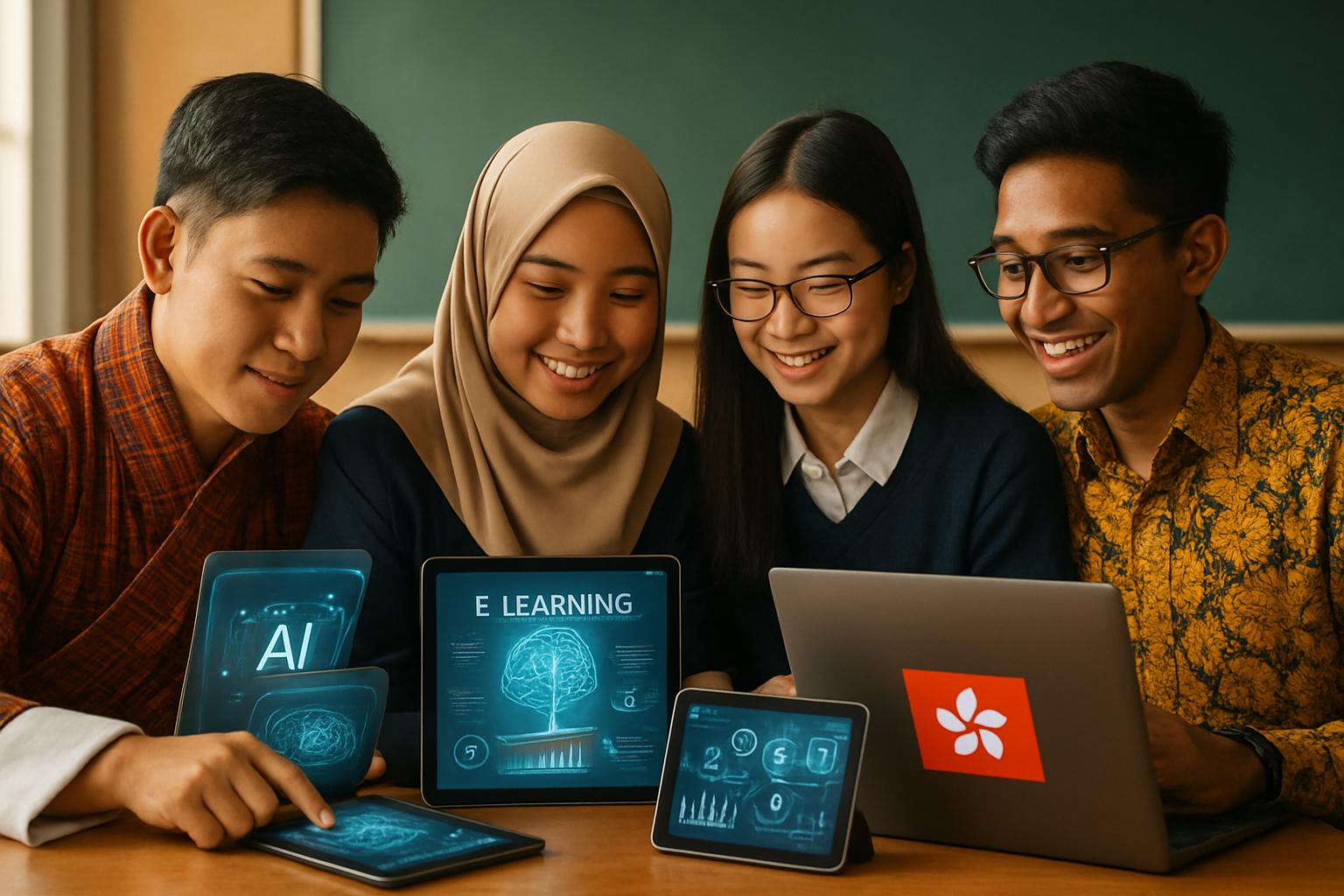
Three nations across Asia are redefining educational paradigms through distinct but complementary approaches that blend traditional values with cutting-edge technology, setting new standards for global educational reform in 2026.
Bhutan's Royal University is expanding higher education pathways through five new four-year degree programs at the College of Language and Culture Studies in Trongsa, scheduled to begin this July. The initiative represents a strategic commitment to producing "culturally grounded and globally competent graduates" who can support the nation's future development while preserving its unique cultural heritage.
Simultaneously, Malaysia's Sabah state is advancing artificial intelligence integration in Islamic education, building on the groundbreaking State Religious Secondary School (SMAN) AI concept, while Hong Kong has successfully concluded its inaugural "AI in Education Forum Series & Showcase," attracting over 5,000 representatives from government, industry, academia, and research sectors.
Bhutan's Cultural-Educational Integration Model
The College of Language and Culture Studies' expansion reflects Bhutan's sophisticated approach to educational modernization. The five new programs are designed to blend Bhutanese values with global competencies, addressing the critical challenge facing many developing nations: how to participate in the global economy while maintaining cultural identity.
This initiative builds on Bhutan's established Gross National Happiness philosophy, which prioritizes sustainable development, environmental conservation, cultural preservation, and good governance. The new degree programs will equip students with internationally relevant skills while ensuring they remain connected to their cultural roots.
The timing is strategic, as Bhutan continues its careful approach to modernization. The programs will prepare graduates for both domestic leadership roles and international opportunities, reflecting the kingdom's balanced approach to globalization that has made it a unique model in South Asian development.
Malaysia's AI-Islamic Education Pioneer Initiative
Malaysia's educational innovation continues with the strategic framework launched by Sabah's Ministry of Education, Science, Technology and Innovation (KPSTI) to accelerate artificial intelligence integration across the state's education ecosystem. Minister Datuk James Ratib emphasized that this initiative reinforces the state government's commitment to "future-ready learning and sustainable human capital development."
This framework builds on Malaysia's earlier breakthrough - the world's first AI-integrated Islamic school (SMAN) in Sabah, which combines artificial intelligence with both naqli (Islamic religious) and aqli (academic) learning. The integration covers administrative systems, delivery mechanisms, and teaching-learning processes, representing a revolutionary approach to religious education that embraces technology while preserving core Islamic values.
"The initiative reinforces the state government's commitment to future-ready learning and sustainable human capital development."
— Datuk James Ratib, KPSTI Minister
The success of Malaysia's approach is evident in its broader educational achievements, including a remarkable 97.82% teacher placement rate (42,315 of 43,257 positions filled) and comprehensive digital transformation initiatives. The AI integration strategy addresses both technological advancement and cultural-religious preservation, offering a template for Muslim-majority nations worldwide.
Hong Kong's AI Heritage Education Breakthrough
Hong Kong's "AI in Education Forum Series & Showcase," organized jointly by the Education Bureau, HKPC Academy of the Hong Kong Productivity Council, and Hong Kong Education City, represents the most comprehensive examination of AI's educational applications in the Asia-Pacific region. The three-day event drew over 5,000 participants and was conducted under the theme "Accelerating AI Integration into Educational Settings to Enhance Learning and Teaching Effectiveness."
The forum was aligned with China's national "15th Five-Year Plan" recommendations to fully implement the "AI+" initiative, demonstrating how regional educational policies can support national technological advancement goals. The event showcased practical applications of AI in heritage education, building on Hong Kong's earlier success with WonderBot 2.0 conversational learning systems.
Hong Kong's approach emphasizes practical implementation over theoretical discussion. The showcase featured real-world AI applications that enhance rather than replace human teaching, addressing concerns about technology displacing educational professionals while demonstrating AI's potential to improve learning outcomes.
Global Context and Educational Technology Renaissance
These developments occur within what educational experts are calling the "2026 Educational Technology Renaissance" - a global transformation characterized by thoughtful integration of AI and digital tools with traditional educational values. Unlike previous waves of educational technology that often prioritized efficiency over outcomes, the current movement emphasizes human-centered approaches that enhance rather than replace fundamental educational relationships.
The three nations profiled represent different but complementary models for educational modernization. Bhutan's approach prioritizes cultural preservation within global competency development. Malaysia demonstrates how religious education can successfully integrate with cutting-edge technology. Hong Kong shows how practical AI applications can enhance learning effectiveness without compromising educational quality.
This diversity of approaches is crucial as educational systems worldwide grapple with similar challenges: preparing students for an AI-integrated economy while maintaining human creativity and critical thinking; preserving cultural and traditional knowledge while developing global competencies; and leveraging technology to enhance rather than replace quality teaching.
Implementation Challenges and Success Factors
Despite the promising developments, all three regions face significant implementation challenges. The global memory crisis, with semiconductor prices surging sixfold and affecting major manufacturers Samsung, SK Hynix, and Micron, creates infrastructure bottlenecks that may persist until 2027 when new fabrication facilities come online.
Teacher training emerges as another critical factor. Malaysia's success stems partly from its comprehensive teacher development programs and strong governmental support. Hong Kong's forum emphasized the importance of preparing educators for AI-enhanced classrooms rather than expecting them to adapt independently. Bhutan's approach requires faculty capable of bridging traditional cultural knowledge with contemporary global skills.
Financial sustainability also presents challenges. While Malaysia benefits from strong state government commitment and Bhutan receives support through its careful economic development strategy, the long-term funding requirements for maintaining AI infrastructure and continuous teacher development remain substantial.
Lessons for Global Educational Reform
The success patterns emerging from these three regions offer valuable insights for educational systems worldwide. First, successful AI integration requires clear pedagogical objectives rather than technology-driven implementation. Each region has articulated specific learning outcomes that technology serves to enhance.
Second, cultural sensitivity and preservation must be integral to technological advancement rather than competing priorities. Bhutan's emphasis on cultural grounding, Malaysia's integration of Islamic principles, and Hong Kong's heritage focus demonstrate that educational modernization can strengthen rather than weaken cultural identity.
Third, stakeholder engagement proves essential. Hong Kong's massive forum participation, Malaysia's comprehensive ministry involvement, and Bhutan's university-level commitment show that successful educational transformation requires broad-based support and coordination.
Future Implications and Regional Leadership
These educational initiatives position their respective regions as potential leaders in different aspects of global educational transformation. Bhutan's model offers insights for small nations seeking to preserve cultural identity while developing global competencies. Malaysia's AI-Islamic integration provides a template for Muslim-majority countries worldwide. Hong Kong's practical AI applications demonstrate how advanced economies can leverage technology for educational enhancement.
The timing is significant as educational systems worldwide recover from pandemic disruptions and prepare for an increasingly AI-integrated economy. The approaches demonstrated by these three regions suggest that successful educational transformation requires balancing multiple priorities: technological advancement with human development, global competencies with local identity, innovation with tradition.
As these programs mature and demonstrate outcomes, they are likely to influence educational policy discussions internationally. The 2026 Educational Technology Renaissance appears to be moving beyond the early enthusiasm for digital transformation toward more sophisticated approaches that recognize technology as a powerful tool for achieving enduring educational goals rather than an end in itself.
The success of these diverse approaches may ultimately demonstrate that effective educational reform in the AI age requires not standardized solutions but thoughtful adaptation of technological tools to serve the specific cultural, economic, and social needs of different educational communities worldwide.