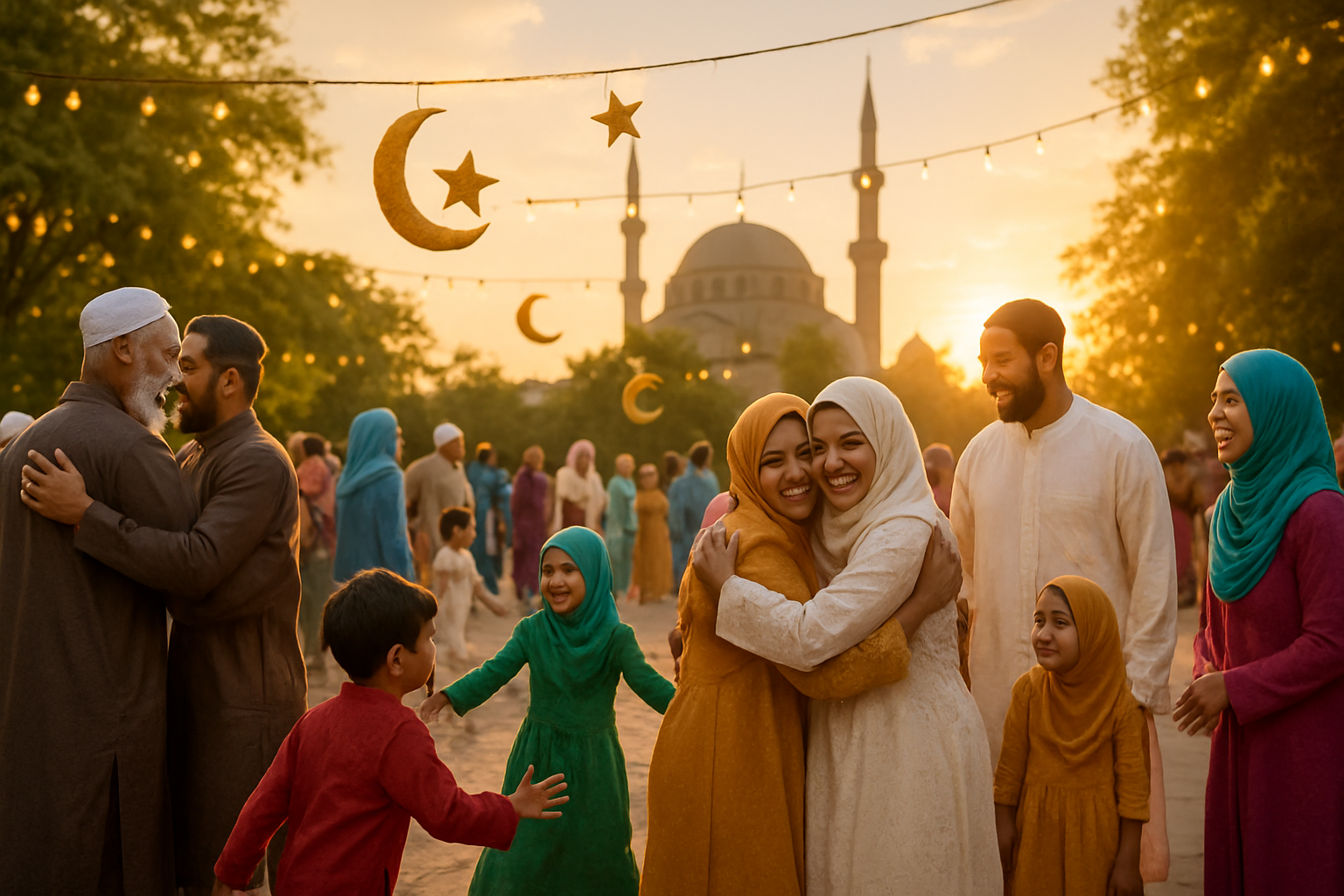
Nearly two billion Muslims across the globe are celebrating Eid al-Fitr 2026, marking the joyous conclusion of Ramadan with moon sighting confirmations announced across multiple countries throughout March 19, 2026.
The festive celebrations began as religious authorities from Algeria to Malaysia confirmed the sighting of the Shawwal crescent moon, officially ending the holy month of fasting and beginning three days of Eid festivities. The International Center for Astronomy published the first photographs of the Shawwal crescent captured from Abu Dhabi at 6:35 PM local time on Thursday, March 19, showing the moon positioned 6.6 degrees from the sun with an age of 14.2 hours.
Regional Moon Sighting Confirmations
Oman was among the first nations to officially announce Eid al-Fitr, declaring Friday, March 20 as the first day of celebration after confirming the moon sighting on Thursday evening. The Sultanate's announcement followed similar confirmations across the Gulf region, continuing a pattern of coordinated religious observance that has characterized Ramadan 2026.
Jordan's Grand Mufti Dr. Ahmad Al-Hasanat announced that Friday would mark the beginning of Shawwal 1447 AH following a formal moon sighting ceremony at the King Hussein Mosque. The decision was endorsed by the Council of Fatwa and Islamic Research based on scientific astronomical data and reports from authorized lunar observation committees.
King Abdullah II of Jordan extended warm congratulations to Jordanians via social media platform X, writing: "May Allah accept our acts of worship, and may our beloved homeland and dear people be blessed with prosperity on the occasion of the blessed Eid al-Fitr. May Allah bring it back upon everyone with goodness, blessing, and abundance."
Global Variations in Celebration Dates
While most countries confirmed Friday, March 20 as the first day of Eid, some nations announced Saturday, March 21 as their celebration date. Malaysia's Keeper of the Rulers' Seal confirmed that Muslims in the country would celebrate Aidilfitri on Saturday following astronomical calculations, making Malaysia one of several nations observing a day later due to local moon visibility conditions.
Pakistan's Central Ruet-i-Hilal Committee, meeting in Islamabad under Chairman Maulana Abdul Khabir Azad, confirmed Saturday, March 21 as the official Eid date after the Shawwal moon was not sighted anywhere in the country on Thursday evening. This decision affects approximately 240 million Pakistani Muslims and demonstrates the traditional approach of relying on local moon sighting rather than astronomical calculations.
Unprecedented International Coordination
The Eid celebrations mark the conclusion of what religious scholars are calling the most internationally coordinated Ramadan in modern Islamic history. Saudi Arabia's unprecedented religious diplomacy program distributed 2.2 million copies of the Quran to 120 countries, provided 1,000 tons of dates, and deployed 91 imams to 49 nations to support global Muslim communities during the holy month.
"This Ramadan has demonstrated the power of international cooperation in facilitating religious observance while preserving the authenticity of Islamic traditions."
— Dr. Ahmad Al-Hasanat, Grand Mufti of Jordan
The sophisticated coordination extended beyond religious programming to include educational accommodations across Muslim-majority countries, with modified school schedules implementing 9-10 AM class starts instead of earlier hours to accommodate fasting students. Egypt extended business hours until 2:00 AM to recognize altered consumption patterns and evening social activities following iftar meals.
Leadership Messages and Government Responses
Political leaders across the Muslim world exchanged congratulatory messages, reflecting the diplomatic significance of Eid celebrations. Kuwait's Emir Sheikh Mishal Al-Ahmad Al-Jaber Al-Sabah exchanged congratulatory telegrams with Arab and Islamic world leaders, expressing wishes for the occasion to return with goodness and blessings for the Arab and Islamic nations.
The Crown Prince of Kuwait also sent congratulatory messages to the Emir, while senior government officials including the Prime Minister and National Guard Chief extended their well-wishes, demonstrating the festival's importance in maintaining diplomatic relationships and national unity.
Celebrations Amid Regional Challenges
This year's Eid celebrations take place against a complex regional backdrop, with Muslim communities in conflict-affected areas finding ways to maintain traditional observances despite challenges. Students in Qatar connected to conflict-affected regions are celebrating Eid far from their families due to travel disruptions, with many finding innovative ways to stay connected and maintain traditions through virtual gatherings and community support networks.
The resilience of Muslim communities in maintaining their religious observances despite external challenges has been a defining characteristic of Ramadan 2026, with community leaders emphasizing the importance of spiritual solidarity and mutual support during difficult times.
Economic and Social Impact
The transition from Ramadan to Eid traditionally marks a significant shift in economic activity, with increased consumer spending on clothing, food, gifts, and travel. Kuwait's banking sector announced closures on March 19 following Central Bank consultations, with electronic services continuing to ensure accessibility during the holiday period.
Saudi Arabia's Ministry of Islamic Affairs announced prayer timings for major cities across the Kingdom, with Eid prayers scheduled for 6:39 AM in Makkah, 6:40 AM in Madinah, 6:12 AM in Riyadh, and varying times across other cities. The ministry urged worshippers to arrive early to ensure smooth organization and crowd management.
Technology Integration and Modern Observance
The celebration of Eid 2026 continues the trend of technology integration seen throughout Ramadan, with mobile applications for prayer times, Quranic recitation, and charitable giving enabling global diaspora participation across different time zones. This technological synthesis with traditional spiritual practices has allowed Muslim communities worldwide to maintain authentic religious expression while adapting to contemporary circumstances.
The successful integration of modern communication technologies with ancient Islamic traditions has created a template for global religious observance that respects cultural diversity while fostering spiritual unity among nearly two billion Muslims worldwide.
Cultural Traditions and Community Celebrations
Traditional Eid customs are being observed with renewed enthusiasm following the intensive spiritual month of Ramadan. Communities are preparing for the characteristic joy of Eid morning prayers, family gatherings, gift exchanges, and charitable giving that defines the celebration.
The emphasis on zakat (charitable giving) during Eid serves as a continuation of the increased charitable activity during Ramadan, with Muslim communities contributing significantly to both Islamic community programs and secular charitable initiatives addressing broader social needs including homelessness, food insecurity, and educational support.
Looking Forward: Legacy of Ramadan 2026
As Muslims worldwide celebrate Eid al-Fitr, religious leaders and community organizers are reflecting on the unprecedented success of international coordination during Ramadan 2026. The sophisticated governmental accommodations, religious institutional leadership, and community organization that characterized the holy month have created a lasting template for future religious observances.
The celebration represents not just the end of a month of fasting, but the conclusion of what many are calling a watershed moment in modern Islamic practice—demonstrating how ancient spiritual traditions can maintain their essential character while adapting to contemporary global realities through international cooperation, technological integration, and inclusive governmental policies.
As families gather for Eid prayers and festivities across the globe, the celebration serves as both a joyous conclusion to Ramadan's spiritual discipline and a testament to the enduring power of religious community in fostering individual growth and collective solidarity across diverse cultural and national boundaries.