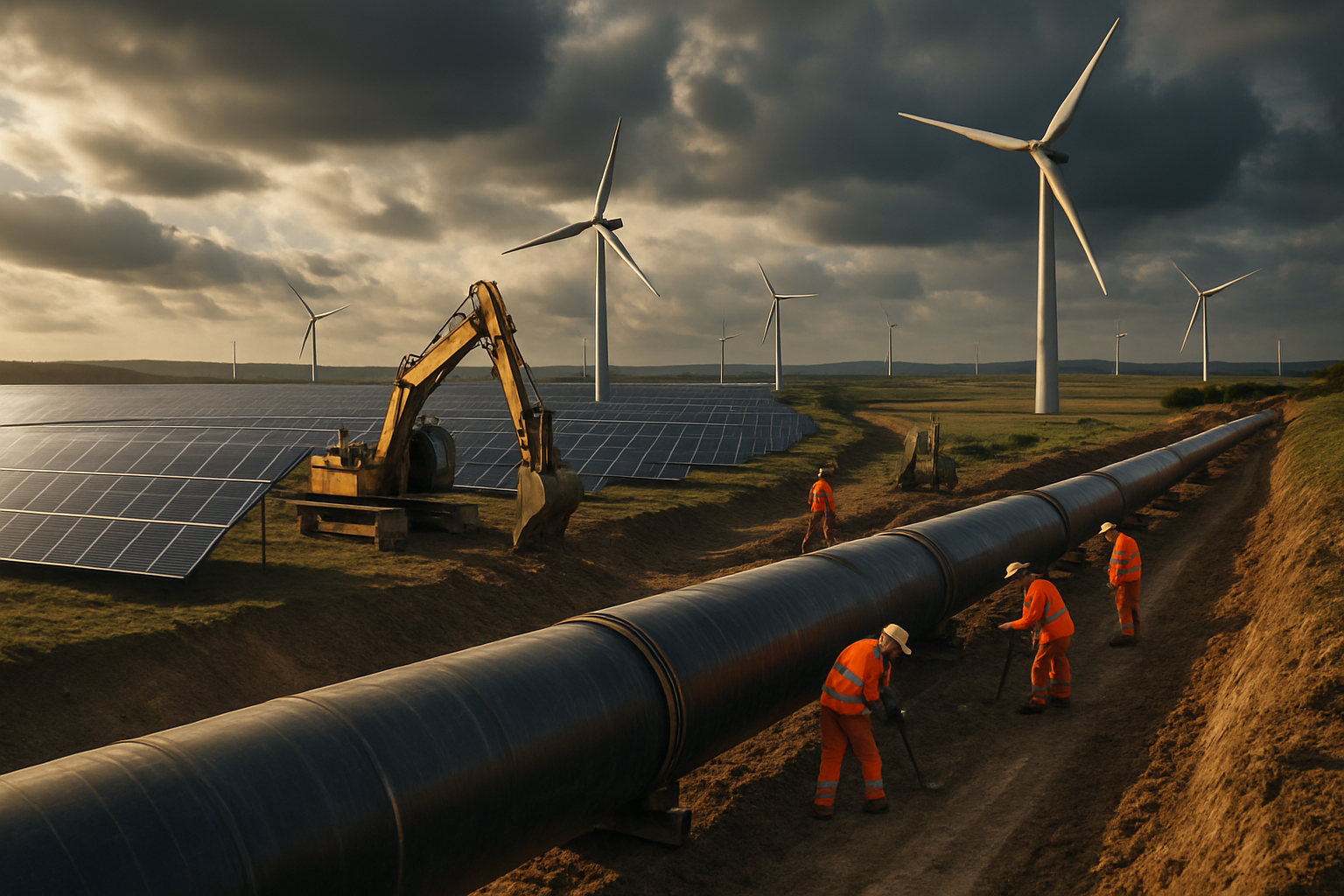
Major energy infrastructure projects are accelerating across multiple continents as countries advance green energy corridors, strengthen existing pipeline networks, and forge new international partnerships to secure their energy futures amid unprecedented global demand.
The current surge in energy infrastructure development represents a critical response to mounting pressures on global energy systems, with nations pursuing diverse strategies ranging from renewable energy corridors to traditional pipeline expansions. These developments come as energy security has become a paramount concern for governments worldwide, driving unprecedented levels of international cooperation and investment.
Azerbaijan Emerges as Strategic Energy Hub
Azerbaijan continues to strengthen its position as a crucial East-West energy coordinator, with significant developments in both traditional and renewable energy sectors. The country has been recognized by the U.S. Chamber of Commerce as a strategic regional energy hub, with current U.S.-Azerbaijan trade totaling $74.9 million annually but holding massive expansion potential from Azerbaijan's $27.2 billion in global exports.
Recent developments have seen bp invest $3.4 billion in the Shah Deniz gas field, including $2.315 billion in operating expenditure and $1.087 billion in capital spending for Shah Deniz 2 development. This substantial investment underscores international confidence in Azerbaijan's energy potential and its role in diversifying European energy supplies.
The country is simultaneously advancing green energy corridor infrastructure, including the ambitious Black Sea green power corridor that requires the world's longest and deepest subsea power cables. This project represents a paradigm shift toward renewable energy transmission on an unprecedented scale, connecting European and Central Asian energy markets through sophisticated underwater infrastructure.
Regional Partnerships Strengthen Energy Security
Georgia has reaffirmed its commitment to the Southern Gas Corridor and Black Sea Energy Cable projects, reinforcing the strategic importance of regional cooperation in energy infrastructure development. These initiatives are part of a broader network of energy corridors that span from the Caspian region to European markets, providing alternative supply routes and reducing dependence on traditional energy pathways.
The strengthening of energy partnerships extends beyond traditional gas and oil projects. SOCAR, Azerbaijan's state oil company, has been actively engaging with international partners, including discussions with Slovakia's SPP to boost Azerbaijan-Slovakia energy ties. These bilateral relationships are crucial for creating resilient energy networks that can withstand geopolitical pressures and supply disruptions.
Global Context of Energy Transformation
The acceleration of energy infrastructure projects occurs against a backdrop of significant global energy market volatility. Natural gas prices have surged 24% in Europe and 78% in the United States, creating both challenges and opportunities for energy infrastructure developers. This price volatility has intensified focus on supply chain diversification and energy security measures.
Critical supply chain vulnerabilities continue to threaten global energy transition goals, with China controlling 60% of production and 90% of refining capacity for lithium, cobalt, and rare earth elements essential for renewable energy infrastructure. The US-EU-Japan Critical Minerals Partnership, involving 55 countries and seven African suppliers, represents a strategic response to these dependencies.
Memory chip shortages have created additional complications, with prices increasing sixfold and affecting renewable control systems until new fabrication facilities come online in 2027. These technological constraints highlight the interconnected nature of modern energy systems and the importance of comprehensive supply chain planning.
Climate Urgency Drives Innovation
The energy infrastructure surge is occurring during a period of unprecedented climate urgency. January 2026 marked the 18th consecutive month of temperatures exceeding 1.5°C above pre-industrial levels, demonstrating that human-induced warming is overriding natural climate variability. This climate context adds urgency to the deployment of clean energy infrastructure and the transition away from fossil fuel dependence.
Estonia has emerged as a renewable energy leader, achieving 88% renewable electricity in 2024 and operating continental Europe's largest battery storage facility with capacity to serve 90,000 households. These achievements demonstrate the feasibility of rapid renewable energy deployment when supported by appropriate infrastructure investments.
Hungary continues construction of the Paks II nuclear project, a €39.1 billion investment that represents Europe's largest atomic energy project with IAEA backing. This massive undertaking illustrates the diverse pathways countries are pursuing to achieve energy security while meeting climate commitments.
Technology Integration and Smart Infrastructure
Modern energy infrastructure projects are increasingly characterized by sophisticated technology integration, including digital monitoring, smart grid management, automated efficiency systems, and predictive maintenance capabilities. These technological advances enable more precise environmental and economic benefit measurement, which is crucial for policy development and investment decisions.
The integration of renewable energy sources with traditional energy infrastructure requires advanced grid management systems capable of handling variable energy flows. Projects like Azerbaijan's green energy corridors and Estonia's battery storage facilities represent the cutting edge of this technological evolution.
International Cooperation Models
The success of major energy infrastructure projects increasingly depends on multilateral cooperation approaches that leverage diverse expertise, financing sources, and technological capabilities. The Middle Corridor development, which aligns with China's Belt and Road Initiative, demonstrates how countries can participate in multiple international frameworks while maintaining strategic autonomy.
Energy infrastructure is increasingly viewed as an economic development engine that creates multiplier effects through enhanced commerce, improved efficiency, and increased competitiveness. These projects generate both direct employment during construction phases and permanent operational jobs, while also attracting additional investment in related sectors.
Implementation Challenges and Solutions
Despite the momentum behind energy infrastructure development, significant challenges remain. Financing sustainability, particularly for developing nations, requires innovative funding mechanisms and international support. Technical capacity building demands sustained education, training, and institutional investment to ensure projects can be effectively managed and maintained.
Climate change itself poses risks to infrastructure projects, disrupting timelines and requiring adaptive management approaches that can respond to rapidly changing environmental conditions. Success increasingly requires flexible project designs that can accommodate evolving climate conditions and technological advances.
Environmental protection has become a prerequisite for international investment, with advanced waste management, community engagement, and comprehensive impact assessments now standard requirements rather than optional additions. This evolution reflects a fundamental shift from extractive development models toward comprehensive approaches that benefit local populations while providing global market access.
Strategic Implications for Global Energy Security
The current wave of energy infrastructure development represents a fundamental transformation in global energy relationships. Countries are pursuing strategic diversification of supply sources and routes while building resilient networks capable of withstanding various forms of disruption.
The success of these infrastructure projects will largely determine the shape of global energy markets for decades to come. Nations that successfully develop comprehensive energy infrastructure combining traditional and renewable sources, supported by smart grid technology and international partnerships, are positioning themselves as energy superpowers in an increasingly carbon-constrained world.
Regional integration through energy corridors is creating new geopolitical realities, with countries like Azerbaijan positioned at the center of major energy flows between Europe and Asia. These developments are reshaping traditional alliance structures and creating new forms of economic interdependence that may prove more durable than purely political arrangements.
As the world continues to grapple with climate change, energy security concerns, and technological transformation, the infrastructure projects being developed today will serve as the foundation for tomorrow's energy systems. The decisions being made now about energy corridor development, technology integration, and international cooperation will influence global prosperity and security for generations to come.