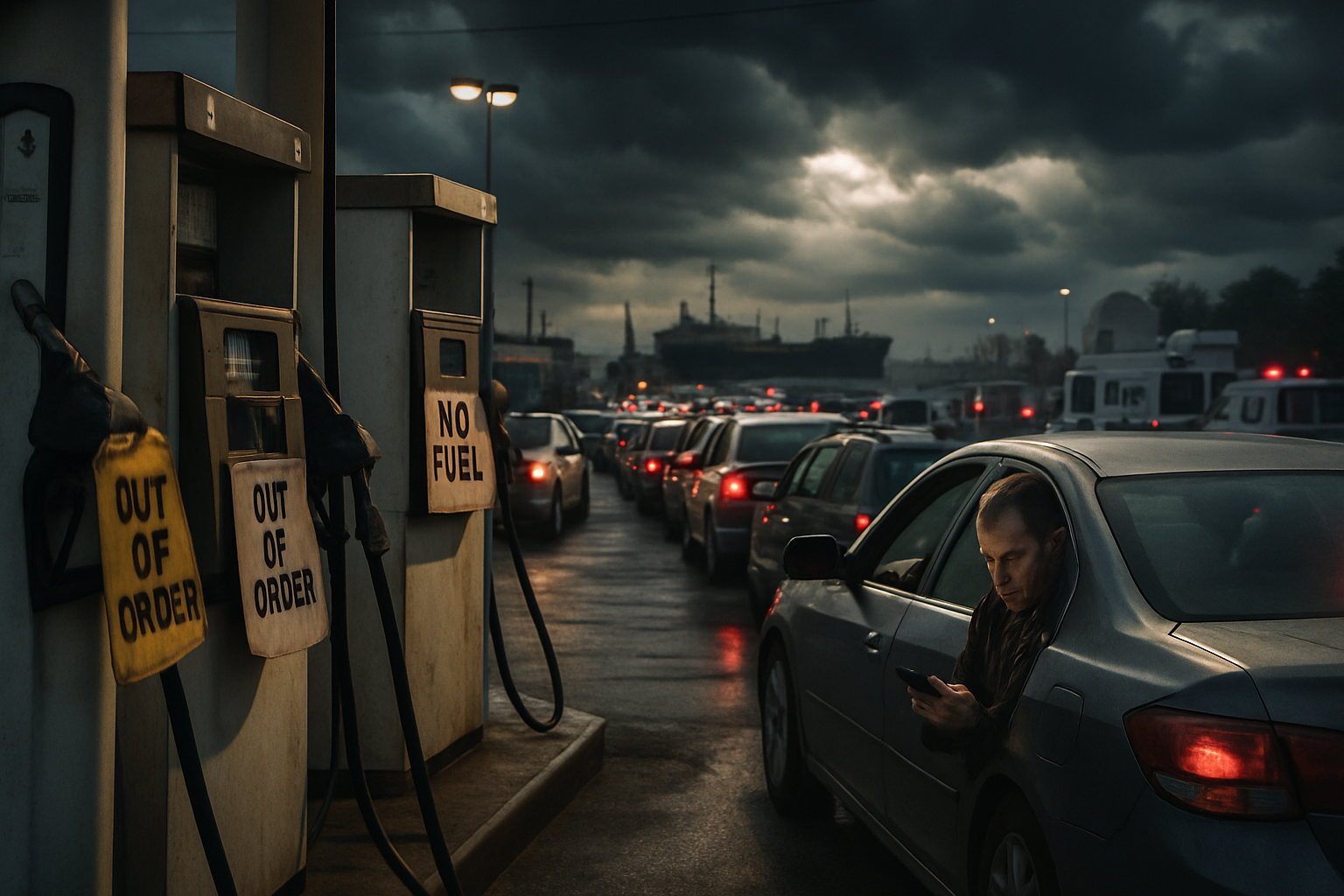
Governments across six continents have launched the most extensive emergency fuel subsidy programs since the 1970s oil shocks, as Iran's closure of the Strait of Hormuz drives global energy prices to unprecedented levels and threatens economic stability worldwide.
The crisis, now in its fourth week, has seen oil prices breach $100 per barrel for the first time since 2022, with Brent crude peaking at $119.50 and West Texas Intermediate recording an historic 18.98% single-day jump to $108.15. The Iranian Revolutionary Guard's declaration that the Strait of Hormuz is "unsafe for shipping" has effectively blocked 40% of global seaborne oil transit through the critical 21-mile chokepoint.
Massive Government Interventions Across Multiple Continents
Pakistan has emerged as the epicenter of the crisis response, with both Sindh and Punjab governments announcing comprehensive relief packages. Sindh Chief Minister Murad Ali Shah unveiled a scheme providing motorcycle owners Rs2,000 in fuel subsidies, while Punjab has made all public transportation free, including the Orange Line Train, Metro Bus, Speedo Bus, and Green Electro Bus services.
"For three weeks, the prime minister did not increase the cost of fuel; however, the policy had both benefits and some harms," explained CM Murad, noting the difficult balance between economic necessity and public welfare as fuel prices hit Rs458.41 per liter for petrol and Rs520.35 for high-speed diesel.
"We usually go to the countryside, but because of the petrol situation, we decided to stay at home this year. Working people need their petrol, but we're retired, we can stay at home."
— Elsa Ucak, Sydney Retiree
The Australian experience reflects a global trend of ordinary citizens altering fundamental life patterns due to fuel scarcity. Across eastern Australia, hundreds of petrol stations in Queensland, Victoria, and South Australia have run completely dry, forcing unprecedented government intervention.
European Nations Abandon Free Market Principles
France has deployed 500 fuel station inspectors to prevent price manipulation, representing the largest fuel market intervention in the country's modern history. Prime Minister Sébastien Lecornu declared that "war cannot serve as pretext for abusive increases," introducing new targeted aid measures including direct subsidies and tax relief.
Spain has implemented a 30-cent reduction at fuel pumps, while Italy has introduced comprehensive tax caps. Lithuania cut train ticket prices in half to encourage public transport usage, and Lithuania has reduced excise taxes while introducing windfall profit taxes on retail fuel sales.
The Netherlands' CPB economic planning bureau warns that household spending power faces "minimal growth under pressure from international developments," prompting calls for immediate fiscal intervention.
Historic Strategic Reserve Deployments
The International Energy Agency announced the largest strategic petroleum reserve release in its 50-year history, deploying 400 million barrels from 32 member countries—more than double the 182.7 million barrels released during the 2022 Ukraine crisis.
Japan leads the deployment with 80 million barrels, marking the first release since the 2011 Fukushima disaster. With 95% of Japan's oil supplies dependent on Middle East imports and 70% transiting through the now-closed Strait of Hormuz, the country faces an existential energy security threat.
Germany has confirmed participation in the coordinated release, while the United States is expected to contribute the largest volume. US Energy Secretary Christopher Wright is reportedly considering lifting additional sanctions on Russian oil to stabilize global markets.
Bangladesh Implements National Fuel Rationing
Bangladesh has imposed nationwide fuel rationing affecting 170 million people, representing the largest rationing program globally since the 1970s. The government has cut office hours and mandated the closure of wedding hall lighting to conserve energy, demonstrating the crisis's impact on cultural and social life.
The measures echo those implemented during historical energy crises but reflect the unique vulnerabilities of developing nations to global supply disruptions.
Aviation Industry Faces Catastrophic Disruption
The aviation sector has experienced its worst crisis since COVID-19, with over 18,000 flights cancelled worldwide. Jet fuel costs have soared from $85-90 per barrel to $150-200, representing a 122% increase that airlines describe as "unsustainable."
Dubai International Airport, the world's busiest with 86 million passengers annually, remains completely shut due to missile damage. Eight countries—Iran, Iraq, Israel, UAE, Qatar, Syria, Kuwait, and Bahrain—maintain simultaneous airspace closures, creating what industry experts call an "aviation black hole" disrupting Europe-Asia flight corridors.
Air France-KLM has implemented emergency surcharges of 50 euros for economy and 200 euros for business class on long-haul routes, while Norwegian and other carriers have introduced similar measures.
Financial Markets in Turmoil
Global financial markets have experienced their worst crisis since 2008. Pakistan's KSE-100 index recorded its largest single-day decline in history at -8.97%, while South Korea's KOSPI dropped 12%, triggering circuit breakers as the Korean won hit a 17-year low.
PayPal's $1.1 billion IPO has been postponed indefinitely due to market volatility, while European markets have suffered severe losses. Central banks from the European Central Bank to the Bank of Japan are coordinating emergency liquidity measures, though traditional monetary policy has proven limited in effectiveness against structural geopolitical disruptions.
Supply Chain Collapse Beyond Energy
The crisis extends far beyond fuel, with major shipping companies Maersk and MSC suspending all Persian Gulf operations. Over 150 oil and LNG tankers remain stranded in the Persian Gulf with billions of dollars in cargo value, while Iran has deployed an estimated 2,000-6,000 naval mines using small vessels.
Manufacturing sectors dependent on Gulf supply networks—automotive, electronics, and textiles—face severe disruptions. China has suspended refined fuel exports and cancelled committed shipments, while Singapore retailers report 30% increases in logistics costs.
Natural Gas Crisis Compounds Energy Emergency
Natural gas prices have exploded 24% in Europe and 78% in the United States, reaching €47.32/MWh—the highest level since February 2025. Qatar, which supplies approximately 20% of global LNG exports, has halted production at its critical Ras Laffan and Mesaid facilities following Iranian attacks.
Qatar's Energy Minister Saad Al Kaabi has warned that Gulf states may declare force majeure "within weeks" if oil approaches $150 per barrel, threatening to "bring down economies of the world."
Nuclear Diplomacy Breakdown Triggers Crisis
The energy crisis stems from the complete collapse of US-Iran nuclear negotiations, despite what officials described as "broad agreement on guiding principles"—the most progress since the 2018 JCPOA withdrawal. Iran's insistence on excluding ballistic missiles and proxy groups from negotiations clashed with US demands for comprehensive constraints.
The diplomatic failure led to Operation Epic Fury, described as the largest coordinated US-Israeli military operation since 2003, which Iran answered with Operation True Promise 4, including the Strait of Hormuz closure.
Regional Coalition Under Severe Strain
The traditional Saudi-UAE-Qatar-Egypt consensus supporting diplomatic solutions faces unprecedented pressure from Iranian attacks on member territories. The UAE reported one civilian killed in Abu Dhabi, Kuwait suffered 32 injured in airport strikes, and Qatar reported eight wounded while intercepting 65 missiles and 12 drones.
Egyptian President Abdel Fattah el-Sisi condemned attacks on "sisterly countries," warning of "comprehensive chaos" if the crisis escalates further.
Energy Architecture Transformation Imperative
Energy security experts warn that the crisis exposes dangerous over-dependence on strategic chokepoints in volatile geopolitical regions. The 21-mile Strait of Hormuz represents a single-point failure in modern logistics with no realistic alternatives capable of handling the diverted volume.
Samuel Ciszuk, senior oil analyst, describes this as "the most severe energy security crisis in decades, exposing single-chokepoint vulnerabilities that require fundamental restructuring." Alternative Arabian Peninsula routes lack adequate capacity and infrastructure, creating inevitable bottlenecks and cost increases.
Nuclear Governance Crisis Context
The energy crisis occurs against the backdrop of the most dangerous nuclear governance environment since the Cold War. The New START treaty expired on February 5, marking the first time in over 50 years without US-Russia nuclear constraints. Iran continues 60% uranium enrichment with over 400kg of near weapons-grade material.
UN Secretary-General António Guterres has declared nuclear risks at their "highest in decades," calling the situation "the greatest test of multilateral cooperation and crisis management in the modern era."
Long-Term Implications and Recovery Prospects
Unlike weather-related disruptions with predictable patterns, recovery timelines depend entirely on military operations resolution and diplomatic normalization. Aviation industries cannot schedule operations with closed airspace, while energy markets remain volatile with critical transit routes blocked.
The crisis represents what experts call a "template-setting moment" for 21st-century energy security policy. Success in containing the escalation could provide frameworks for future nuclear crisis resolution. Failure may accelerate military solutions, reshape Middle Eastern geopolitics for decades, encourage nuclear proliferation globally, and undermine diplomatic credibility worldwide.
As governments implement the most extensive fuel subsidies since the 1970s, the fundamental question remains whether the international community can coordinate effective responses to address both immediate supply needs and long-term energy security architecture vulnerabilities exposed by this unprecedented crisis.
The coming weeks will prove critical in determining whether this crisis marks a temporary disruption or a permanent shift toward a more fragmented and volatile global energy system, with implications extending far beyond current events to reshape international stability mechanisms for decades to come.