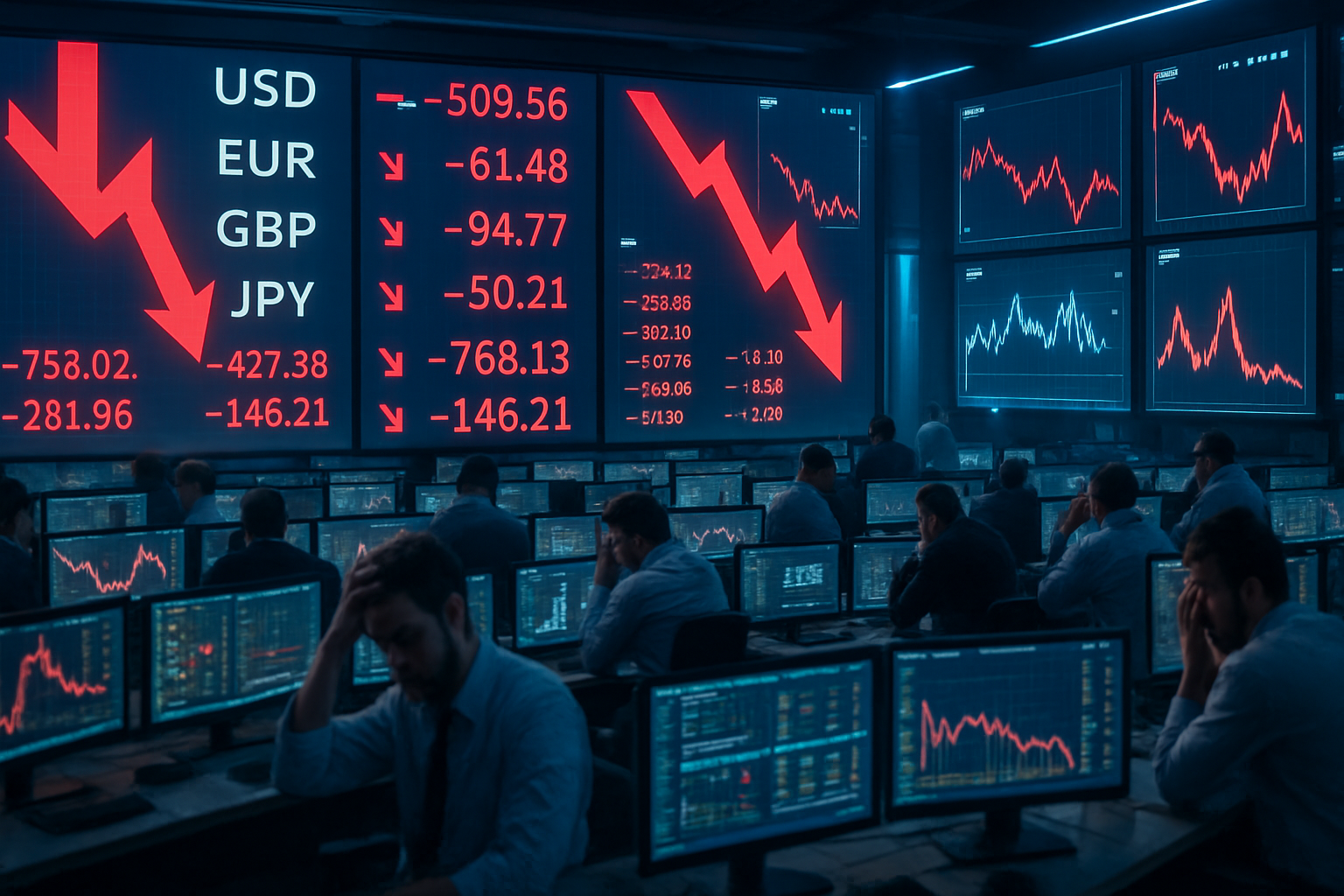
Stock markets plunged globally on Thursday as an escalating energy crisis triggered by Middle East conflict drove oil prices above $100 per barrel for the first time since 2022, creating unprecedented economic volatility across currencies, commodities, and equity markets worldwide.
Historic Market Declines Across Multiple Regions
The global selloff reached historic proportions, with Denmark's C25 index seeing all companies decline Thursday afternoon, while the Pakistani KSE-100 suffered its largest single-day drop in exchange history, plummeting 8.97%. South Korea's KOSPI crashed 12% with circuit breakers activated, marking the worst performance since 2008, as the Korean won hit a 17-year low against the dollar.
"Samtlige C25-selskaber falder torsdag eftermiddag," reported Danish financial media, highlighting the breadth of the selloff that spared no sector or geography. The crisis extended beyond developed markets to emerging economies, where currency pressures intensified dramatically.
Energy Crisis Drives Market Panic
The market turmoil stems from Iran's Revolutionary Guard declaring the Strait of Hormuz "unsafe for shipping," effectively blocking 40% of global seaborne oil transit through the critical 21-mile chokepoint. Brent crude surged to a peak of $119.50 per barrel, while West Texas Intermediate jumped 18.98% to $108.15 - the largest single-day increase on record.
Natural gas prices exploded across regions, rising 24% in Europe and a staggering 78% in the United States. European gas prices rocketed to €47.32 per megawatt-hour, reaching levels not seen since February 2025. The crisis deepened when Qatar, responsible for approximately 20% of global LNG exports, halted production at its Ras Laffan and Mesaid facilities following Iranian drone attacks.
"This is the most severe energy security crisis in decades, exposing our dangerous over-dependence on strategic chokepoints"
— Samuel Ciszuk, Energy Analyst
Currency Markets in Turmoil
Currency markets experienced severe volatility as investors fled to safe havens. The Philippine peso crashed to a record low of P60.10 against the US dollar, shedding 58 centavos from the previous day's close. The weakening currency threatens to exacerbate inflation pressures as the Philippines imports 98% of its crude oil from the Middle East region.
Russia's ruble also suffered significant losses, with the dollar rising above 87 rubles for the first time since April 2024. The euro traded above 97 rubles, its highest level since October 2025, reflecting widespread flight from emerging market currencies amid the global uncertainty.
South Africa's rand breached R17 per dollar Thursday morning, continuing the pattern of commodity-linked currencies weakening as global growth concerns intensified despite higher energy prices benefiting some resource-rich nations.
Supply Chain Disruption Reaches Critical Levels
The crisis extends far beyond energy markets, with major shipping companies Maersk and MSC suspending all Persian Gulf operations. Over 150 oil and LNG tankers remain stranded in the Persian Gulf, representing billions of dollars in cargo value. The 21-mile Strait of Hormuz has proven to be a dangerous single-point failure for modern global logistics, with no realistic alternative routes capable of handling the diverted volume.
Aviation industry disruption reached unprecedented levels, with over 18,000 flights cancelled worldwide - the most extensive disruption since COVID-19. Eight countries simultaneously closed their airspace, including Iran, Iraq, Israel, UAE, Qatar, Syria, Kuwait, and Bahrain. Dubai International Airport, the world's busiest with over 86 million passengers annually, remains completely shut down due to missile damage.
Central Bank Emergency Response
Central banks worldwide coordinated emergency responses as traditional monetary policy tools showed limited effectiveness against structural geopolitical disruptions. The European Central Bank and Bank of Japan led coordinated emergency liquidity provisions to prevent broader financial contagion, while several major corporations postponed planned market activities.
The crisis prompted the International Energy Agency to announce its largest strategic petroleum reserve release in 50-year history - 400 million barrels from 32 member countries, more than double the 182.7 million barrels released during the 2022 Ukraine crisis. Japan committed to releasing 80 million barrels starting March 16, marking the first deployment since the 2011 Fukushima disaster.
Global Consumer Impact Intensifies
Consumer impacts spread rapidly across continents as energy costs surge. Sweden faces electricity increases of 10-20 öre and gasoline rises of 1-2 kronor per liter, with the Malmö region most exposed due to continental integration. Ireland reported heating oil approaching €2 per liter amid what officials termed "brazen rip-offs," while Austria documented fuel increases of 20%.
Bangladesh implemented fuel rationing for 170 million people, while Bosnia-Herzegovina reported being reduced to just two days of gas reserves. Pakistan, facing the highest fuel prices in South Asia at Rs321.17 per liter, implemented wartime austerity measures including four-day government work weeks.
Diplomatic Breakdown Catalyst
The crisis stems from the complete collapse of US-Iran nuclear talks despite achieving a "broad agreement on guiding principles" - the most progress since the 2018 JCPOA collapse. However, fundamental scope disagreements proved insurmountable, with Iran excluding ballistic missiles and regional proxies as "red lines" while the US demanded comprehensive agreements covering missiles, armed groups, and human rights.
This diplomatic breakdown led to Operation Epic Fury, the largest US-Israeli coordinated operation since 2003, followed by massive Iranian retaliation under "Operation True Promise 4." The rapid transition from diplomatic breakthrough to military confrontation demonstrates the fragility of crisis management in the multipolar era.
Nuclear Governance Crisis Context
The broader nuclear governance crisis adds urgency to the situation. The New START treaty expired February 5, marking the first time in over 50 years without US-Russia nuclear constraints. Iran continues 60% uranium enrichment with over 400 kilograms of weapons-grade material - sufficient for multiple nuclear weapons. UN Secretary-General António Guterres warned that nuclear risks are at their "highest in decades."
Energy Architecture Transformation Imperative
The crisis exposes fundamental vulnerabilities requiring years or decades to address through supply diversification and renewable energy transitions. Strategic petroleum reserves provide only temporary buffer against sustained disruptions. The dangerous over-dependence on volatile geopolitical regions and strategic chokepoints necessitates revolutionary changes in energy security planning.
"The situation is going longer than people initially thought, and financial markets are becoming the ultimate constraint on prolonged conflict"
— Damien Boey, Portfolio Strategist
Template-Setting Implications for 21st Century
March 2026 represents a watershed moment in global financial markets, exposing strategic vulnerabilities and supply chain fragilities that could reshape international relations for decades. The crisis affects regional war prevention, global energy security, nuclear governance credibility, and international law enforcement simultaneously - testing post-WWII order principles at an unprecedented scale.
Recovery timelines remain uncertain, dependent on military operations resolution and diplomatic normalization rather than predictable economic factors. Unlike weather disruptions, aviation industries cannot schedule long-term operations with multiple airspaces closed, while energy markets remain volatile with critical transit routes blocked.
This crisis serves as the greatest test of multilateral cooperation in crisis management in the modern era, with implications extending far beyond current events to determine precedents for 21st-century conflict resolution, energy market evolution, and diplomatic versus military solutions to international disputes.