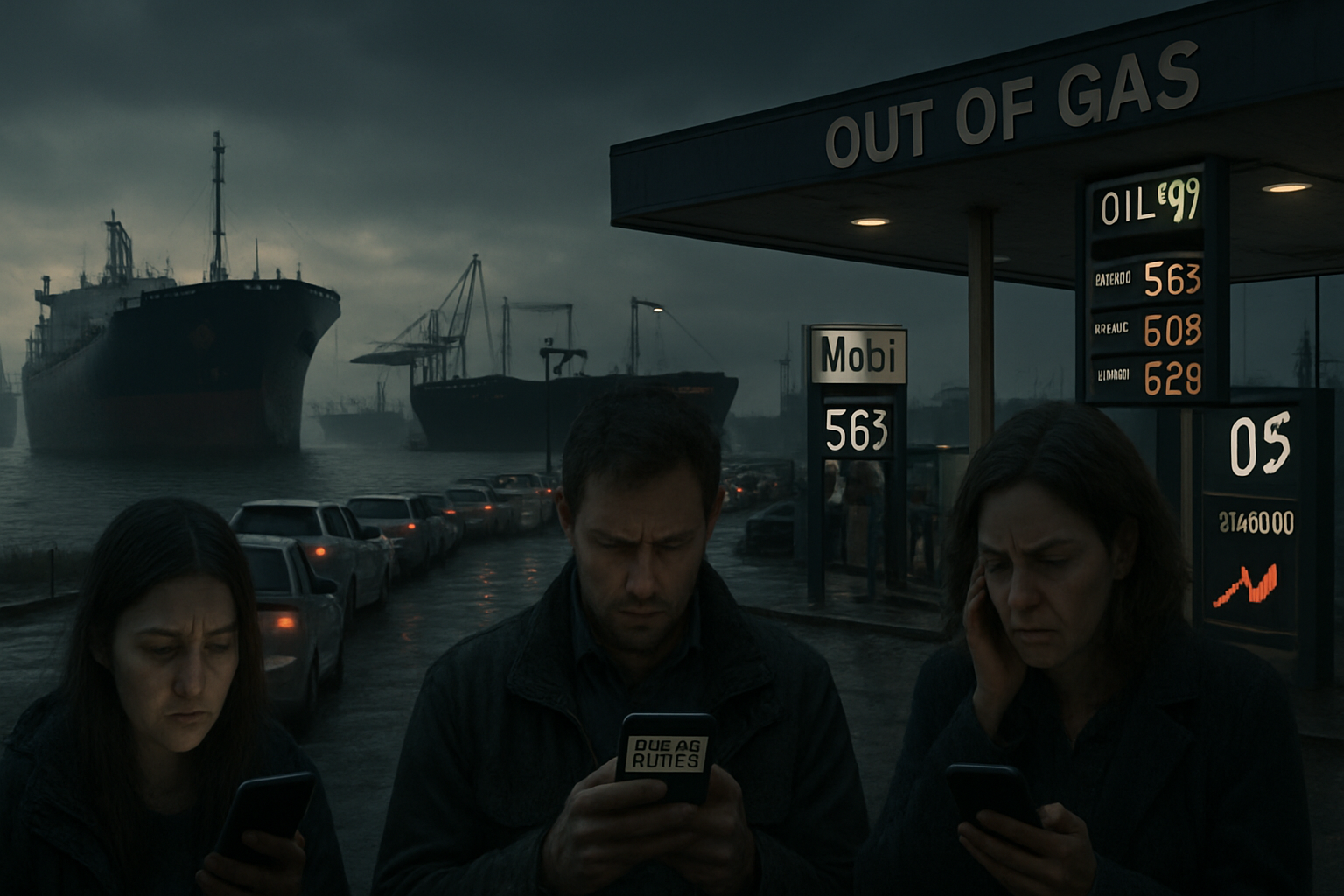
The world faces its most severe energy crisis since the 1970s oil shocks as Iran's Revolutionary Guard maintains its blockade of the Strait of Hormuz, triggering a cascade of emergency government interventions and fuel subsidies across multiple continents to shield consumers from record-breaking energy prices.
Oil prices have surged past $100 per barrel for the first time since 2022, with Brent crude peaking at $119.50 and West Texas Intermediate recording an unprecedented 18.98% single-day jump to $108.15. The crisis stems from Iran's declaration that the Strait of Hormuz—a critical 21-mile chokepoint handling 40% of global seaborne oil transit—is "unsafe for shipping," effectively blocking one of the world's most vital energy arteries.
Historic Government Interventions
Governments worldwide have abandoned traditional free-market approaches, implementing unprecedented emergency measures to protect consumers from soaring fuel costs. In Austria, Finance Minister Magnus Brunner announced a comprehensive fuel price brake system, redistributing excess fuel tax revenues directly back to consumers as prices surge by 20%.
Pakistan has taken dramatic action, with Prime Minister Shehbaz Sharif cutting the petrol levy by Rs80 per liter after announcing an unprecedented 43% increase in petrol prices and 55% in high-speed diesel. The government is now coordinating provincial administrations to implement subsidized fuel quotas for motorcyclists, farmers, and transporters, involving a fiscal impact of Rs65-70 billion per month.
"We're seeing the most comprehensive emergency fuel interventions since the 1970s oil crises," said energy analyst Samuel Ciszuk. "Governments are being forced to choose between fiscal sustainability and social stability."
— Samuel Ciszuk, Energy Security Expert
In Luxembourg, diesel prices have jumped by 16.5 centimes to reach a record €2.186 per liter, the highest level since March 10, 2022, during the early weeks of the Russia-Ukraine conflict. Irish consumers face what officials describe as "brazen rip-offs" as heating oil approaches €2 per liter, prompting government consideration of emergency tax reductions.
Strategic Reserves Deployment
The International Energy Agency has authorized the largest strategic petroleum reserve release in its 50-year history—400 million barrels from 32 member countries, more than double the 182.7 million barrels released during the 2022 Ukraine crisis. Japan is contributing 80 million barrels, marking its first strategic reserve deployment since the 2011 Fukushima disaster, despite its 95% dependence on Middle Eastern oil, with 70% transiting through the now-blocked Strait of Hormuz.
Germany has confirmed its participation in the coordinated release, while the United States is expected to be the largest contributor. Energy Secretary Christopher Wright is even considering lifting additional sanctions on Russian oil to bring "hundreds of millions of barrels of sanctioned oil" to market for supply stabilization.
Aviation and Shipping Industries in Crisis
The energy crisis has created parallel disasters in aviation and shipping. Over 18,000 flights have been cancelled worldwide—the most extensive disruption since COVID-19—as eight countries maintain simultaneous airspace closures across Iran, Iraq, Israel, UAE, Qatar, Syria, Kuwait, and Bahrain. Dubai International Airport, the world's busiest with 86 million passengers annually, remains shut due to missile damage.
Jet fuel costs have skyrocketed from $85-90 per barrel to $150-200, representing a 122% increase that airlines are passing directly to consumers through emergency surcharges. Major shipping companies Maersk and MSC have suspended all Persian Gulf operations, leaving more than 150 oil and LNG tankers stranded with billions of dollars in cargo value.
Regional Impact Variations
The crisis affects different regions with varying intensity based on their energy integration and import dependencies. Sweden, particularly the Malmö region with its continental integration, faces electricity increases of 10-20 öre and gasoline price rises of 1-2 kronor per liter. Ireland confronts what officials term "brazen rip-offs" as heating oil approaches €2 per liter.
In Asia, Bangladesh has implemented nationwide fuel rationing affecting 170 million people, while Pakistan faces its highest fuel costs in South Asia at Rs321.17 per liter, prompting the government to declare wartime austerity measures including four-day work weeks for government offices. Australia sees hundreds of service stations running dry across NSW, Queensland, Victoria, and South Australia, with the Australian Competition and Consumer Commission monitoring potential price gouging as fuel approaches the critical $3 per liter threshold.
Financial Market Carnage
Global financial markets have experienced severe disruption, with Pakistan's KSE-100 recording its largest single-day decline in history at -8.97%. South Korea's KOSPI index fell 12%, triggering circuit breakers as the Korean won hit a 17-year low. Even PayPal's $1.1 billion IPO has been postponed indefinitely due to market volatility.
Central banks including the European Central Bank and Bank of Japan are coordinating emergency liquidity measures to prevent broader financial contagion, though traditional monetary policy tools prove limited against structural geopolitical disruptions.
Diplomatic Crisis at the Root
The energy crisis stems from the complete collapse of US-Iran nuclear negotiations, despite what had been described as a "broad agreement on guiding principles"—the most progress since the 2018 JCPOA breakdown. Iran insisted on excluding ballistic missiles and proxy groups as "red lines," while the US demanded comprehensive coverage including missiles, armed groups, and human rights issues.
The diplomatic failure led to Operation Epic Fury, the largest coordinated US-Israeli military operation since 2003, followed by Iranian retaliation through Operation True Promise 4 and the subsequent Strait of Hormuz blockade. The crisis occurs against the backdrop of the New START treaty's expiration on February 5, marking the first time in over 50 years that the US and Russia operate without nuclear constraints.
Energy Architecture Vulnerabilities Exposed
The crisis has brutally exposed the dangerous vulnerabilities of the global energy system's over-dependence on strategic chokepoints. The 21-mile Strait of Hormuz represents a single-point failure for modern logistics, with no realistic alternative routes capable of handling the diverted volume without significant time and cost penalties.
"This is the most severe energy security crisis in decades, exposing our dangerous over-dependence on strategic chokepoints that can be weaponized in geopolitical conflicts."
— Qatar Energy Minister Saad Al Kaabi
Qatar Energy Minister Saad Al Kaabi has warned that Gulf states may declare force majeure "within weeks" if oil approaches $150 per barrel, which would "bring down the economies of the world." Qatar has already halted LNG production at its Ras Laffan and Mesaid facilities, representing approximately 20% of global exports, following Iranian attacks.
Long-term Implications
The March-April 2026 energy crisis represents a watershed moment for 21st-century energy security policy, demonstrating the urgent need for fundamental transformation to reduce dependence on volatile geopolitical regions and strategic chokepoints. While strategic petroleum reserves provide temporary relief, they cannot address sustained disruptions that require years or decades of supply diversification and renewable energy transitions.
The crisis serves as a template for future energy security challenges, with implications extending far beyond current events. Success in containing the crisis could provide a framework for nuclear crisis resolution and strengthen diplomatic precedents. Failure could accelerate military solutions, reshape Middle Eastern geopolitics for decades, encourage global nuclear proliferation, and undermine diplomatic credibility worldwide.
As UN Secretary-General António Guterres described it, this represents "the greatest test of multilateral cooperation and crisis management in the modern era," determining whether diplomatic or military solutions will define the framework for 21st-century international stability mechanisms globally.