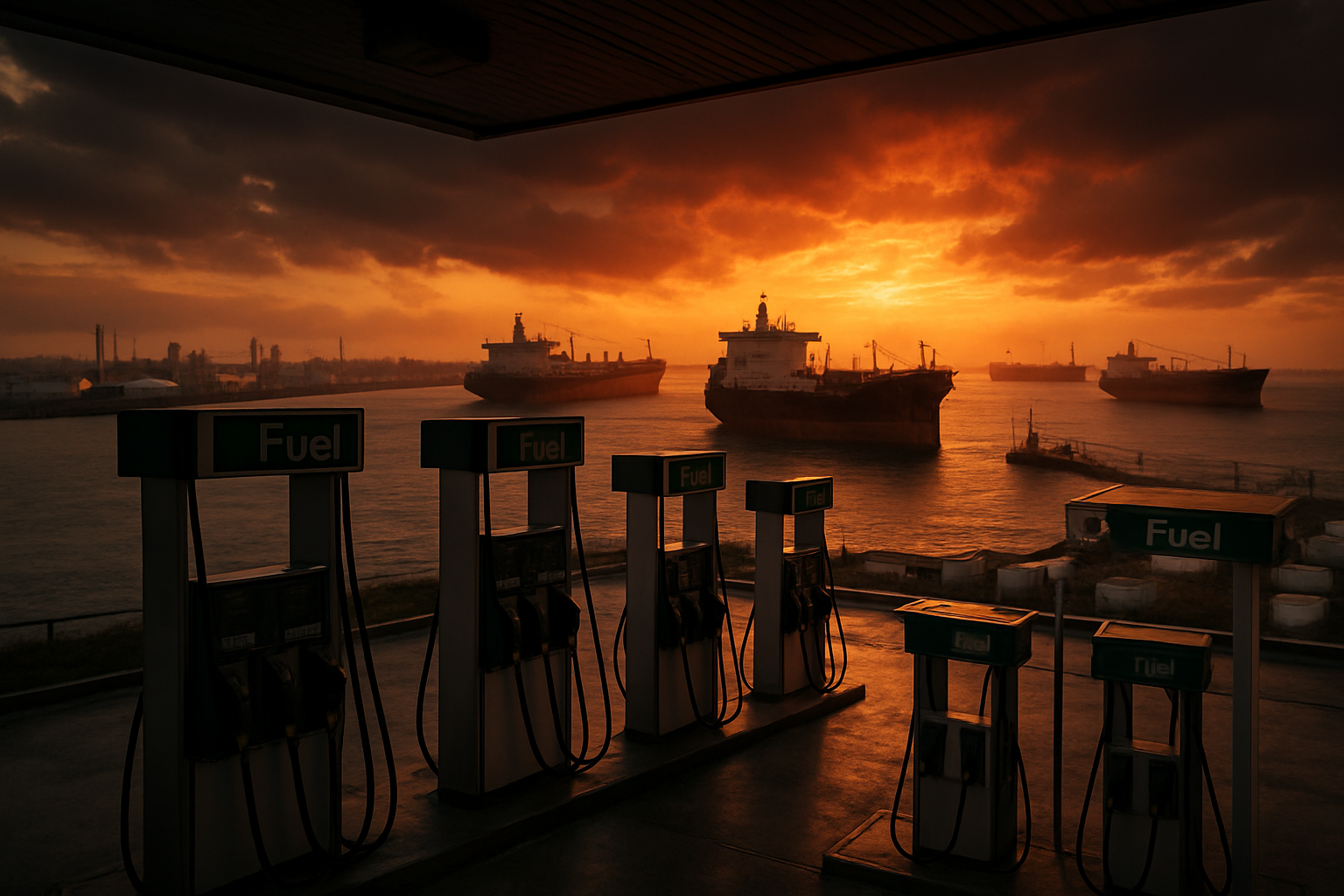
The ongoing Iran conflict has triggered the most severe global energy crisis since the 1970s oil shocks, with rising fuel costs and energy supply disruptions fundamentally reshaping multiple sectors from aviation to manufacturing, while paradoxically accelerating Asia's transition to renewable energy sources.
Aviation Industry Faces Existential Crisis
Air Canada has announced the suspension of critical international routes to New York's JFK International Airport for nearly five months, becoming the latest casualty in what industry experts are calling the worst aviation fuel shortage in modern history. The airline will suspend service to JFK throughout the summer season as Iran's ongoing conflict creates severe jet fuel shortages that have sent prices soaring by over 120%.
According to source reports from multiple regions, the suspended routes include Toronto-JFK, Toronto-Salt Lake City, Montreal-JFK, and domestic routes Vancouver-Fort McMurray and Toronto-Yellowknife. The International Energy Agency's Director Fatih Birol has issued an unprecedented warning that Europe has "perhaps six weeks of jet fuel" remaining before widespread flight cancellations become inevitable by early June.
The crisis scale is staggering: over 18,000 flights have been cancelled worldwide—the most extensive disruption since COVID-19. Eight Middle Eastern countries maintain simultaneous airspace closures, creating what experts describe as an "aviation black hole" that has severed Europe-Asia corridors. Dubai International Airport, which handles 86 million passengers annually, remains completely shut down due to missile damage.
Manufacturing Exodus from China Accelerates
Chinese manufacturers are dramatically recalibrating their overseas expansion plans as the energy crisis compounds existing challenges. Lawrence Wong's toy factory in Vietnam, originally planned for 600 square meters at the start of 2026, represents a broader trend of Chinese companies seeking more stable operating environments outside the mainland.
The South China Morning Post reports that with domestic profits narrowing and production capacity expanding, Chinese firms are continuing to widen their overseas footprints in search of new, more lucrative markets. However, the global energy crisis is forcing these companies to reassess their international strategies as supply chain costs surge and energy security becomes paramount.
Manufacturing sectors dependent on Gulf networks—particularly automotive, electronics, and textiles—are experiencing severe disruptions. China has suspended refined fuel exports, while Singapore reports 30% increases in logistics costs, demonstrating the far-reaching impact beyond traditional energy sectors.
Asia's Green Energy Revolution Accelerates
In an unexpected development, the energy crisis is catalyzing Asia's transition to renewable energy at unprecedented speed. Thailand exemplifies this transformation, with solar panel installations spreading rapidly across homes, garages, and warehouses throughout the sun-drenched kingdom.
The Iran war has accomplished what years of climate summits could not: turning solar power into an absolute necessity. Demand for solar panels has overwhelmed companies like Wayso, whose managing director reports being unable to hire technicians fast enough to meet surging demand. "We can't hire quickly enough," notes the company's leadership, highlighting the dramatic shift from fossil fuel dependence to renewable alternatives.
This transition represents more than mere adaptation—it signals a fundamental restructuring of Asia's energy architecture, driven by necessity rather than environmental considerations alone. The crisis has exposed dangerous over-dependence on strategic chokepoints, particularly the 21-mile Strait of Hormuz, which handles 40% of global oil transit.
Australia's Property Market Under Pressure
The energy crisis is creating unexpected ripple effects in global real estate markets, with Australia experiencing a particularly acute impact. Property sellers are facing another anxious week of auctions as the economic fallout from the Iran conflict continues to spook buyers about bidding.
Industry experts report that prospective purchasers are playing a "waiting game" before bidding on new homes, leaving vendors who must sell increasingly stranded. Data from property research company Cotality shows that across Australia's combined capital cities, the auction clearance rate is tracking below 60%—rising slightly from Easter weekend's 55% to just 57% last week.
There are growing concerns that the Australian property market faces a "winter of discontent" the longer the conflict continues. The uncertainty is particularly acute given Australia's heavy reliance on fuel imports and the direct impact of rising energy costs on household budgets and economic confidence.
Global Government Emergency Response
Governments worldwide are implementing the most severe emergency energy measures since the 1970s oil crisis. The International Energy Agency has deployed the largest strategic petroleum reserve release in 50-year history—400 million barrels from 32 countries, more than double the 2022 Ukraine crisis response.
Japan is releasing 80 million barrels for the first time since the 2011 Fukushima disaster, while Germany has strengthened antitrust laws to prevent gas station price manipulation—representing the most significant market intervention in modern German policy. Hungary has imposed immediate price caps to counter "war-driven price explosions," while France has deployed 500 fuel inspectors to prevent manipulation.
The crisis has forced multiple nations to abandon free-market principles in favor of consumer protection, with countries from Bangladesh (implementing fuel rationing for 170 million people) to New Zealand (considering "Muldoon-era" emergency measures not seen since the 1970s) taking unprecedented action.
Supply Chain Transformation
The energy crisis has exposed fundamental vulnerabilities in global supply chains that extend far beyond traditional energy sectors. The Persian Gulf serves as a critical trade hub affecting consumer goods, industrial materials, and food distribution worldwide. With Maersk and MSC suspending operations and over 150 oil and LNG tankers stranded in the Persian Gulf, the economic impact reaches every corner of the global economy.
The 21-mile Strait of Hormuz has proven to be a dangerous single-point failure in modern logistics, with no realistic alternatives for handling the massive volumes of oil and LNG that transit the waterway daily. This has forced companies and governments to fundamentally reassess their supply chain strategies and geographic dependencies.
Long-term Implications
Energy experts describe this as the most severe energy security crisis in decades, exposing strategic chokepoint vulnerabilities that require fundamental restructuring. Samuel Ciszuk notes that the crisis has revealed "single-chokepoint vulnerabilities" that demand comprehensive solutions, while Qatar's Energy Minister Saad Al Kaabi has warned of potential force majeure declarations that could drive oil to $150 per barrel, threatening to "bring down economies of the world."
The crisis represents a watershed moment for 21st-century energy security planning, requiring fundamental transformation to reduce dependence on strategic chokepoints. Success in managing this crisis could provide frameworks for future nuclear and energy security challenges, while failure could accelerate military solutions and reshape geopolitics for decades.
Recovery timelines remain uncertain, dependent on military and diplomatic resolution rather than predictable economic factors. Unlike weather-related disruptions, this crisis requires coordinated international responses addressing root geopolitical causes while building more resilient energy and supply chain systems for the future.