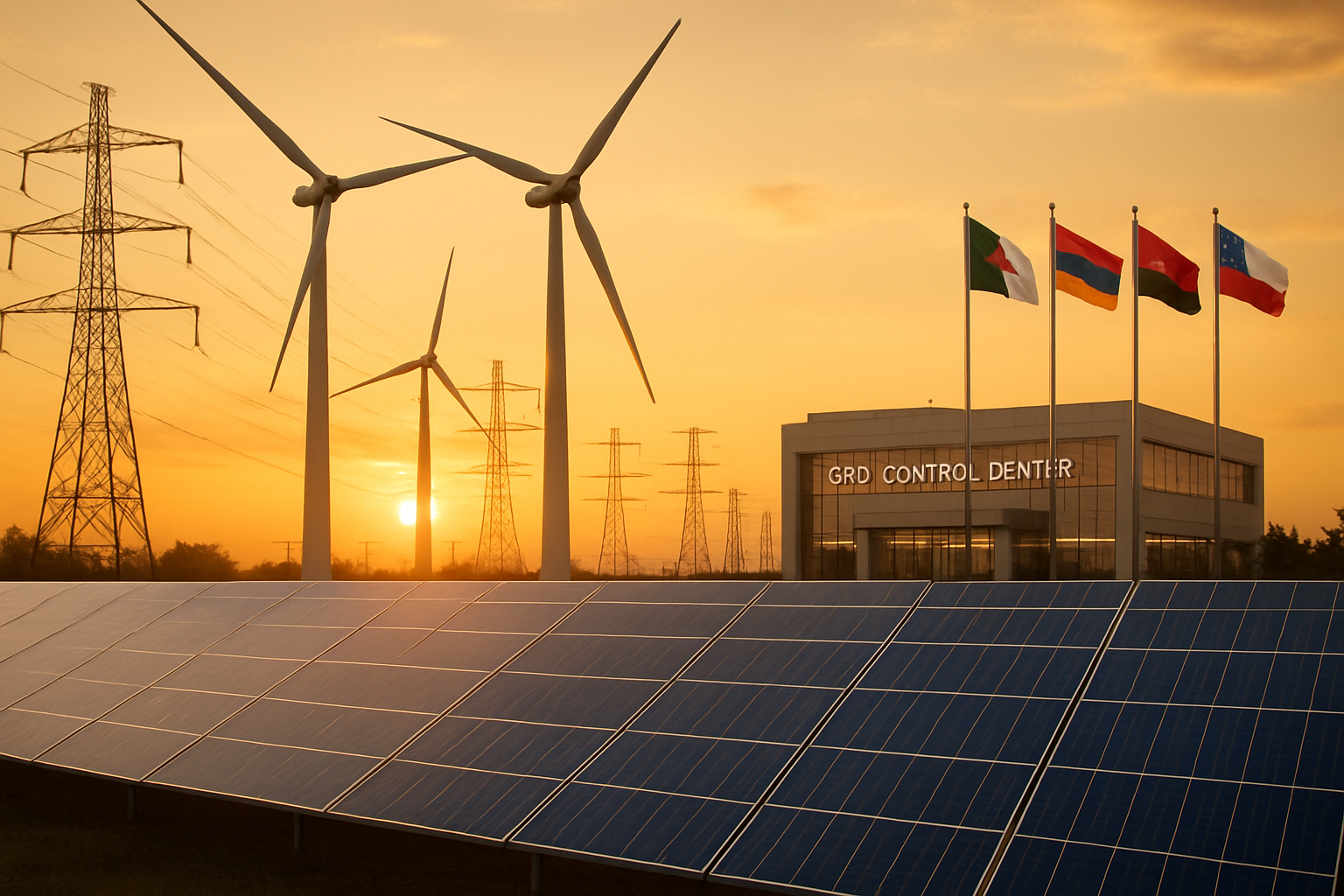
A coordinated wave of energy infrastructure projects and international partnerships is reshaping regional power networks across four continents, as nations accelerate renewable energy development and strengthen grid connectivity amid growing global energy demands.
February 2026 has witnessed unprecedented momentum in energy cooperation and infrastructure investment, with developments spanning from North Africa's renewable partnerships to South America's solar expansion and Central Asia's regional integration efforts. These projects collectively represent billions in investment and demonstrate how international cooperation is becoming the cornerstone of modern energy security strategies.
Algeria-Italy Partnership Strengthens Mediterranean Energy Corridor
Algeria's Energy and Renewable Energy Minister Murad Ajjal received Italy's Environment and Energy Security Minister Gilberto Pichetto Fratin in Algiers this week, marking a significant expansion of bilateral energy cooperation. The meeting, part of a high-level Italian delegation visit, focused on enhancing collaboration in traditional energy sectors and renewable energy development.
The discussions took place on the sidelines of the "North Africa - Connecting Continents" seminar, organized jointly by the Bank of Algeria and the International Monetary Fund. This framework represents President Abdelmadjid Tebboune's strategic directive to strengthen Algerian-Italian economic cooperation, particularly in the energy sector where Algeria serves as a crucial natural gas supplier to Europe.
"The partnership with Italy represents a model for regional energy cooperation that balances traditional energy exports with future renewable energy development."
— Energy Industry Analyst, Mediterranean Energy Council
Algeria's positioning as a regional energy hub has gained strategic importance as European nations seek to diversify energy supplies. The country's vast solar potential and established energy infrastructure make it an ideal partner for Italy's energy transition goals and broader European energy security objectives.
Armenia-Japan Renewable Energy Initiative Launched
Armenia has embarked on a groundbreaking renewable energy cooperation agreement with Japan, involving the Ministry of Environment, the Ministry of Territorial Administration and Infrastructures, and Japan's KOMAIHALTEC Corporation. This quadrilateral memorandum of understanding signals Armenia's commitment to diversifying its energy portfolio and reducing dependence on traditional sources.
The partnership leverages Japan's advanced renewable energy technologies and expertise in grid integration, while Armenia provides opportunities for large-scale renewable deployment across its mountainous terrain. This collaboration reflects the growing trend of technology transfer partnerships between developed and developing nations in the energy sector.
Armenia's strategic location in the South Caucasus positions it as a potential regional renewable energy hub, connecting European and Asian markets through clean energy corridors. The Japanese partnership brings cutting-edge technology and financing mechanisms that could accelerate Armenia's renewable energy transition significantly.
Angola's Lobito Corridor Infrastructure Revolution
Angola's Transport Minister Ricardo de Abreu emphasized the critical importance of effective coordination among partners for the success of the Lobito Corridor project, describing it as essential for transforming the corridor into a true regional development axis. The minister highlighted that while there is significant international interest in the project, coordination mechanisms have been the missing element for successful implementation.
The Lobito Corridor represents one of Africa's most ambitious infrastructure projects, connecting the Atlantic port of Lobito to mineral-rich regions in Angola and the Democratic Republic of Congo. This strategic railway and logistics network aims to reduce Africa's dependence on raw material exports by creating value-added processing opportunities along the corridor.
"What was missing was a mechanism that could ensure effective coordination among all partners. There is great interest around the Lobito Corridor, but it has been arriving in an uncoordinated manner through a set of projects."
— Ricardo de Abreu, Angola's Transport Minister
The project's success depends on integrating multiple stakeholders, including international investors, regional governments, and local communities. The corridor is expected to catalyze economic development across the region while providing alternative export routes for Central African resources.
Chile's Renewable Energy Milestone
Pacific Hydro's Don Patricio solar project received environmental approval for installation in Tiltil, representing a US$368 million investment with nearly 190 MW of power generation capacity. This approval marks a significant milestone in Chile's renewable energy expansion and demonstrates the country's commitment to clean energy development.
The project contributes to Chile's ambitious renewable energy targets and reinforces the country's position as a leader in South American clean energy development. Chile's favorable solar conditions and supportive regulatory framework have attracted significant international investment in renewable infrastructure.
The Don Patricio project will contribute clean, renewable energy to Chile's national grid, supporting the country's decarbonization goals while creating local employment opportunities and economic development in the Tiltil region.
Global Energy Security Context
These developments occur against the backdrop of a complex global energy landscape shaped by geopolitical tensions, supply chain challenges, and accelerating climate commitments. The European Union has warned that critical material shortages, particularly China's control of 60% of global production and 90% of refining capacity for essential elements like lithium and cobalt, threaten renewable energy scaling efforts.
The coordinated approach seen in Algeria-Italy cooperation, Armenia-Japan partnerships, and other international energy collaborations represents a strategic response to these challenges. By diversifying supply chains, sharing technology, and creating regional energy networks, nations are building more resilient energy systems.
Regional Integration and Economic Impact
The infrastructure projects described reflect broader regional integration trends, from Mediterranean energy corridors to African continental trade frameworks and South American renewable energy networks. These initiatives create economic multiplier effects beyond direct energy benefits, including job creation, technology transfer, and enhanced regional connectivity.
The Angola Lobito Corridor exemplifies this approach, transforming transportation infrastructure into a catalyst for broader economic development. Similarly, the Algeria-Italy partnership creates opportunities for technology sharing and joint investment in next-generation energy systems.
Armenia's collaboration with Japan demonstrates how smaller nations can leverage international partnerships to accelerate their energy transition while contributing to regional energy security. These models provide templates for other nations seeking to balance energy security with sustainable development goals.
Technology Transfer and Innovation
A common thread across these projects is the emphasis on technology transfer and innovation. The Armenia-Japan partnership brings advanced renewable energy technologies to the South Caucasus region, while the Algeria-Italy cooperation combines traditional energy expertise with renewable energy innovation.
Chile's solar project incorporates state-of-the-art photovoltaic technology, contributing to the global learning curve for renewable energy deployment. These technology transfers accelerate global energy transition while building local capacity and expertise.
The integration of digital technologies, smart grid systems, and advanced materials in these projects positions them at the forefront of the modern energy infrastructure revolution. This technological sophistication enhances efficiency, reliability, and environmental performance while reducing long-term operational costs.
Future Outlook and Strategic Implications
The momentum demonstrated in February 2026 suggests a sustained acceleration in global energy infrastructure development. The combination of climate commitments, energy security concerns, and economic opportunities is driving unprecedented international cooperation in the energy sector.
Success in these initiatives could establish new models for international energy cooperation, demonstrating how nations can achieve energy security while advancing climate goals through collaborative approaches. The emphasis on regional integration and technology sharing may become the standard approach for energy infrastructure development.
However, challenges remain, including financing sustainability, technical capacity building, and coordination among diverse stakeholders. The lessons learned from current projects will inform future energy cooperation initiatives and shape the global energy system's evolution toward greater sustainability, security, and accessibility.
As these projects advance through implementation phases, they will provide crucial data on the effectiveness of international energy cooperation models and their potential for replication across different regional contexts. The success of these initiatives may determine the pace and scope of global energy transition in the coming decade.