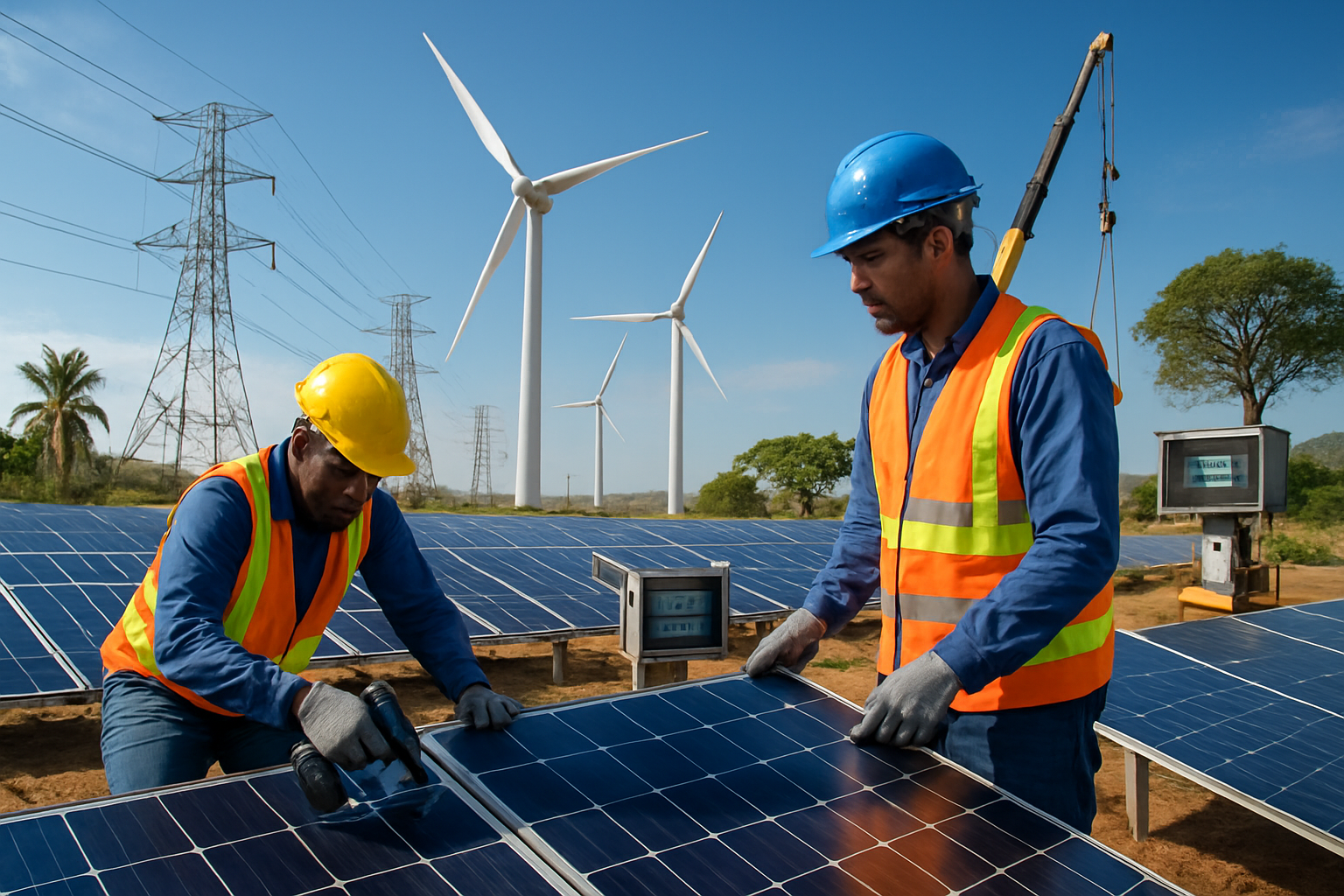
A coordinated global energy infrastructure renaissance is gaining momentum across five continents, with breakthrough projects spanning from Gabon's "Mission 300" electrification initiative to Guyana's solar expansion and Cyprus's major power generation deals, demonstrating an unprecedented commitment to energy security and climate action.
The convergence of these developments in early April 2026 represents a watershed moment in global energy policy, occurring during what climate scientists confirm as the 21st consecutive month of temperatures exceeding 1.5°C above pre-industrial levels. This sustained warming trend is driving nations to accelerate their energy transition strategies while simultaneously addressing immediate power security needs.
Africa Leads Continental Electrification Drive
Gabon is positioning itself at the forefront of African energy transformation, hosting the 10th edition of the Africa Energy Market Place from April 8-9, 2026, in Libreville. The conference, organized in partnership with the African Development Bank, centers on the ambitious "Mission 300" initiative targeting electricity access for 300 million Africans by 2030.
This initiative builds on significant momentum across the continent, where recent discoveries and investments are reshaping the energy landscape. Gabon's Grand N'Gongui oil field discovery in February 2026 marked the first major petroleum find of the Fifth Republic, while March brought Assala Energy's Magoga-1 offshore hydrocarbon discovery, providing crucial revenue streams to fund renewable infrastructure.
The strategic importance of Africa's energy development cannot be overstated. According to the African Finance Corporation, the continent holds $29.5 trillion in mineral reserves—20% of the global total—with $8.6 trillion remaining untapped. Seven African countries, including Angola, the Democratic Republic of Congo, Guinea, Kenya, Morocco, Sierra Leone, and Zambia, are participating in the US-EU-Japan Critical Minerals Partnership, challenging China's dominance in 60% of global production and 90% of refining capacity for lithium, cobalt, and rare earth elements essential for renewable energy infrastructure.
Caribbean Solar Revolution Gains Momentum
Guyana's renewable energy sector achieved a remarkable milestone with Prime Minister Brigadier (Ret'd) Mark Phillips officially commissioning the Aurora Solar Farm at the Aurora Gold Mine site in Region Seven. The expanded facility now boasts nearly 50 megawatts of installed solar capacity, supported by advanced battery storage systems.
This development is particularly significant given Guyana's extraordinary projected electricity demand surge—Power and Light forecasts a 600% increase by 2030, from the current 236 MW peak to 1,650 MW, reflecting rapid economic transformation driven by oil discoveries and renewable investments. The country has already demonstrated success with its mini-hydropower plants in Region Nine, which saved the government over 17,000 drums of fossil fuel in less than two years of operation.
The Caribbean's renewable push extends beyond individual nations, with Taiwan Technical Mission and St. Kitts Electricity Company completing critical site assessments for renewable energy microgrids. These distributed energy systems provide backup power during extreme weather events while reducing fossil fuel dependence—a template increasingly adopted by small island developing states facing climate vulnerabilities.
Central Asian Energy Corridor Takes Shape
Kazakhstan's ratification of a historic green energy partnership with Azerbaijan and Uzbekistan is creating the world's first transcontinental green energy corridor connecting Central Asia to European markets. This initiative, originally signed in Baku on November 13, 2024, represents a fundamental shift in regional energy geopolitics.
Azerbaijan's positioning as a key East-West energy coordinator, recognized by the U.S. Chamber of Commerce, has attracted significant international investment. The country achieved a crucial economic diversification milestone with non-oil GDP reaching 52.7% of total output in December 2025, providing a foundation for sustainable renewable investment beyond traditional energy exports.
The region's strategic importance extends to telecommunications integration, with Aztelekom launching solar-powered GPON (Gigabit Passive Optical Network) stations in rural villages, demonstrating the revolutionary integration of renewable energy into critical communications infrastructure.
European Infrastructure Modernization
Cyprus represents a fascinating case study in balancing immediate energy security needs with long-term renewable goals. The Electricity Authority of Cyprus (EAC) reached an agreement with German industrial giant Siemens for three diesel generators to upgrade the Dhekeleia power station, each rated at 27 megawatts.
This development occurs alongside Cyprus's remarkable solar success, with one in six homes now generating solar power. However, the rapid expansion has created grid management challenges, requiring sophisticated zero-export solar connections to maintain stability while allowing households to avoid periodic power outages.
These technical challenges highlight a broader trend across European renewable deployment: the need for advanced grid infrastructure and storage solutions to accommodate variable renewable generation. Estonia continues to demonstrate leadership with 88% renewable electricity and continental Europe's largest battery storage facility serving 90,000 households.
Technology Integration and Supply Chain Resilience
Modern energy infrastructure projects are incorporating sophisticated technology integration from the design phase, including real-time monitoring, predictive maintenance, AI-powered optimization, and automated operations. This technological sophistication enables precise environmental and economic benefit measurement crucial for policy development.
However, significant supply chain vulnerabilities persist. Memory chip shortages have led to sixfold price increases affecting smart grid and renewable energy control systems, with shortages expected to continue until 2027 when new fabrication facilities come online. These constraints are driving innovation in edge computing architectures and distributed processing systems to increase network resilience.
The response to supply chain challenges is fostering unprecedented international cooperation. The US-EU-Japan Critical Minerals Partnership involves 55 countries working to diversify supply chains away from excessive dependence on any single nation. This effort includes developing alternative suppliers and investing in domestic processing capabilities.
Climate Urgency Drives Investment
The acceleration of energy infrastructure development occurs against a backdrop of mounting climate urgency. January 2026 marked the hottest month in recorded history, extending an unprecedented warming streak that has seen human-induced climate change override natural variability, including La Niña cooling effects.
This sustained warming creates cascading environmental effects that traditional energy systems struggle to address. Rising sea levels threaten coastal power plants, changing precipitation patterns affect hydroelectric generation, and increasing extreme weather frequency disrupts transmission networks. The response is driving massive investment in climate-resilient energy infrastructure designed for future conditions rather than historical patterns.
Economic multiplier effects from these investments extend far beyond construction activities. Digital infrastructure generates $3-4 in economic returns per dollar invested over a decade, while renewable energy creates both immediate construction employment and permanent operational positions. Regional integration benefits through cross-border connectivity enable energy trading and disaster resilience cooperation.
International Cooperation Models
The current energy infrastructure surge demonstrates evolving international cooperation models that go beyond traditional North-South aid relationships. South-South cooperation is expanding, with developing nations emerging as environmental solution providers rather than aid recipients.
Technology transfer mechanisms are supporting rapid infrastructure scaling while respecting local autonomy and cultural priorities. The Netherlands-DRC water partnership, Islamic Development Bank commitments to Mauritania, and Taiwan Technical Mission collaboration with Caribbean nations exemplify sophisticated financing that combines public investment, international development cooperation, and private expertise while maintaining African and Caribbean ownership of development priorities.
These partnerships demonstrate that environmental protection functions as an economic development strategy rather than a regulatory burden. Countries implementing comprehensive environmental protection strategies demonstrate greater economic resilience and attract sustainable investment across multiple sectors.
Future Trajectory and Strategic Significance
April 2026 represents a critical juncture in global energy development, where the choice between reactive crisis management and proactive energy system transformation may determine the pace of clean energy deployment during the decisive climate action decade.
The projects documented across Africa, the Caribbean, Central Asia, and Europe provide practical templates for scaling renewable energy protection globally through coordinated approaches that address multiple challenges while building local capacity and fostering international cooperation. Success depends on implementing solutions at sufficient speed and scale to match the urgency of climate challenges.
The energy infrastructure renaissance of 2026 may be remembered as the moment when humanity systematically began building sustainable prosperity foundations for an uncertain but interconnected future. The convergence of technological advancement, environmental urgency, and international cooperation is creating unprecedented conditions for transformation.
As the environmental action window narrows and ecological systems approach critical thresholds, the tools, knowledge, and cooperation frameworks demonstrated by these diverse international initiatives provide hope that comprehensive energy transformation is achievable. The success of these projects will influence energy policy strategies for decades ahead, determining humanity's capacity to maintain planetary habitability during the most environmentally challenging period in recorded history.