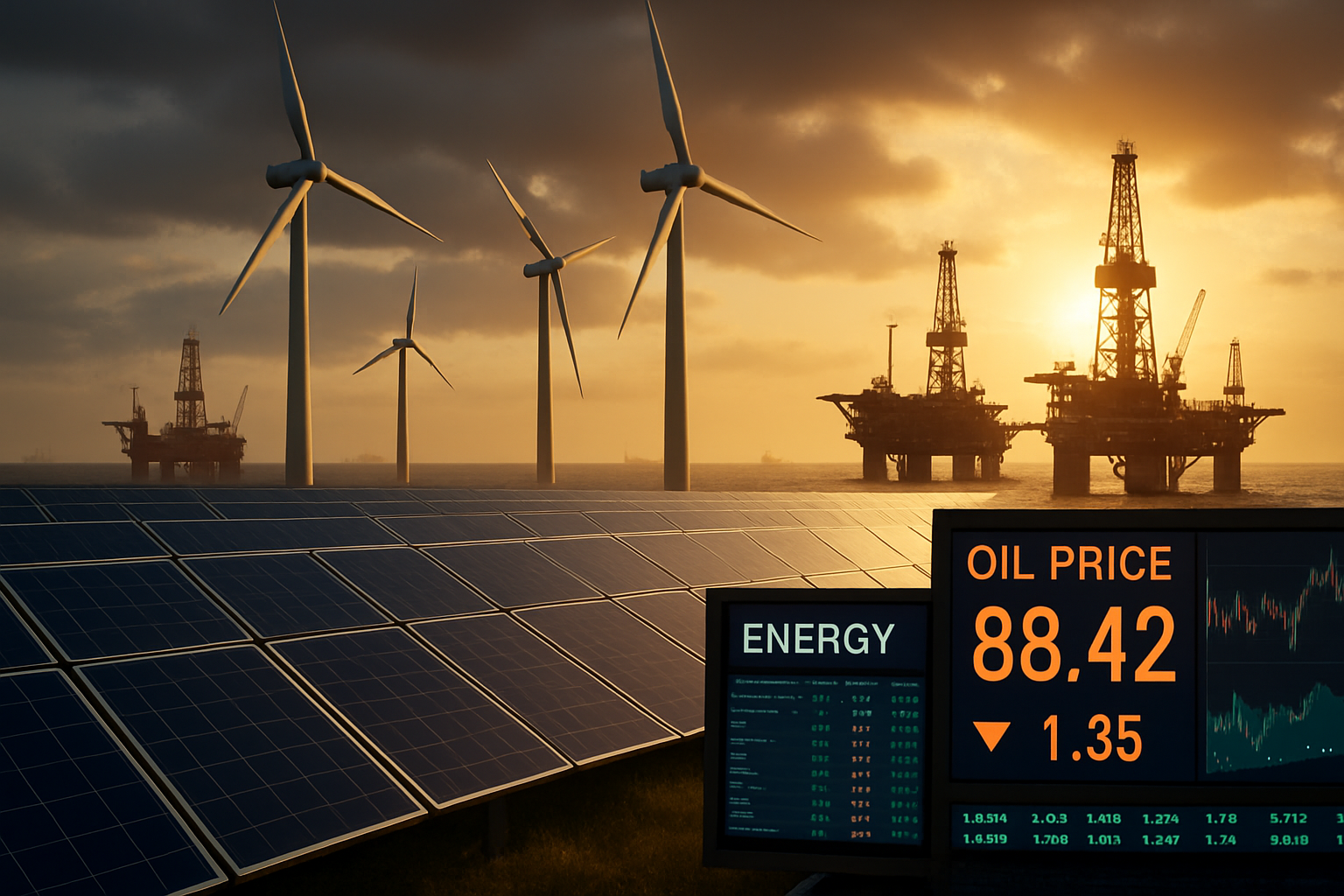
Global energy markets are experiencing significant upheaval as oil prices surge amid escalating US-Iran tensions while countries across the world accelerate renewable energy initiatives, creating a complex landscape of traditional and clean energy dynamics.
Oil markets posted substantial gains on Thursday, February 12, 2026, with Azerbaijan's benchmark Azeri Light crude rising to $72.20 per barrel at Italy's Augusta port, reflecting broader market confidence despite ongoing geopolitical uncertainties. The upward trajectory continues a pattern established in recent weeks as investors monitor tensions between the United States and Iran.
Oil Markets React to Geopolitical Tensions
By early Thursday trading, Brent crude futures climbed 34 cents to $69.74 per barrel, while U.S. West Texas Intermediate crude advanced 37 cents to $65.00 per barrel. The gains build on previous session increases, with Brent rising 0.87 percent and WTI gaining more than 1.05 percent.
Regional crude benchmarks followed suit, with Kuwaiti crude rising by $1.22 to reach $66.40 per barrel according to Al-Rai daily. The coordinated price increases reflect market concerns about potential supply disruptions as diplomatic tensions between Washington and Tehran continue despite ongoing nuclear negotiations in Oman.
"Market sentiment was shaped largely by uncertainty surrounding Washington's approach to Tehran. President Trump said no 'definitive' decision had been reached regarding Iran, though negotiations would continue."
— Times Kuwait Market Analysis
The energy sector's volatility occurs against a backdrop of heightened military activity in the Persian Gulf, which handles approximately 40% of global oil transit. Recent incidents include F-35C aircraft from the USS Abraham Lincoln shooting down Iranian drones and IRGC vessels harassing US tankers in the Strait of Hormuz.
Renewable Energy Acceleration Across Asia
While traditional energy markets grapple with geopolitical uncertainty, renewable energy initiatives are advancing rapidly across multiple regions. Malaysia's Sarawak state has announced ambitious plans to continue its Renewable Energy Agenda beyond the Post Covid-19 Development Strategy (PCDS) 2030.
Premier Datuk Patinggi Tan Sri Abang Johari Tun Openg outlined four priority sectors for post-2030 development: hydroelectric dams, hydrogen, biomass, and solar energy. The strategic focus positions Sarawak as a regional leader in clean energy transition.
"We have five years to complete PCDS 2030, and beyond that, we will focus on the continuation of our Renewable Energy Agenda," Abang Johari stated, emphasizing the state's commitment to sustainable energy development.
Regional Energy Hub Development
Azerbaijan continues establishing itself as a crucial regional energy coordinator, with international recognition growing for its strategic East-West energy corridor positioning. The US Chamber of Commerce has identified Azerbaijan as a key player in South Caucasus energy development, with current US-Azerbaijan trade totaling $74.9 million annually but showing massive expansion potential.
Azerbaijan's energy exports of $27.2 billion globally position the country 71st worldwide in export rankings, with significant room for growth in partnerships with American companies viewing the South Caucasus as a strategic hub between European and Asian energy markets.
Supply Chain Challenges and Critical Materials
The renewable energy transition faces significant challenges from critical materials shortages, with China controlling 60% of global production and 90% of refining capacity for essential components like lithium, cobalt, and rare earth elements. These supply chain vulnerabilities have prompted the US-EU-Japan Critical Minerals Partnership involving 55 countries to diversify sourcing strategies.
Memory chip prices have increased sixfold due to unprecedented demand from AI development and renewable energy control systems, creating additional cost pressures across the energy technology sector. The shortage is expected to persist until 2027 when new fabrication facilities come online.
Infrastructure Investment Surge
Despite supply chain challenges, global energy infrastructure investment continues expanding. Estonia recently opened continental Europe's largest battery storage facility with capacity to serve 90,000 households, while Austria achieved 88% renewable electricity production in 2024, demonstrating viable pathways toward energy independence.
Regional cooperation initiatives are multiplying, with Algeria-Italy partnerships strengthening Mediterranean energy corridors and Armenia-Japan agreements advancing renewable technology transfer to mountainous terrain applications.
Market Volatility and Climate Urgency
Energy market developments occur amid unprecedented climate conditions, with January 2026 marking the 18th consecutive month of 19 exceeding 1.5°C above pre-industrial levels. This sustained warming pattern overrides natural climate variability, intensifying urgency for renewable energy deployment while paradoxically increasing immediate fossil fuel demand during extreme weather events.
Natural gas prices have surged 24% in Europe and 78% in the United States recently, driven by winter demand and supply constraints. These increases create economic pressure supporting renewable investment while complicating financing due to higher energy costs throughout the economy.
"The current energy crisis exposes our continued vulnerability to geopolitical disruptions and supply chain stress, demonstrating the need for strategic diversification."
— Energy Market Analysis
Strategic Implications and Future Outlook
The convergence of traditional energy market volatility with accelerating renewable deployment creates both opportunities and challenges for global energy security. Countries successfully balancing immediate energy needs with long-term clean energy investment are positioning themselves advantageously for the post-carbon transition.
OPEC's decision to maintain production discipline despite rising prices and market pressures reflects strategic calculation about long-term market dynamics. Meanwhile, the EU's 20th sanctions package targeting Russian energy exports continues reshaping global energy trade patterns, forcing supply chain realignments that benefit alternative suppliers.
The energy sector's evolution demonstrates how geopolitical tensions, climate urgency, and technological innovation intersect to create new paradigms for energy security. Success in this environment requires adaptive strategies combining traditional energy reliability with renewable infrastructure development through international cooperation and strategic investment.
Looking Ahead
As global energy markets navigate between immediate supply concerns and long-term sustainability goals, the next phase will likely be characterized by increased regional cooperation, continued supply chain diversification, and accelerated renewable deployment despite ongoing challenges. The ability to manage this transition effectively will determine energy security and economic competitiveness for decades to come.
Market participants are closely monitoring both the progression of US-Iran nuclear talks and the implementation of renewable energy projects across multiple regions, as these developments will significantly influence global energy market dynamics in the coming months.