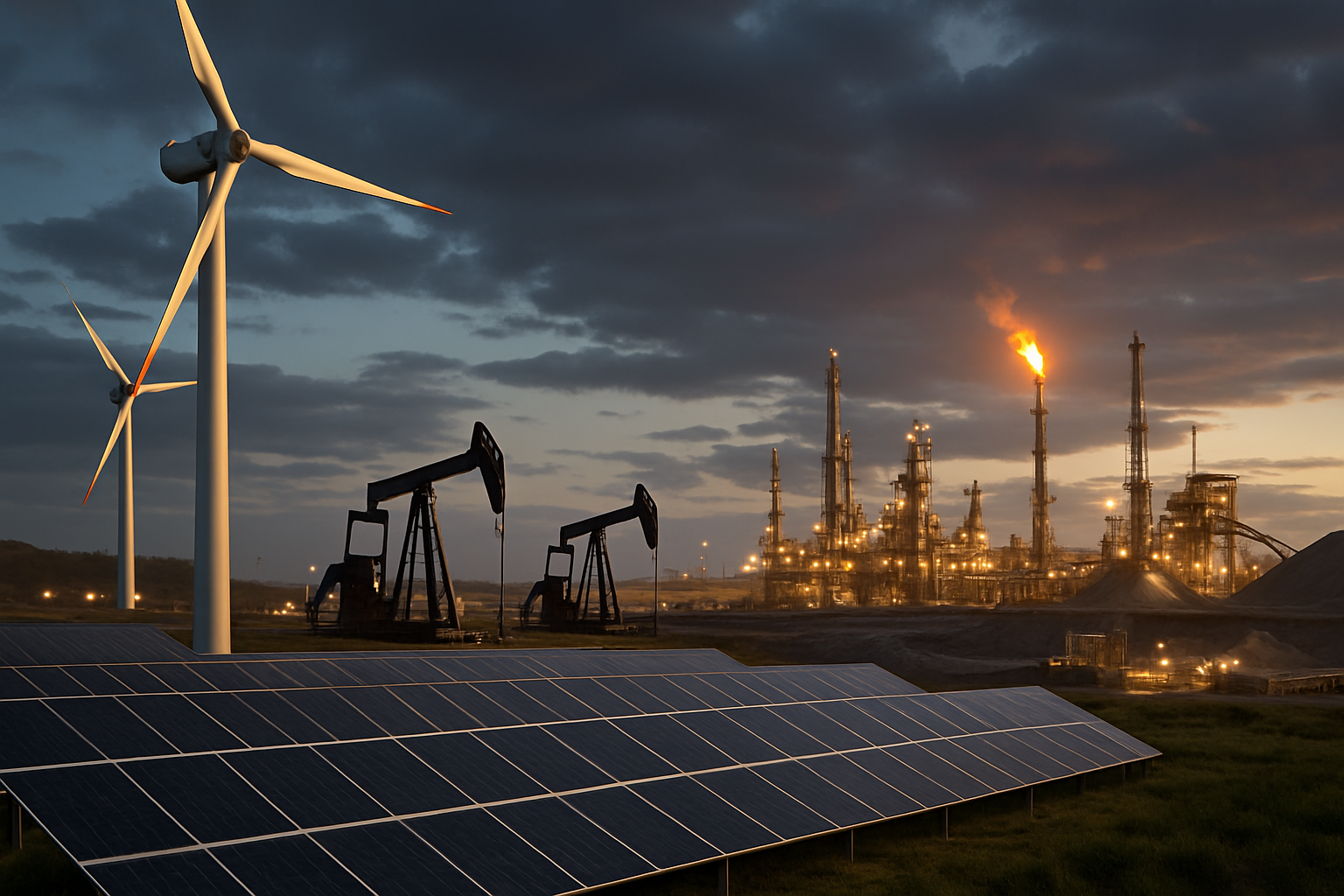
A transformative wave of energy and mining investments is reshaping the global strategic resource landscape, with major developments spanning from Afghanistan to Norway signaling unprecedented international cooperation amid supply chain diversification efforts.
Recent developments across multiple continents demonstrate the accelerating shift toward energy security and resource sovereignty. Key partnerships include German company Green International expressing interest in Afghanistan's mineral resources, bp's $3.4 billion investment in Azerbaijan's Shah Deniz gas field, and Norway's ConocoPhillips planning a massive 20 billion kroner investment in North Sea fields.
Afghanistan Emerges as Mining Investment Target
German company Green International has expressed significant interest in investing in Afghanistan's rich mineral resources following high-level meetings with officials from the Ministry of Mines and Petroleum. The discussions focused on opportunities in oil and gas extraction and processing, as well as solid and metallic mineral projects.
Meraj Mohammad Meraj, chief of staff of the Minister of Mines and Petroleum, welcomed the company's interest, stating: "Afghanistan is a mineral-rich country. The Ministry of Mines and Petroleum encourages investment from reputable international investors."
This development represents a significant shift as international companies seek to diversify their mineral supply chains amid global strategic competition. Afghanistan's vast untapped mineral wealth, estimated to be worth trillions of dollars, includes deposits of lithium, copper, iron ore, and rare earth elements crucial for renewable energy technologies.
Azerbaijan Consolidates Energy Hub Position
In a major demonstration of confidence in the South Caucasus energy corridor, bp and its partners invested approximately $3.4 billion in Azerbaijan's Shah Deniz gas field during 2025. This massive investment included $2.315 billion in operating expenditure and $1.087 billion in capital spending, largely directed toward the continued development of Shah Deniz 2.
The investment underscores Azerbaijan's strategic importance as an energy bridge between Europe and Asia. The U.S. Chamber of Commerce has identified Azerbaijan as a key regional energy coordinator, with current U.S.-Azerbaijan trade totaling $74.9 million annually but holding massive expansion potential from Azerbaijan's $27.2 billion global export capacity.
Meanwhile, Hungary has expressed interest in participating in the restoration of Azerbaijan's liberated territories while expanding cooperation in green energy projects. President of SOCAR, Rovshan Najaf, has been actively discussing joint energy projects with U.S. companies and Israeli cooperation initiatives, further cementing Azerbaijan's role as a regional energy hub.
European Energy Efficiency Leadership
Cyprus has recorded a remarkable 23.2 percent reduction in its net domestic energy use intensity over the last decade, according to Eurostat. This achievement significantly outpaces the EU average and demonstrates the effectiveness of targeted energy efficiency policies.
The figures show that the EU economy used 56.1 million terajoules of energy in 2023, representing a 4.1 percent decrease compared to the previous year. Cyprus's performance stands out as businesses and government bodies were responsible for 72.3 percent of total production activities, while household consumption accounted for the remaining 27.7 percent.
"Cyprus has demonstrated that significant energy efficiency improvements are possible through targeted policy interventions and technological adoption."
— European Commission Energy Analysis
North Sea Revival and Norwegian Investment
ConocoPhillips and its partners are planning to invest 20 billion kroner in revitalizing old North Sea fields around Ekofisk. The company sees new opportunities in the Albuskjell, Vest Ekofisk, and Tommeliten Gamma fields, representing a major vote of confidence in the long-term viability of North Sea operations.
This investment comes at a critical time when European nations are seeking to enhance energy security and reduce dependence on volatile international supplies. The North Sea remains one of Europe's most important hydrocarbon provinces, and the renewed investment signals continued confidence in traditional energy sources as part of a balanced energy portfolio.
Strategic Implications and Global Context
These developments occur against the backdrop of unprecedented global energy market transformation. Historical context reveals that this represents part of a broader $570+ billion global infrastructure surge, including major mining investments across Africa, renewable energy projects in the Caribbean, and strategic partnerships challenging China's dominance in critical minerals.
The timing is particularly significant as January 2026 was confirmed as the hottest month in recorded history, marking the 18th consecutive month exceeding 1.5°C above pre-industrial levels. This climate urgency is driving massive investments in both traditional and renewable energy sectors as nations seek to balance immediate energy security with long-term sustainability goals.
Supply Chain Diversification Imperative
Central to these investment patterns is the urgent need to diversify global supply chains. The EU has warned that climate goals are threatened by critical materials shortages, with China controlling 60% of global production and 90% of refining capacity for lithium, cobalt, and rare earth elements essential for renewable energy infrastructure.
The U.S.-EU-Japan Critical Minerals Partnership, involving 55 countries, represents a coordinated response to these vulnerabilities. African nations including Angola, DRC, Guinea, Kenya, Morocco, Sierra Leone, and Zambia are participating as alternative suppliers, while countries like Finland have launched Europe's first major lithium mining operation after a 25-year development period.
Technology Integration and Innovation
Modern energy and mining projects increasingly incorporate sophisticated technology integration including digital monitoring, smart grid management, automated efficiency systems, and renewable energy integration. Projects demonstrate the evolution from traditional extractive models toward comprehensive development strategies that benefit local populations while engaging global markets.
Environmental protection has become a prerequisite for international investment, with modern projects incorporating advanced waste management, community engagement, and renewable energy systems. This shift represents a fundamental change from reactive crisis management to proactive ecosystem service management.
Economic Multiplier Effects
The economic implications of these investments extend far beyond immediate job creation. Infrastructure development catalyzes broader economic transformation through manufacturing capabilities, technology transfer, and regional integration. Mining and energy projects create corridor effects, enabling shared processing facilities and coordinated development that maximizes investment impact across multiple countries.
Regional integration frameworks like the African Continental Free Trade Area (AfCFTA) enable cross-border mining ventures, shared infrastructure, and regional value chains. This approach represents a shift from simple resource extraction to comprehensive development models combining value addition, environmental protection, and regional integration.
Implementation Challenges and Opportunities
Despite the massive investment commitments, significant challenges remain. These include infrastructure limitations, regulatory complexity, commodity price volatility, and the need for sustained political commitment across electoral cycles. Environmental compliance, community relations, and supply chain restructuring require sophisticated project management and international cooperation.
However, the convergence of climate urgency, geopolitical competition, and technological advancement is creating unprecedented opportunities. Countries that can provide secure, transparent investment environments while maintaining high environmental and governance standards are attracting larger commitments and gaining competitive advantages.
Future Trajectory and Strategic Significance
The February 2026 investment surge represents a pivotal moment in global energy and mining development. The combination of traditional energy security concerns with renewable energy transition requirements is driving a fundamental restructuring of global supply chains and strategic partnerships.
Success in this transformation requires balancing immediate energy security needs with long-term sustainability goals through international cooperation, technological innovation, and adaptive management strategies. The projects announced and implemented during this period are likely to influence global energy and mining patterns for decades to come.
As nations navigate the complex intersection of energy security, climate commitments, and economic development, the ability to forge sophisticated international partnerships while maintaining resource sovereignty will determine success in the emerging global energy landscape. The current investment surge suggests that this balancing act is not only possible but essential for sustainable prosperity in an era of accelerating global change.