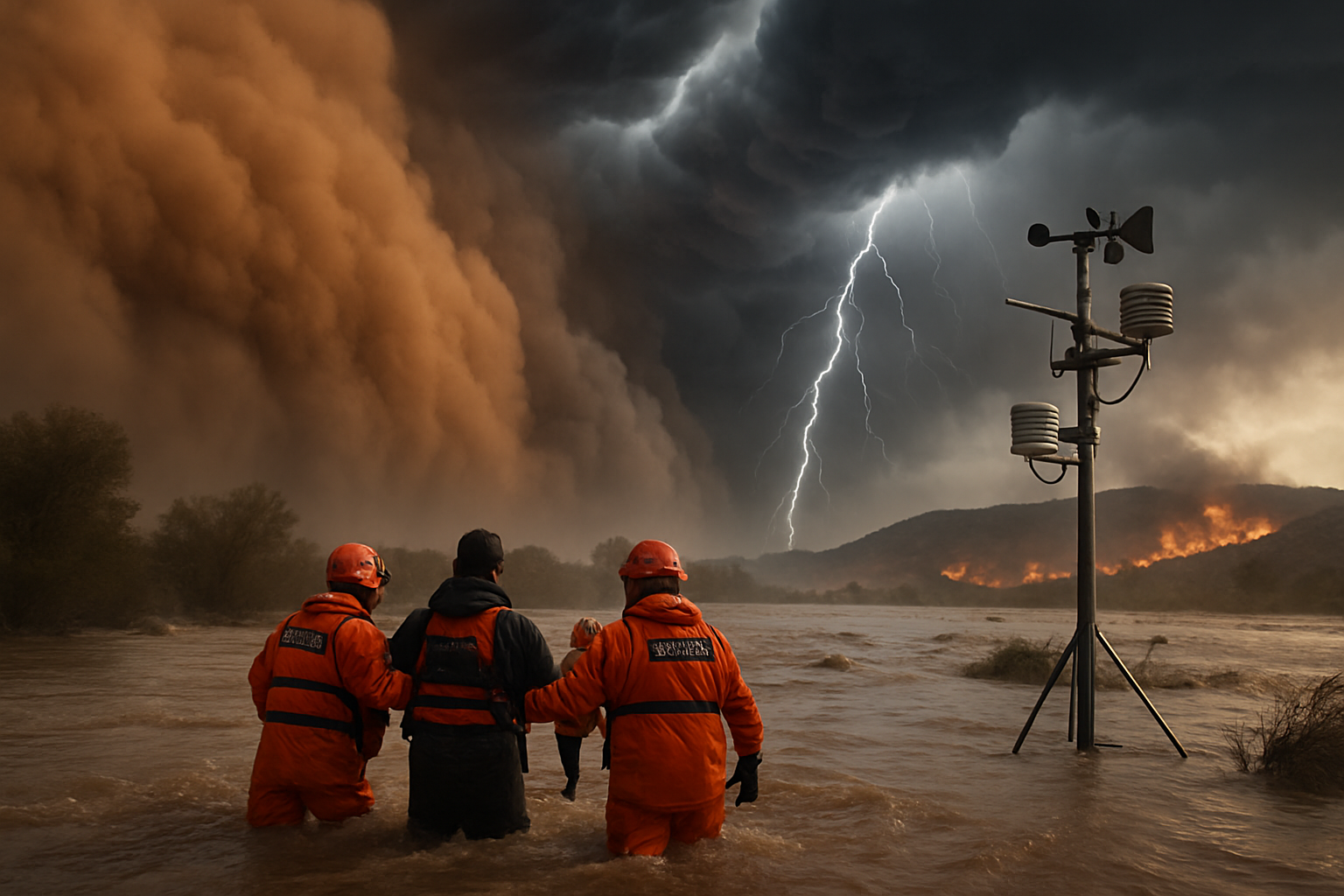
Multiple environmental crises are unfolding simultaneously across five countries as extreme weather events, conservation emergencies, and infrastructure failures converge during what appears to be the 24th consecutive month of global temperatures exceeding the critical 1.5°C pre-industrial threshold—marking the longest sustained extreme warming period in recorded human history.
From devastating sandstorms in Algeria to agricultural flooding in East Timor, the current convergence of climate disasters represents a paradigm shift from sequential regional emergencies to what scientists now term "compound disasters"—multiple environmental crises occurring simultaneously across vast geographic areas, fundamentally challenging traditional emergency response frameworks.
Algeria Faces Triple Weather Threat
Algeria's National Meteorological Office has issued emergency warnings for severe weather conditions affecting multiple southern provinces. The country is experiencing a dangerous triple threat: powerful winds exceeding 100 km/h accompanied by intense sandstorms, torrential thunderstorms producing 20mm+ rainfall in affected regions, and extreme weather volatility that has rendered traditional seasonal forecasting obsolete.
The affected provinces include Béchar, Béni Abbès, Adrar, Bordj Badji Mokhtar, In Salah, Tamanrasset, and El Oued. Meteorological services warn that the sandstorms pose severe respiratory hazards, while the combination of high winds and sudden precipitation creates dangerous flooding conditions in typically arid regions.
Jordan Confronts Atmospheric Instability
The Hashemite Kingdom is experiencing significant atmospheric disruption as relatively cool and humid air masses create unstable weather conditions. The Jordan Meteorological Department reports a notable temperature drop accompanied by intermittent rain showers, thunderstorms, and occasional hail throughout various regions.
Of particular concern is the potential for flash flooding in the northeastern desert regions, where brief but intense precipitation could overwhelm traditional drainage systems and create dangerous water accumulation in valleys and low-lying areas.
New Zealand's Conservation Emergency
In a stark illustration of the intersection between climate change and biodiversity crisis, approximately 3,000 eels were rescued from the rapidly drying Pukepuke Lagoon in the Manawatū region. The Department of Conservation and Horizon Regional Council have launched a comprehensive investigation into this environmental emergency, which highlights the increasing vulnerability of aquatic ecosystems to extreme weather fluctuations.
The rescue operation underscores New Zealand's broader struggle with climate-driven environmental disasters, building upon months of extreme weather events that have tested the nation's emergency response capabilities and conservation resources.
East Timor Agricultural Crisis
Flooding caused by heavy rainfall has devastated approximately 60 hectares of rice fields in the Laklo Administrative Post within Manatuto Municipality, directly threatening food security in a region already vulnerable to climate impacts. José Soares, Director of Agriculture for Manatuto Municipality, confirmed that several days of intense precipitation caused water levels to rise dramatically, inundating rice production areas critical to local food systems.
This agricultural disaster represents more than immediate crop losses—it exemplifies how extreme weather events disproportionately impact food security in developing nations, where agricultural systems often lack the resilience infrastructure necessary to withstand increasingly unpredictable climate patterns.
Emergency Response Evolution
The simultaneous nature of these environmental crises exposes critical weaknesses in global emergency response systems. Traditional mutual aid mechanisms, designed for sequential regional disasters, prove inadequate when multiple continents face emergencies concurrently.
The Australian Fire Emergency Services Authority (AFAC) has identified this shift toward "compound disasters" as a fundamental challenge requiring entirely new approaches to resource allocation and international coordination. Emergency services are operating at or beyond capacity limits globally, while transportation networks, power grids, and communication systems designed for historical climate patterns repeatedly fail when extreme weather exceeds their operational parameters.
Climate Science Context
These events unfold against the backdrop of unprecedented global warming. January 2026 remains the hottest month on record, extending a warming streak that has completely overridden natural climate variability, including La Niña cooling effects that would typically moderate temperatures.
The World Meteorological Organization indicates a 50-60% probability of El Niño development between July and September 2026, which could drive temperatures into unprecedented territory by combining baseline warming with natural cycle amplification. This "climate volatility paradox" enables simultaneous global heat records and devastating regional extremes through disrupted atmospheric circulation and polar vortex patterns.
Conservation Renaissance Amid Crisis
Despite the mounting challenges, a global conservation renaissance is emerging, characterized by unprecedented international coordination and technological innovation. Recent successes demonstrate that well-designed programs can achieve remarkable results even under extreme environmental stress.
The integration of cutting-edge technology—including environmental DNA sampling, satellite monitoring, and AI-powered threat detection—with traditional ecological knowledge and community-based management represents a fundamental evolution in conservation methodology. This synthesis creates comprehensive frameworks that combine scientific rigor with cultural sensitivity and community ownership.
Economic and Social Implications
The economic devastation extends far beyond immediate emergency response costs. Agricultural operations face billions in losses as extreme weather destroys crops and disrupts supply chains during critical growing seasons. Tourism industries confront extended cancellations and infrastructure damage during peak revenue periods.
Recovery timelines have fundamentally shifted from weeks to months or years, representing a permanent change in disaster response approaches. The concept of "building back better" has evolved from an optional enhancement to an essential survival strategy for communities facing permanent climate volatility.
International Cooperation Under Strain
Environmental challenges transcend political boundaries as atmospheric systems and ocean currents operate regardless of borders. The simultaneity of current disasters is testing cooperation mechanisms that were developed assuming stable regions could assist others during isolated emergencies.
Traditional frameworks require fundamental restructuring to address the reality of multiple continents facing disasters concurrently. Success demands unprecedented international cooperation, enhanced multi-sector coordination, and sustained financial commitments recognizing environmental protection as essential infrastructure rather than regulatory burden.
Critical Action Window
Environmental scientists warn that the window for effective climate action is narrowing rapidly as ecological systems approach critical thresholds that could trigger irreversible changes affecting global food security, climate stability, and human settlements.
The convergence of extreme weather, infrastructure vulnerabilities, and emergency response limitations underscores the urgent need for coordinated international action. Current conditions provide a preview of routine circumstances in the 2030s without comprehensive climate adaptation investment.
Technology and Tradition Integration
Successful responses consistently demonstrate sophisticated integration of cutting-edge technology with traditional ecological knowledge and community management. Advanced monitoring systems—including satellite imagery, environmental DNA sampling, and AI analysis—provide rapid threat assessment capabilities, but they require community engagement and local expertise for maximum effectiveness.
This hybrid approach offers resilience through multiple pathways for addressing complex, interconnected challenges. The synthesis represents a maturation of environmental protection strategies beyond purely technological or traditional approaches toward comprehensive frameworks.
Strategic Significance
April 2026 represents a watershed moment in global environmental protection—a critical choice between reactive crisis management and transformative infrastructure adaptation. The tools, knowledge, and cooperation frameworks exist for comprehensive environmental protection, but success depends on unprecedented speed of coordination and sustained international cooperation.
Additional weather systems are developing in the Atlantic and Pacific regions, and the persistence of crisis conditions may establish a "new normal" of extreme weather frequency and intensity that permanently challenges traditional frameworks.
The fundamental question facing humanity is whether we can organize and implement solutions rapidly enough to maintain planetary habitability during Earth's most environmentally challenging period in recorded history. The choices made in the coming months will prove decisive for global climate resilience strategies affecting generations to come.