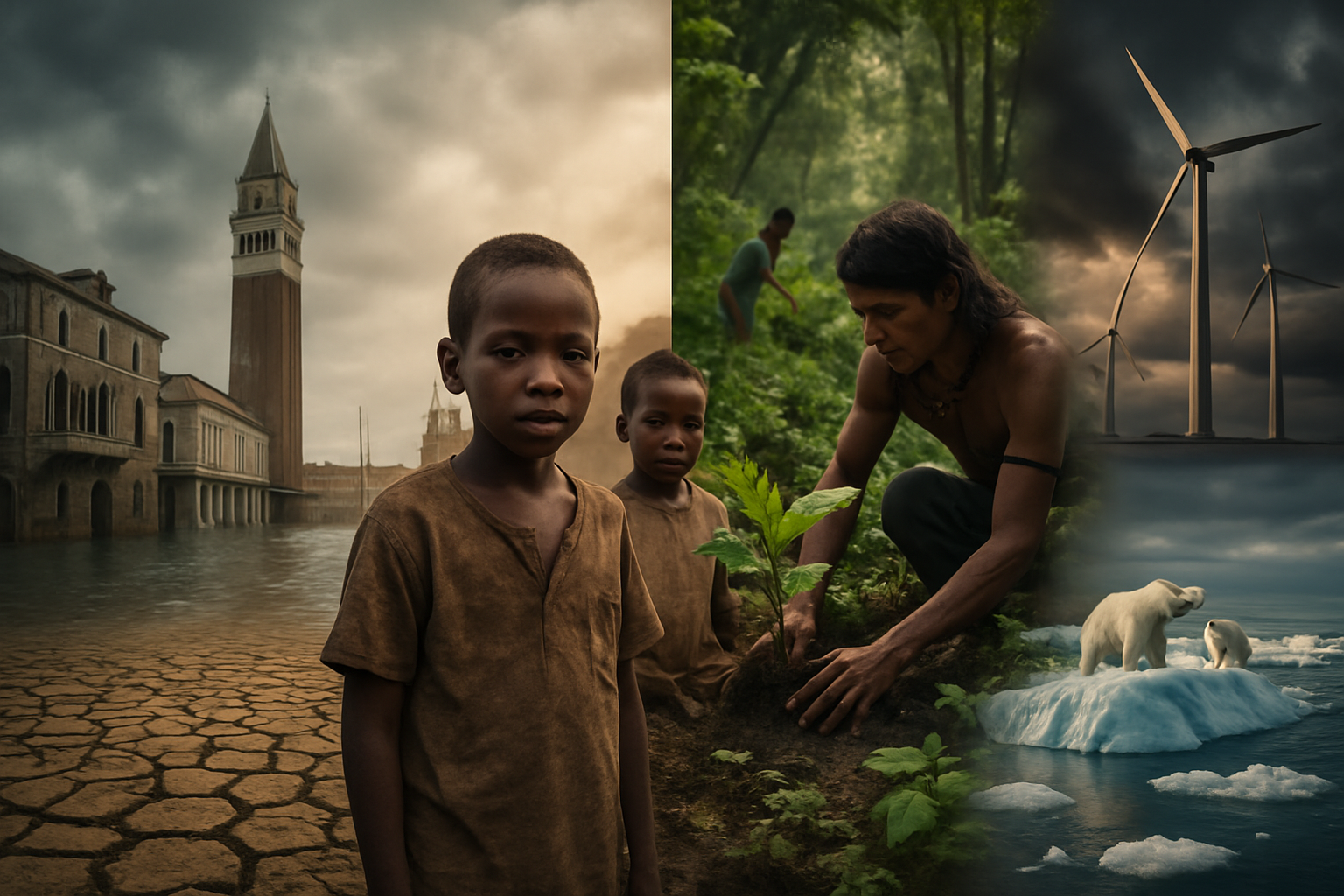
As the world marks its 23rd consecutive month of temperatures exceeding the critical 1.5°C pre-industrial threshold—the longest sustained extreme warming in recorded human history—nine countries across four continents are simultaneously confronting environmental crises that reveal both the accelerating pace of climate change and humanity's evolving response to planetary threats.
From research teams proposing radical solutions to save Venice from rising seas to community-led reforestation projects in Uganda, the current environmental landscape presents a stark dichotomy: unprecedented challenges coupled with remarkable innovation in conservation efforts.
Venice's Existential Crisis
Austrian researchers have unveiled four potential scenarios for Venice's survival, including the previously unthinkable option of relocating the historic city entirely. The study, published amid mounting concerns over accelerating sea-level rise, represents the sobering reality facing coastal cities worldwide as traditional flood defenses prove increasingly inadequate.
The research comes as Dutch scientists revealed that global sea levels have been systematically underestimated by 30 centimeters to one full meter over the past 15 years, potentially affecting up to 132 million people worldwide who face greater coastal threats than previously calculated.
Africa's Environmental Paradox
In the Democratic Republic of Congo, a startling statistic has emerged: approximately 56 million children—nearly half the country's population—now live in areas exposed to climate change risks, according to the Ministry of Environment's Direction of Sustainable Development.
Yet across the continent, innovative conservation efforts are flourishing. In Uganda, Absa Bank has launched an ambitious school greening initiative aimed at planting 700,000 trees across 300 schools in Northern Uganda, targeting the growth of 2 million indigenous, fruit, shade, and medicinal trees over the next three years.
Botswana presents a contrasting narrative of environmental resilience, with rising river levels in Chobe National Park bringing new life to floodplains as Zambezi River overflow pushes water downstream through the park's channels, revitalizing the Satau floodplains ecosystem.
Extreme Weather Testing Global Response Systems
The simultaneous nature of current environmental challenges is overwhelming traditional disaster response mechanisms. In Canada, flooding has forced a state of emergency to continue on Manitoulin Island, Ontario, while Sweden faces mounting insurance costs exceeding one billion kronor from Storm Johannes damage alone.
New Zealand meteorologists are tracking severe weather systems with 150mm of rain and possible thunderstorms threatening parts of the South Island, as the country grapples with increasingly complex weather patterns that test emergency response capabilities nationwide.
"The reality is that we're seeing compound disasters—multiple emergency types occurring simultaneously across vast geographic areas, fundamentally challenging traditional resource allocation and mutual aid mechanisms."
— Emergency Management Expert, Australian Fire and Emergency Services Authority
The Conservation Renaissance
Despite mounting challenges, 2026 has witnessed what experts term a "global conservation renaissance," characterized by unprecedented coordination between scientific innovation, community engagement, and international cooperation.
In São Tomé and Príncipe, centuries-old Gabonese animist traditions are being revived to protect coastlines, with worshippers presenting offerings to sea spirits off the coast of Pointe-Denis. This represents the sophisticated synthesis of traditional ecological knowledge with modern conservation efforts that is becoming increasingly common worldwide.
Sweden demonstrates this integration through climate marches led not by young activists, but by elderly citizens expressing concern for future generations. "There's a risk that grandchildren will inherit a very complicated world to manage," says 78-year-old participant Lena, encapsulating the intergenerational urgency driving current environmental movements.
Technology and Traditional Knowledge Integration
Successful environmental protection initiatives increasingly demonstrate sophisticated synthesis of cutting-edge technology with traditional ecological knowledge and community-based management. Environmental DNA sampling, satellite monitoring, and AI-powered analysis are being combined with generations of indigenous wisdom to create comprehensive frameworks that respect cultural sensitivity while leveraging global technological capabilities.
This evolution represents a fundamental departure from purely technological or traditional approaches toward integrated strategies that combine scientific rigor with community ownership and cultural understanding.
Economic Implications and Opportunities
Environmental protection is increasingly recognized as an economic development strategy rather than a regulatory burden. Countries implementing comprehensive environmental protection consistently demonstrate greater economic resilience and attract sustainable investment across multiple sectors including eco-tourism, environmental technology manufacturing, and green services.
Economic analyses reveal that ecosystem services from intact natural systems often provide greater long-term value than resource extraction activities. Wetlands prevent billions in flood damage, forests regulate water and climate patterns, while biodiversity hotspots support pharmaceutical research and eco-tourism worth hundreds of billions annually.
International Cooperation Under Strain
The simultaneity of current environmental crises is testing international cooperation mechanisms designed for sequential rather than concurrent global disasters. Traditional mutual aid frameworks, where stable regions assist those facing isolated emergencies, are proving inadequate when multiple continents face simultaneous challenges.
Environmental challenges transcend political boundaries through ocean currents, atmospheric systems, and species migrations, making unilateral conservation efforts insufficient. Success requires unprecedented coordination through shared monitoring systems, collaborative enforcement, and innovative financing that recognizes ecosystem services as essential economic infrastructure.
The Critical Action Window
Environmental scientists warn that the window for effective climate action is narrowing rapidly as ecological systems approach critical thresholds that could trigger irreversible changes affecting global food security, climate stability, and human settlements.
The choice between reactive crisis management and proactive ecosystem service management has become increasingly critical. Current conditions provide a preview of routine circumstances expected by the 2030s without comprehensive climate adaptation investment.
Looking Forward: Transformation or Crisis
The convergence of environmental challenges across multiple continents in 2026 represents a potential watershed moment for global environmental protection. The tools, knowledge, and cooperation frameworks exist for comprehensive environmental protection, but success depends on unprecedented speed and coordination through sustained international cooperation and enhanced political commitment.
As additional weather systems develop across Atlantic and Pacific regions, the persistence of current crisis conditions may establish a "new normal" characterized by extreme weather frequency and intensity that permanently challenges traditional emergency response frameworks.
The fundamental question remains whether humanity can organize and implement solutions rapidly enough to maintain planetary habitability during what many scientists describe as Earth's most environmentally challenging period in recorded history.
"We're at a decisive moment where the choices made in the coming months will determine climate resilience strategies for generations to come. The integration of cutting-edge technology with traditional ecological wisdom offers pathways to maintaining planetary habitability, but it requires immediate, coordinated global action of maximum urgency."
— International Climate Research Consortium