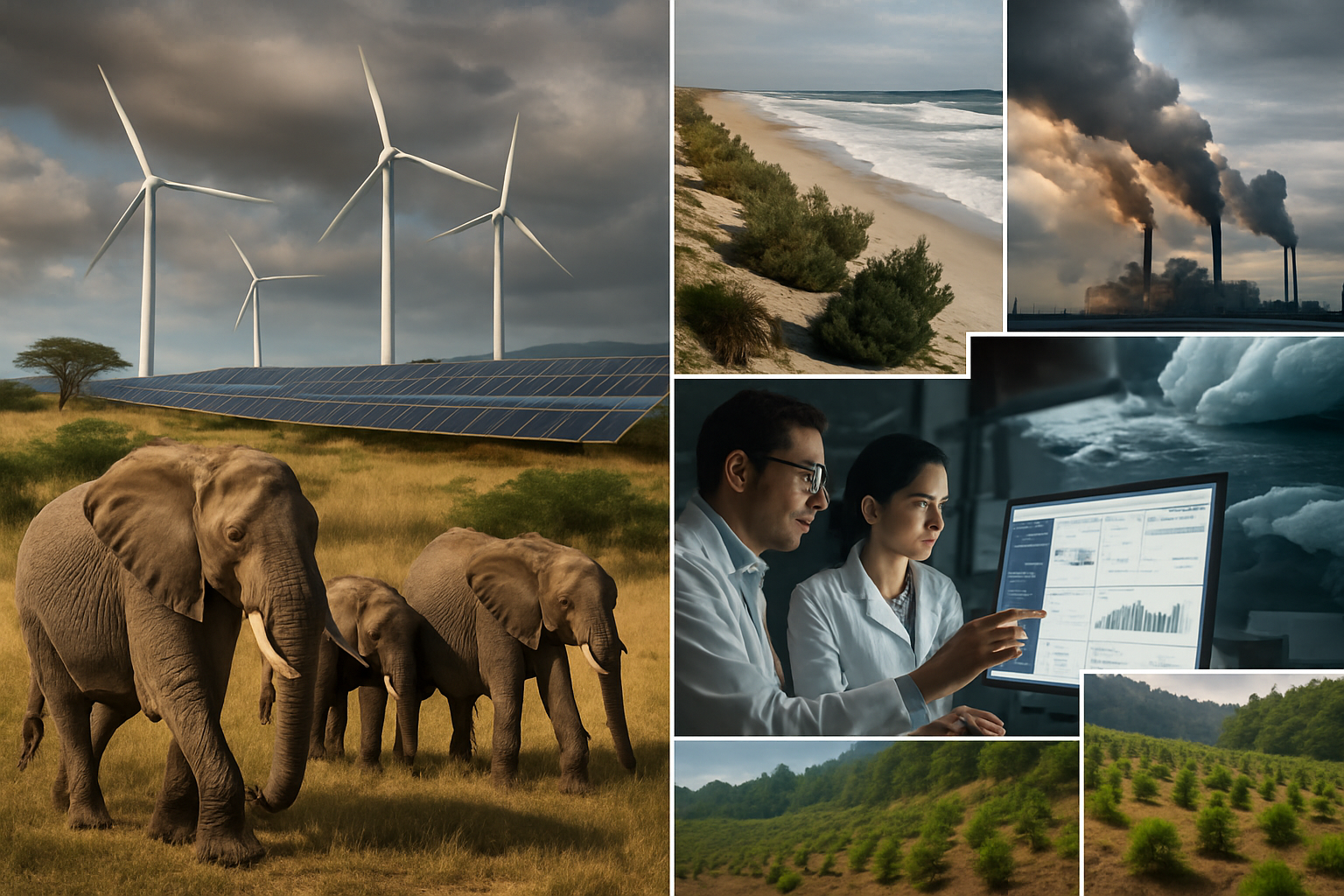
A coordinated surge in environmental initiatives across three continents demonstrates unprecedented global momentum in addressing climate challenges, with Cameroon launching Africa's first national waste exchange, Chile rediscovering endangered species after decades, and Pakistan mobilizing integrated climate-nutrition action amid escalating environmental pressures.
From the establishment of groundbreaking waste management systems in Central Africa to wildlife conservation breakthroughs in South America and comprehensive climate adaptation frameworks in South Asia, February 2026 marks a pivotal moment in global environmental protection efforts. These initiatives emerge during the 18th consecutive month of global temperatures exceeding 1.5°C above pre-industrial levels, underscoring the urgency driving coordinated international environmental action.
Cameroon's Revolutionary Waste Management Framework
Cameroon has positioned itself at the forefront of African environmental innovation with the official launch of its National Waste Exchange on February 12, 2025, in Yaoundé. Sylvie Rebecca Essomba, Director General of the National Waste Exchange, emphasized the institution's readiness across governance, human resources, and political dimensions, declaring that "our national policies are mobilizing."
The exchange represents a paradigm shift from traditional waste disposal to systematic circular economy approaches, treating waste as a valuable resource rather than a burden. "We want to bring together all these waste handlers around a unique and innovative tool that ensures waste will be seen differently," Essomba explained, highlighting the market-based approach where waste supply and demand converge.
This initiative reflects broader African environmental leadership documented throughout 2026, building on successful models from Indonesia's biological waste processing programs and Saint Vincent's marine conservation partnerships. The waste exchange demonstrates sophisticated technology-tradition integration, combining modern market mechanisms with community-based resource management practices that have sustained African societies for generations.
Chile's Biodiversity Conservation Triumph
In a remarkable conservation milestone, Chile's National Forest Corporation (CONAF) Los Ríos and the Darwin's Frog NGO achieved the first official documentation of Darwin's frog (Rhinoderma darwinii) in over three decades at the Mocho Choshuenco National Reserve. This extraordinary sighting provides crucial hope for one of the world's most unique amphibian species, famous for the male's remarkable brooding behavior where tadpoles develop in the father's vocal sac.
The rediscovery represents more than scientific achievement—it demonstrates the effectiveness of sustained conservation efforts and international cooperation. The Darwin's frog, endemic to Chilean and Argentine forests, has faced severe population declines due to habitat destruction, climate change, and the devastating chytrid fungus that has decimated amphibian populations globally.
Dr. Claudio Soto-Azat from Universidad Andrés Bello, who leads Darwin's frog conservation efforts, emphasized the significance: "This finding gives us renewed hope and confirms that our conservation strategies, including habitat protection and captive breeding programs, are yielding results." The reserve's diverse ecosystem, spanning from temperate rainforests to Andean highlands, provides essential habitat connectivity crucial for species recovery.
Pakistan's Integrated Climate-Nutrition Framework
Pakistan has emerged as a leader in comprehensive climate adaptation through the landmark stakeholder dialogue "From Policy to Practice – Advancing Integrated Climate, Nutrition and Food Security Action in Pakistan." Hosted by the Pakistan Food System Transformation Secretariat (PFSTS) at the Pakistan Agricultural Research Council (PARC) in collaboration with the Global Alliance for Improved Nutrition (GAIN), this initiative addresses Pakistan's position among the world's most climate-vulnerable nations.
The dialogue brought together senior representatives from government ministries, development partners, academia, and technical experts to advance coordinated approaches at the critical intersection of climate change, nutrition, and food security. With Pakistan facing recurrent floods, droughts, and extreme weather events that disrupt food systems and exacerbate malnutrition, the integrated framework represents essential adaptation strategy.
Average annual disaster-related losses estimated at USD 2 billion—with 83% attributed to floods—underscore the urgent need for resilient solutions. The framework emphasizes community-based adaptation, recognizing that local knowledge systems combined with modern climate science provide the most effective responses to environmental challenges.
"The challenge for 2026 is not to identify the problem, but to assume responsibility for solving it."
— Climate Policy Expert, Regional Environmental Conference
Technology-Community Integration Models
These initiatives demonstrate sophisticated synthesis of cutting-edge technology with traditional ecological knowledge and community-based management. Cameroon's waste exchange combines digital monitoring systems with established community resource management practices. Chile's conservation success integrates environmental DNA technology, camera traps, and satellite monitoring with indigenous forest stewardship knowledge spanning generations.
Pakistan's approach exemplifies this integration through combining advanced meteorological forecasting, drought-resistant crop varieties, and precision agriculture techniques with traditional farming wisdom and community-based disaster preparedness systems developed over centuries of adaptation to variable climate conditions.
Economic Development Through Environmental Protection
Contrary to traditional perceptions of environmental protection as economic constraint, these programs demonstrate conservation as economic development strategy. Cameroon's waste exchange creates employment in waste processing, biotechnology, and environmental services while reducing waste management costs and improving public health outcomes.
Chile's biodiversity conservation enhances the nation's eco-tourism appeal, attracts sustainable development investment, and positions the country as a regional environmental leader. The Mocho Choshuenco region's tourism potential significantly increases with confirmed presence of rare species, creating sustainable income opportunities for local communities.
Pakistan's integrated climate framework addresses food security while building resilience that protects agricultural investments, reduces disaster recovery costs, and creates opportunities in climate-adaptive agriculture, renewable energy, and environmental services sectors.
Global Climate Urgency Context
These developments occur during unprecedented global environmental conditions. January 2026 marked the hottest month in recorded history, extending an extraordinary streak of 18 consecutive months exceeding 1.5°C above pre-industrial levels. This persistent warming demonstrates human-induced climate change overriding natural climate variability, including La Niña cooling effects that typically moderate global temperatures.
The environmental initiatives across Cameroon, Chile, and Pakistan represent sophisticated responses to accelerating climate pressures. Traditional conservation approaches proved insufficient for the speed and scale of current environmental challenges, driving innovation in integrated solutions that address multiple environmental pressures simultaneously.
International Cooperation Evolution
Success factors across all three initiatives include enhanced international cooperation, knowledge sharing, and innovative financing mechanisms. Cameroon's waste exchange benefits from South-South cooperation with successful Asian circular economy models. Chile's conservation work leverages international research partnerships and funding from global biodiversity protection initiatives.
Pakistan's framework exemplifies multilateral cooperation, combining domestic expertise with international technical assistance, climate finance, and knowledge transfer from nations facing similar climate vulnerabilities. This represents evolution from traditional North-South aid relationships toward more equitable partnerships recognizing developing nations as environmental solutions providers.
Implementation Challenges and Solutions
Despite successes, all initiatives face common challenges including funding sustainability, technical capacity building requirements, and climate change disruption of project timelines requiring adaptive management approaches. However, the diversity of approaches provides resilience against single-solution dependencies.
Cameroon addresses funding challenges through innovative market mechanisms that make waste management financially self-sustaining. Chile ensures long-term conservation success through combining government commitment, international partnerships, and community engagement creating multiple sources of support and expertise.
Pakistan's integrated approach reduces dependency on external funding by creating economic opportunities that make climate adaptation financially viable for communities while building institutional capacity for sustained implementation.
Strategic Significance for Global Environmental Action
The February 2026 environmental conservation surge represents fundamental evolution in global environmental protection strategy. Coordination across waste management innovation, wildlife conservation excellence, and climate adaptation frameworks demonstrates the sophisticated multi-sector approach required for effective environmental action during accelerating climate change.
These initiatives provide templates for scaling environmental protection globally through direct conservation action, community engagement, technological innovation, and international cooperation. Success across diverse geographic, economic, and political contexts demonstrates that effective environmental protection is achievable when combining immediate action with long-term sustainability strategies.
Future Implications
The window for effective environmental action continues narrowing as ecological systems approach critical thresholds. However, the tools and knowledge exist for comprehensive environmental protection, as demonstrated by coordinated responses across Cameroon, Chile, and Pakistan.
Success depends on sustained international cooperation, enhanced coordination across sectors and scales, and increased financial commitments recognizing environmental protection as essential infrastructure for human prosperity and planetary sustainability. The coordinated environmental response emerging in February 2026 may prove decisive for whether conservation can keep pace with environmental change during this critical decade for climate action.
These developments represent hope that humanity possesses both the knowledge and capacity to address environmental challenges at the required scale and speed. The combination of innovative technology, traditional wisdom, community engagement, and international cooperation offers a pathway toward sustainable environmental protection that serves both human communities and planetary ecosystems.