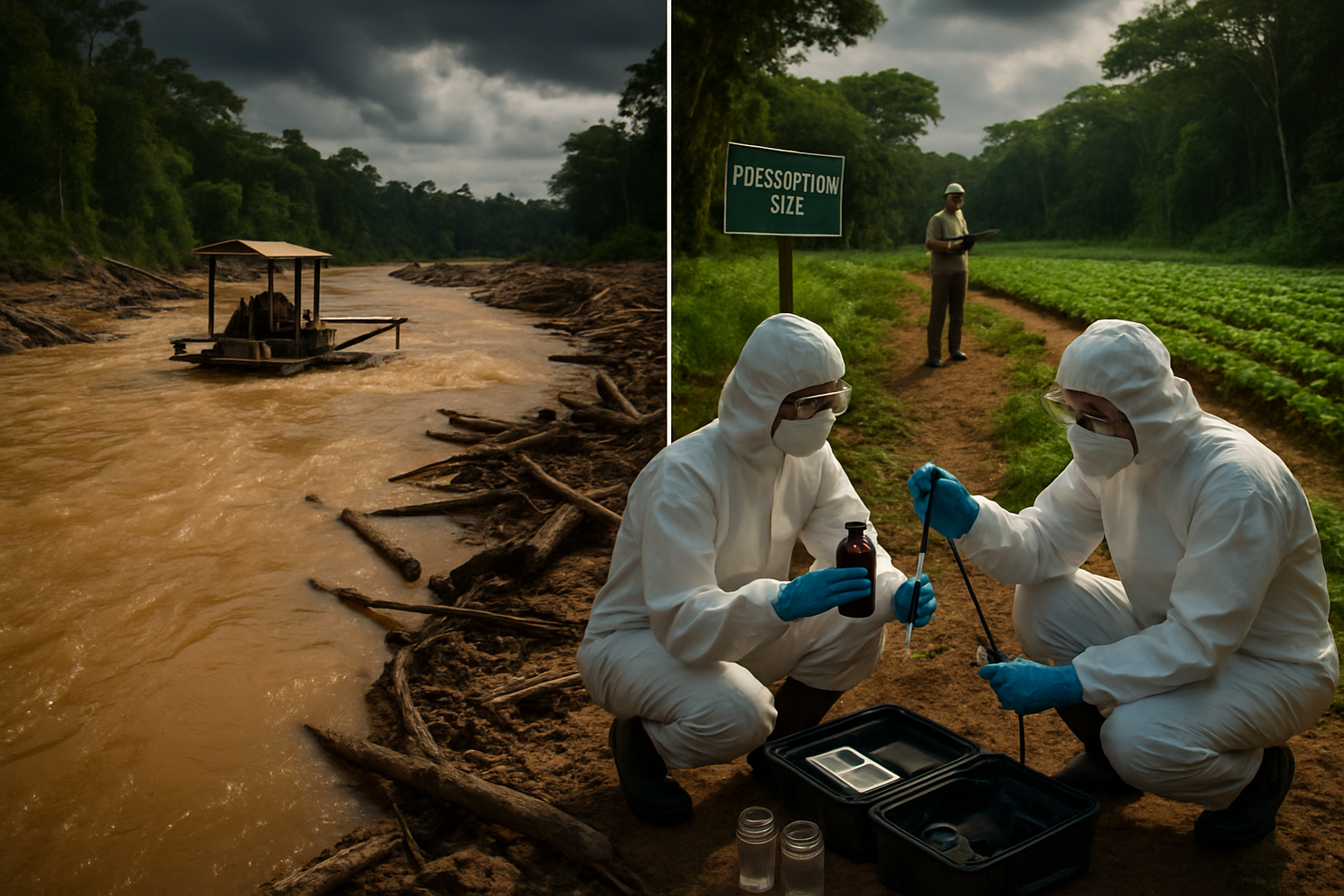
As Ghana celebrates robust economic indicators and rising gold exports, its rivers run brown with the toxic legacy of illegal mining. This stark paradox encapsulates a global environmental crisis where nations worldwide struggle to balance immediate economic needs against long-term ecological survival—often with devastating consequences for both.
A comprehensive Planet News investigation across four nations reveals the deepening chasm between environmental protection rhetoric and on-ground reality, as conservation efforts race against accelerating ecological collapse amid the hottest January on record and unprecedented climate pressures.
Ghana: Economic Success Built on Environmental Betrayal
Ghana's macroeconomic charts paint a picture of recovery and resilience. Growth projections stabilize, gold exports remain robust, and fiscal narratives speak of renewed investor confidence. Yet venture to the banks of the Pra, Ankobra, Offin, or Birim rivers, and the brown waters tell a different story entirely.
The illegal mining practice known as "galamsey" has transformed what environmental experts describe as a "biochemical assault" on the nation's water resources. This is not merely environmental damage—it represents systematic poisoning of ecosystems that millions depend upon for survival.
"The question is no longer whether galamsey is destructive. That debate has long expired. The question now is: have we normalized environmental betrayal and only focused on economic optics?"
— Environmental Analysis, MyJoyOnline
The contamination extends beyond immediate health risks. Rivers that once supported fishing communities and agricultural irrigation now require extensive treatment before any use. The economic cost of this environmental destruction—factoring in healthcare expenses, agricultural losses, and water treatment infrastructure—threatens to dwarf the short-term gains from gold extraction.
Nepal's Climate Vulnerability: Himalayan Meltdown Accelerates
Despite contributing merely 0.1 percent of global greenhouse gas emissions, Nepal has become one of the world's most climate-vulnerable nations. The Himalayan nation now serves as a living battlefield demonstrating how climate change disproportionately impacts countries least responsible for the crisis.
Temperature data reveals alarming trends: the Himalayan region has warmed approximately 0.05°C per decade over the past four decades. This seemingly small increase has triggered catastrophic changes, with nearly 25 percent of Nepal's glaciers disappearing between 1980 and 2010.
The consequences extend far beyond statistics. Melting ice now reveals decades of accumulated waste and human remains, severely polluting water sources for downstream mountain communities. The risk of Glacial Lake Outburst Floods (GLOFs) has increased dramatically, threatening entire valleys with sudden devastating floods.
As observed by our correspondent reporting from Nepal, "rapidly melting glaciers, irregular rainfall, and devastating landslides—all combined, Nepal's nature stands at a critical juncture." The nation's geographical position has transformed it into an unwilling laboratory for climate change impacts, providing crucial early warnings for global mountain ecosystems.
Conservation Success Stories Amid Crisis
While environmental destruction accelerates in some regions, innovative conservation initiatives demonstrate what's possible with coordinated action and community engagement.
Belize: International Cooperation in Action
The Ya'axché Conservation Trust's collaboration with the Food and Agriculture Organization of the United Nations exemplifies effective international conservation partnerships. The "Mainstreaming Biodiversity in Belize's Maya Golden Landscape" project demonstrates how global expertise can strengthen local conservation efforts.
The two-day mission by FAO delegates, including representatives from Jamaica, the Bahamas, and Belize, focused on sustainable agroforestry farms that simultaneously support biodiversity conservation and community livelihoods. This integrated approach addresses both environmental protection and economic development—a crucial balance often missing in conservation efforts.
Key initiatives include expanding the beekeeping sector, developing sustainable non-timber forest products, and creating economic incentives for forest conservation. The project's success lies in its recognition that environmental protection must provide tangible benefits to local communities to ensure long-term sustainability.
Antigua and Barbuda: Emergency Response to Environmental Threats
The Caribbean nation's response to landfill contamination demonstrates both the challenges and potential solutions in environmental crisis management. When contaminants from the Cooks Sanitary Landfill began seeping into Hermitage Bay, the National Office of Disaster Services (NODS) activated emergency protocols in coordination with multiple agencies.
The incident highlights the vulnerability of small island developing states to environmental contamination, where limited land area means that pollution incidents can quickly threaten entire ecosystems and communities. However, the rapid coordinated response also demonstrates the effectiveness of prepared emergency frameworks.
The corrective action plan, developed in accordance with the National Marine Pollution Manual, represents a comprehensive approach involving environmental monitoring, containment measures, and long-term remediation strategies.
The Climate-Conservation Nexus
January 2026's designation as the hottest month in recorded history—marking the 18th of the past 19 months exceeding 1.5°C above pre-industrial levels—provides crucial context for understanding current environmental pressures. This unprecedented warming trend overrides natural climate variability, creating additional stress on already vulnerable ecosystems.
The convergence of climate change and environmental degradation creates compound threats that traditional conservation approaches struggle to address. Ghana's river pollution becomes more dangerous as climate change reduces water availability, making contaminated sources more critical for communities. Nepal's glacier melt accelerates as global temperatures rise, multiplying flood risks and water security challenges.
Economic Dimensions of Environmental Protection
The economic implications of environmental degradation extend far beyond immediate cleanup costs. Ghana's river contamination threatens tourism revenue, agricultural productivity, and public health expenditures. Nepal's climate vulnerability undermines agricultural stability and infrastructure development, while increasing disaster response costs.
Conversely, successful conservation initiatives demonstrate environmental protection as an economic development strategy. Belize's sustainable agroforestry creates employment while preserving biodiversity. Antigua's emergency response systems protect critical tourism infrastructure and maintain investor confidence.
Analysis from our extensive environmental conservation coverage reveals that nations implementing comprehensive environmental protection demonstrate greater economic resilience and attract sustainable development investment. The correlation between environmental health and economic stability becomes increasingly clear as climate pressures intensify.
Challenges in Implementation
Despite growing awareness and international cooperation, significant obstacles impede effective environmental conservation. Funding sustainability remains particularly challenging for developing nations, where immediate economic pressures often override long-term environmental considerations.
Technical capacity building requires sustained investment in education, training, and institutional development. Ghana's struggle with illegal mining enforcement illustrates how inadequate regulatory capacity undermines environmental protection despite legal frameworks.
Climate change itself disrupts conservation project timelines and operational conditions, requiring adaptive management approaches that can respond to rapidly changing environmental conditions. Nepal's experience demonstrates how traditional conservation strategies may prove inadequate for climate-amplified environmental pressures.
Technology and Traditional Knowledge Integration
Successful environmental protection increasingly requires sophisticated synthesis of cutting-edge technology with traditional conservation knowledge and community-based management. Belize's approach combines scientific research with traditional ecological knowledge, creating more robust and culturally appropriate conservation strategies.
Remote sensing, satellite tracking, and environmental monitoring technologies provide real-time data supporting immediate threat response and strategic planning. However, technology alone proves insufficient without community engagement and traditional ecological knowledge systems that have sustained environmental management for generations.
International Cooperation: Essential but Insufficient
The transnational nature of environmental challenges demands unprecedented international cooperation. Ocean currents, air pollution, and climate systems cross boundaries, making unilateral efforts insufficient regardless of their sophistication.
FAO's collaboration with Belize exemplifies effective international partnerships that combine global expertise with local implementation capacity. However, such cooperation remains limited in scale relative to the magnitude of global environmental challenges.
The disconnect between global environmental threats and fragmented response mechanisms creates dangerous gaps in protection coverage. While individual initiatives demonstrate remarkable success, the cumulative impact remains insufficient to address accelerating environmental degradation globally.
Looking Forward: Critical Decisions Ahead
Environmental conservation stands at a critical juncture where the window for effective action continues narrowing rapidly. The contrast between Ghana's economic celebration and environmental destruction illustrates the fundamental choice facing nations worldwide: short-term economic gains versus long-term survival.
Success stories from Belize and emergency responses in Antigua demonstrate that effective environmental protection is achievable with proper coordination, adequate resources, and sustained political commitment. However, scaling these successes globally requires fundamental shifts in how nations prioritize environmental protection relative to immediate economic pressures.
The acceleration of climate change, documented through consecutive monthly temperature records, creates additional urgency for environmental protection efforts. Traditional approaches may prove inadequate for the speed and scale of current environmental challenges, requiring innovative solutions that integrate economic development with environmental protection rather than treating them as competing priorities.
As our investigation reveals, the tools and knowledge exist for effective environmental protection. The critical question is whether political will, economic incentives, and international cooperation can align rapidly enough to prevent irreversible environmental damage that would affect global food security, climate stability, and human prosperity for generations.
The choice between Ghana's brown rivers and Belize's sustainable landscapes represents more than national environmental policy—it reflects humanity's fundamental decision about what kind of planet future generations will inherit.