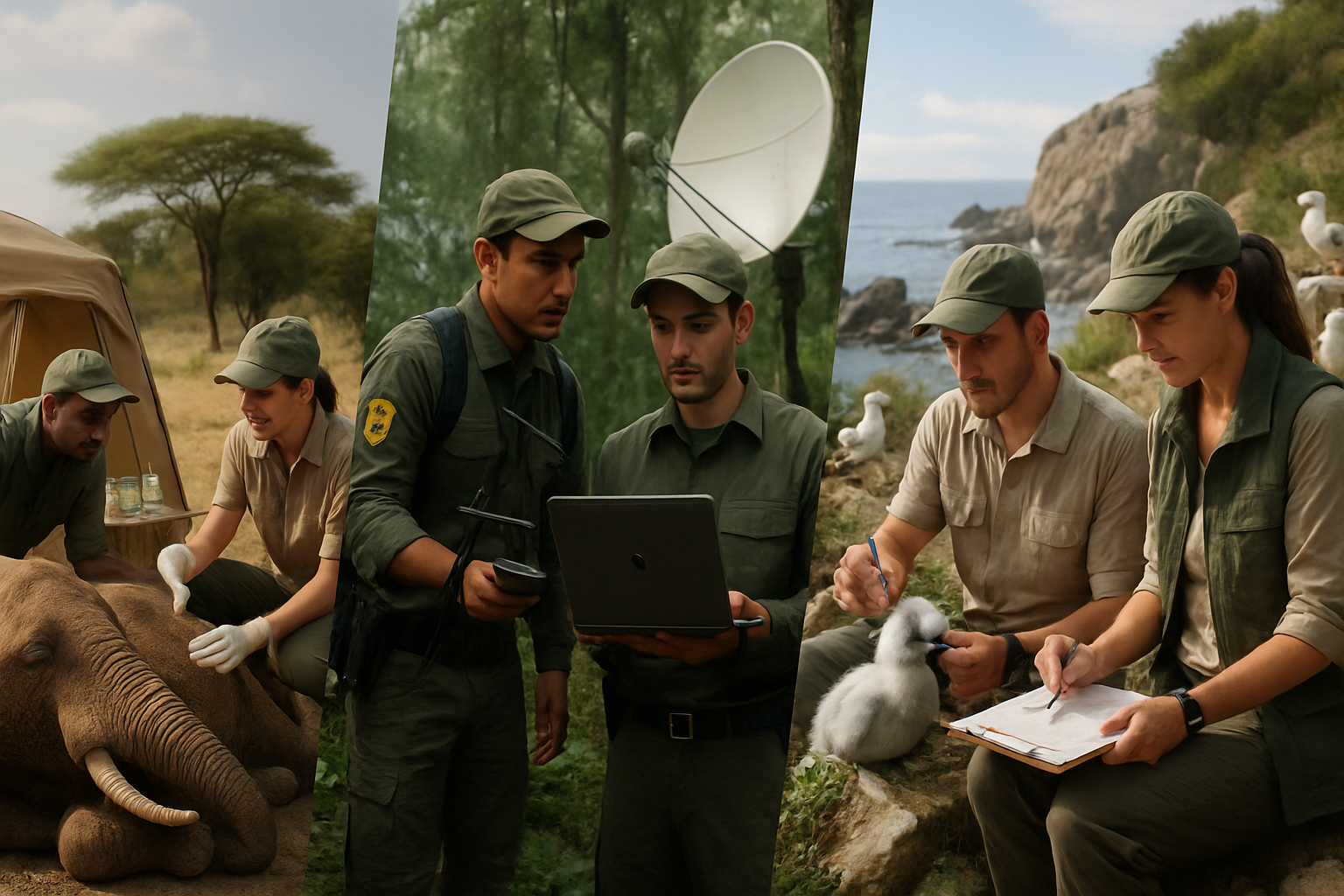
Environmental conservation efforts are reaching a critical juncture as wildlife protection initiatives across three continents reveal both the mounting pressures facing global ecosystems and the innovative approaches emerging to address unprecedented environmental challenges during Earth's most concerning climate period on record.
Recent developments spanning the Democratic Republic of Congo, Paraguay, and Malta illuminate the complex landscape of modern conservation, where traditional wildlife management meets cutting-edge technology, community engagement intersects with scientific expertise, and local actions contribute to planetary-scale environmental protection during humanity's most decisive climate action decade.
Congo's Conservation Renaissance: Community Engagement in Wildlife Protection
In the Democratic Republic of Congo's Maniema province, a groundbreaking conservation initiative is transforming how communities interact with threatened wildlife populations. Adams Cassinga, founding director of Conserv Congo, has launched an extensive awareness campaign targeting diverse community segments about the escalating threats facing regional fauna, particularly the 1,600 forest elephants documented in Salonga National Park during the most recent 2018 inventory.
The Conserv Congo initiative represents a fundamental evolution from traditional top-down conservation approaches toward comprehensive community-based environmental stewardship. Rather than imposing external conservation mandates, the program emphasizes education, local ownership, and sustainable resource management practices that acknowledge the complex relationships between human communities and wildlife populations.
This community-centric approach reflects broader trends in African conservation, where indigenous knowledge systems increasingly integrate with modern environmental science to create more effective and culturally sensitive protection strategies. The initiative's focus on Salonga National Park's elephant populations is particularly significant, as African forest elephants serve critical ecological roles as "ecosystem engineers," dispersing seeds across vast forest areas and maintaining the biodiversity patterns that have sustained Central African ecosystems for millennia.
Paraguay's Emergency Wildlife Response: Rescued Species in Urban Environments
Paraguay's environmental authorities recently coordinated a sophisticated emergency response operation that highlights the growing intersection between urban development and wildlife conservation. The joint effort, led by the Ministry of Environment and Sustainable Development (Mades) in collaboration with volunteer firefighters and the National Police, successfully rescued and relocated an Aguará Guasú (maned wolf) that had wandered into a residential backyard in Asunción's Bañado Sur neighborhood.
The rescued maned wolf represents one of South America's most emblematic species, currently facing extinction due to habitat reduction and fragmentation across its traditional range. The animal's appearance in an urban residential area reflects broader patterns of wildlife displacement occurring throughout Latin America as agricultural expansion and urban development continue fragmenting natural habitats, forcing animals to seek resources in increasingly close proximity to human settlements.
The operation's success demonstrates Paraguay's growing capacity for rapid-response wildlife management, combining professional emergency services with specialized veterinary care and community cooperation. However, the incident also underscores the mounting pressures on Paraguay's remaining natural areas, where species like the maned wolf face diminishing habitat options and increased human-wildlife conflict situations requiring sophisticated management approaches balancing conservation goals with community safety and agricultural productivity needs.
Malta's Marine Conservation Challenge: Confronting Wildlife Crime
In Mediterranean waters, Malta faces a stark reminder of the persistent challenges confronting marine wildlife conservation. BirdLife Malta has issued strong condemnation following the brutal killing of a protected Kestrel (Spanjulett) in Gozo, describing the incident as "cruel and revolting" and emphasizing its significance as both an animal welfare concern and a serious conservation issue threatening regional biodiversity.
The incident, captured on video footage, involved a trapper deliberately crushing the kestrel under his boot, representing what conservation experts characterize as wildlife crime extending far beyond traditional hunting or trapping activities. The deliberate nature of the killing highlights disturbing attitudes among some individuals who view themselves as having absolute authority over wildlife, abusing animals with apparent impunity despite comprehensive legal protections.
BirdLife Malta's response emphasizes that such incidents should "shock society" and trigger serious reflection about humanity's relationship with the natural world. The organization's statement reflects growing international concern about wildlife crime's psychological and ethical dimensions, particularly incidents involving protected species in regions where conservation awareness and legal frameworks should provide adequate deterrence.
Technology Integration and Traditional Knowledge
Across all three conservation initiatives, a common theme emerges: the sophisticated integration of cutting-edge technology with traditional ecological knowledge and community-based management systems. In Congo, Conserv Congo combines modern wildlife monitoring techniques with centuries of indigenous forest stewardship practices. Paraguay's emergency response utilizes advanced veterinary protocols alongside traditional animal handling expertise. Malta's conservation efforts employ digital documentation and legal frameworks supported by decades of Mediterranean bird protection experience.
This technology-tradition synthesis represents a fundamental evolution in conservation methodology, moving beyond either purely technological or purely traditional approaches toward comprehensive frameworks that combine scientific rigor with cultural sensitivity and community ownership. Environmental DNA sampling, satellite monitoring, and AI-powered analysis work alongside traditional tracking techniques, indigenous resource management systems, and community stewardship practices developed over generations.
Global Climate Context and Conservation Urgency
These conservation efforts unfold against an unprecedented global climate backdrop, with environmental scientists confirming that recent months have marked the longest sustained warming streak in recorded human history. The sustained temperature elevation demonstrates human-induced climate change has fundamentally altered Earth's atmospheric systems beyond natural recovery mechanisms, creating compound environmental effects that traditional conservation approaches struggle to address effectively.
Climate change compounds traditional conservation challenges through multiple pathways: rising sea levels threaten coastal ecosystems essential for species like Malta's seabirds; changing precipitation patterns affect forest regeneration critical for Congo's elephant populations; increased extreme weather frequency disrupts migration routes and breeding cycles for species like Paraguay's maned wolves. These interconnected pressures require adaptive management approaches capable of responding to rapidly changing baseline conditions while maintaining long-term sustainability goals.
Economic Dimensions of Environmental Protection
Modern conservation increasingly demonstrates that environmental protection functions as an economic development strategy rather than a regulatory burden. Countries and regions implementing comprehensive wildlife protection consistently show greater economic resilience and attract sustainable investment across multiple sectors, from eco-tourism to green technology manufacturing and environmental services.
Congo's community-based conservation generates international climate finance and research partnerships while supporting local economic development through sustainable forest management and eco-tourism opportunities. Paraguay's wildlife rescue capabilities enhance the country's environmental reputation, potentially attracting sustainable development investment and nature-based tourism. Malta's marine conservation efforts protect the foundational ecosystems supporting the Mediterranean tourism industry worth hundreds of millions annually.
The economic multiplier effects extend beyond direct environmental sectors, including improved public health outcomes, enhanced agricultural productivity through ecosystem services, and reduced infrastructure costs through natural disaster prevention. Ecosystem service valuation increasingly reveals that intact natural systems often provide economic benefits exceeding short-term resource extraction profits.
International Cooperation Imperatives
The transnational nature of environmental challenges demands unprecedented international cooperation, as wildlife migrations, ocean currents, and atmospheric systems connect ecosystems globally, making unilateral conservation efforts insufficient. Success requires coordinated policy frameworks, shared monitoring systems, collaborative enforcement mechanisms, and innovative financing approaches that recognize ecosystem services as essential economic infrastructure.
Knowledge sharing between Congo's community engagement methodologies, Paraguay's emergency response capabilities, and Malta's marine protection creates global conservation networks that provide resilience through multiple adaptation pathways. This represents an evolution from traditional North-South aid relationships toward peer-to-peer cooperation where developing nations emerge as environmental solution providers, leveraging local innovation and indigenous knowledge systems.
Implementation Challenges and Opportunities
Despite remarkable conservation innovations, significant implementation challenges persist across all regions. Funding sustainability remains critical for developing nations where immediate economic pressures often override long-term environmental considerations. Technical capacity building requires sustained investment in education, training, and institutional development. Climate change continues disrupting project timelines, requiring adaptive management approaches capable of responding to rapidly changing conditions.
However, opportunities abound through enhanced international partnerships, accelerated technology transfer, and innovative financing mechanisms that recognize ecosystem services' economic value. The diversity of conservation approaches demonstrated across Congo, Paraguay, and Malta provides resilience against single-solution dependencies, offering multiple pathways for addressing complex environmental challenges spanning biological, physical, and human systems.
Strategic Significance for Global Conservation
The conservation developments across these three regions represent a critical juncture between reactive crisis management and proactive ecosystem service management. The environmental action window continues narrowing as ecological systems approach critical thresholds that could potentially trigger irreversible changes affecting global food security, climate stability, and human settlement patterns.
Yet the tools, knowledge, and cooperation frameworks exist for comprehensive environmental protection, as demonstrated by diverse international initiatives spanning community engagement, emergency response, and wildlife crime prevention. Success depends on sustained international cooperation, enhanced multi-sector coordination, and increased financial commitments that recognize environmental protection as essential infrastructure for human prosperity and planetary sustainability.
As 2026 unfolds, the conservation experiences in Congo, Paraguay, and Malta provide practical templates for scaling environmental protection globally. Their integration of traditional ecological knowledge with modern conservation science creates adaptable frameworks that respect cultural diversity while leveraging global technological capabilities. The window for effective environmental action may be narrowing, but the convergence of innovation, cooperation, and political commitment offers hope for maintaining planetary habitability during Earth's most environmentally challenging period in recorded history.
Future Implications and Scaling Potential
The success or failure of current environmental initiatives may prove decisive for conservation approaches in the decades ahead, influencing global biodiversity protection, climate adaptation, and sustainable development strategies for generations. Congo's community-based model offers templates for tropical forest protection worldwide. Paraguay's urban-wildlife interface management provides lessons for rapidly developing regions globally. Malta's marine conservation enforcement informs Mediterranean-wide protection strategies.
Effective conservation increasingly requires sophisticated synthesis of scientific knowledge, community engagement, technological innovation, and international cooperation through locally-appropriate combinations rather than isolated approaches. As environmental challenges accelerate, the lessons learned from these three distinct conservation contexts may determine whether humanity can organize and implement solutions rapidly enough to maintain the environmental systems upon which all life depends.