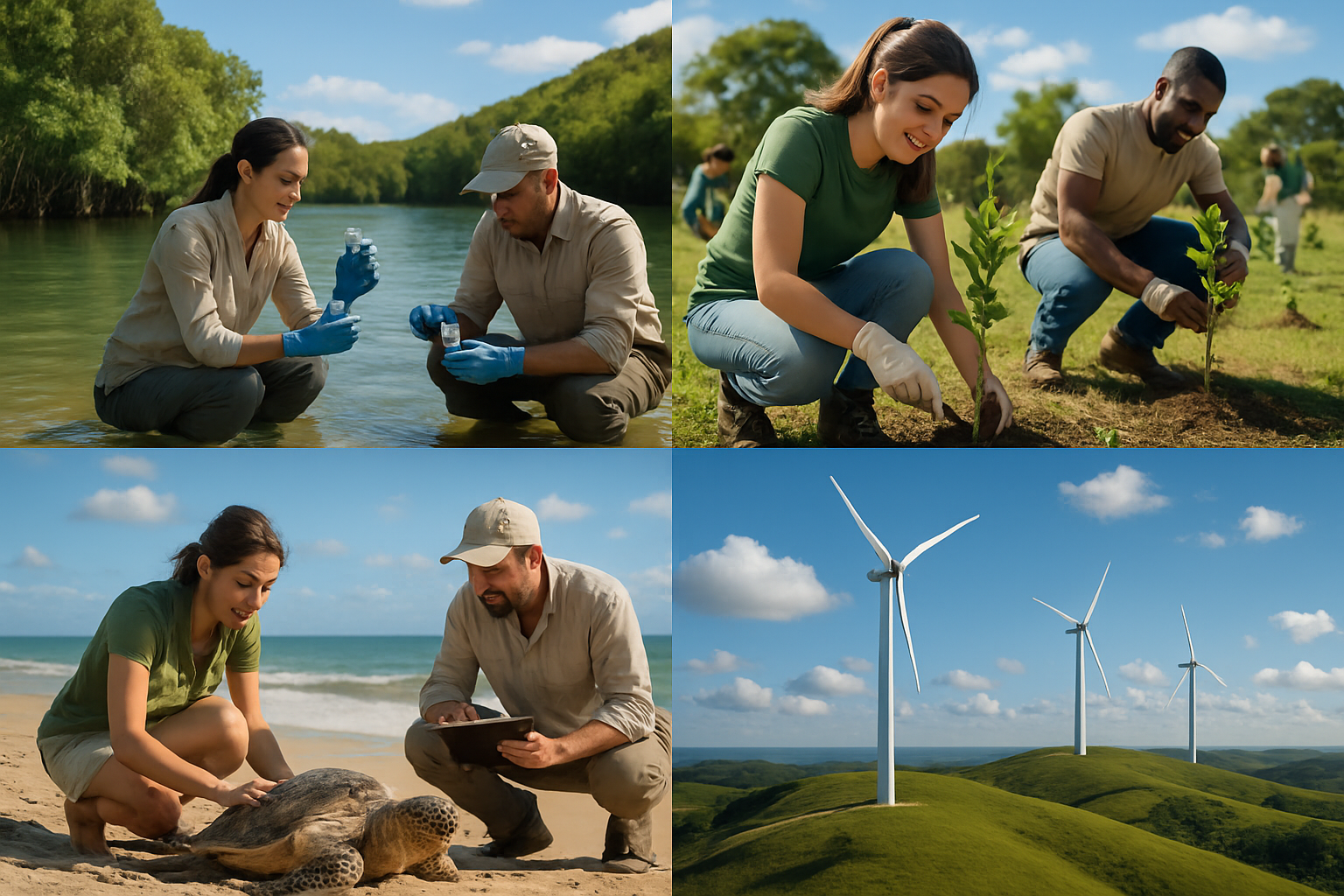
Environmental conservation efforts are gaining unprecedented momentum across three continents as Monaco prepares for its fifth annual zero-waste festival, Saint Lucia strengthens its fight against invasive sargassum seaweed, and revolutionary marine cleanup technology demonstrates the potential for coordinated global environmental action during Earth's 19th consecutive month exceeding 1.5°C above pre-industrial levels.
The convergence of these initiatives represents a fundamental shift in environmental protection strategies, moving from reactive crisis management to proactive ecosystem service management during what scientists describe as the most environmentally challenging period in human history.
Monaco's Zero Waste Revolution
The Principality of Monaco is pioneering sustainable living practices with MonaCollecte 2026, a comprehensive two-day sustainability festival taking place March 6-7 at the Chapiteau de Fontvieille. Organized by Prince Albert's Government in partnership with the Société Monégasque d'Assainissement, this fifth edition centers on the ambitious theme of "Zero Waste."
The festival brings together residents willing to embrace greener habits through a carefully curated mix of collections, hands-on workshops, and awareness activities. Participants can engage in zero-waste cooking demonstrations, learn to create homemade cosmetics from natural ingredients, witness recycled plastic construction techniques, and experience a virtual reality sorting center that makes waste management education both engaging and accessible.
Monaco's approach demonstrates how wealthy nations can leverage resources and innovation to create scalable environmental solutions. The Principality's commitment to waste reduction builds on broader European Union initiatives aimed at achieving circular economy objectives by 2030, positioning Monaco as a regional leader in sustainable development practices.
Caribbean Resilience: Saint Lucia's Sargassum Strategy
Saint Lucia is strengthening its environmental defenses through a new anti-sargassum initiative supported by the United Nations Development Programme (UNDP) in partnership with the Government of Japan. The project addresses one of the Caribbean's most pressing environmental challenges: massive influxes of sargassum seaweed that have increasingly impacted regional beaches, marine ecosystems, and tourism economies since 2011.
The initiative represents a strategic shift from reactive cleanup efforts to proactive management systems that transform sargassum from an environmental burden into a resource opportunity. Scientists and policymakers are exploring innovative uses for collected sargassum, including biofertilizers, construction materials, and renewable energy sources.
This comprehensive approach reflects lessons learned from previous environmental conservation breakthroughs across the Caribbean region, where communities have successfully transformed fishing practices into marine conservation partnerships and developed sophisticated coral reef protection programs.
Marine Technology Innovation
Revolutionary marine cleanup technology is providing new tools for ocean conservation. Advanced connected aquatic drones equipped with IoT sensors and 5G connectivity are being deployed to collect marine waste and microplastics with unprecedented precision and efficiency. These systems, demonstrated at Mobile World Congress 2026, represent a significant advancement in combining digital technology with marine ecosystem protection.
The technology enables real-time monitoring of ocean health while actively removing pollutants that threaten marine life. Early trials show remarkable success in collecting both visible debris and microscopic plastic particles that traditional cleanup methods cannot address effectively.
Global Climate Context and Conservation Response
These environmental initiatives are unfolding against the backdrop of unprecedented global climate conditions. January 2026 was confirmed as the hottest month in recorded history, extending a streak of 19 consecutive months where global temperatures exceeded the critical 1.5°C threshold above pre-industrial levels.
This sustained warming pattern is overriding natural climate variability, including La Niña cooling effects that typically moderate global temperatures. Scientists warn that human-induced climate change has fundamentally altered Earth's atmospheric systems beyond natural recovery mechanisms, creating compound environmental effects that require immediate coordinated responses.
Technology-Tradition Integration
The most successful conservation programs demonstrate sophisticated integration of cutting-edge technology with traditional ecological knowledge and community-based management approaches. Monaco's festival combines advanced waste processing technology with traditional sustainability practices, while Saint Lucia's sargassum program builds on generations of Caribbean maritime expertise enhanced by modern environmental science.
This synthesis represents a fundamental evolution in environmental protection methodology, moving beyond purely technological solutions toward comprehensive, culturally sensitive frameworks that respect local knowledge while harnessing global innovations.
Economic Development Through Environmental Protection
These initiatives demonstrate that environmental protection increasingly functions as an economic development strategy rather than a regulatory burden. Monaco's zero-waste leadership enhances its reputation as a sustainable luxury destination, potentially attracting environmentally conscious tourism and investment worth hundreds of millions annually.
Saint Lucia's innovative sargassum management could transform a costly environmental challenge into a sustainable economic opportunity through biofertilizer production, construction materials, and renewable energy generation. The marine cleanup technology sector represents billions in potential export revenue and high-technology manufacturing jobs across participating nations.
International Cooperation Framework
The success of these initiatives underscores the critical importance of international cooperation in addressing transnational environmental challenges. Ocean currents carry pollution across continental boundaries, atmospheric systems transport environmental effects globally, and species migrations connect ecosystems worldwide, making unilateral conservation efforts insufficient.
The diversity of approaches provides resilience against single-solution dependencies, offering multiple adaptation pathways for addressing complex environmental challenges. Knowledge sharing, technology transfer, and innovative financing enable smaller nations to implement sophisticated conservation programs that contribute to global environmental stability.
Implementation Challenges and Success Factors
Despite the promising developments, significant implementation challenges remain. Funding sustainability is particularly critical for developing nations, where immediate economic pressures often override long-term environmental considerations. Technical capacity building requires sustained investment in education, training, and institutional development.
Climate change continues to disrupt project timelines and operational conditions, requiring adaptive management approaches that can respond rapidly to changing environmental circumstances. However, the success factors consistently include community ownership and engagement, transparent governance frameworks, economic incentives that make protection financially viable, and integration of traditional knowledge with modern conservation science.
Strategic Significance for Global Conservation
These March 2026 environmental initiatives represent a critical juncture in global conservation efforts. The choice between reactive crisis management and proactive ecosystem service management may determine whether conservation efforts can keep pace with accelerating environmental change during what scientists call the decisive climate action decade.
The window for effective environmental action is narrowing as ecological systems approach critical thresholds that could trigger irreversible changes. However, the tools, knowledge, and cooperation frameworks exist for comprehensive environmental protection, as demonstrated by these diverse international initiatives.
Success depends on rapid scaling of these approaches through enhanced international cooperation, sustained financial commitments, and recognition of environmental protection as essential infrastructure for human prosperity and planetary sustainability. The coordination evident across Monaco's waste management innovation, Saint Lucia's marine ecosystem protection, and advanced cleanup technologies provides templates for scaling conservation efforts globally.
As these nations demonstrate sophisticated multi-sector approaches to environmental challenges, they offer hope and practical guidance for the massive coordinated effort required to maintain planetary habitability during this unprecedented period of environmental change.