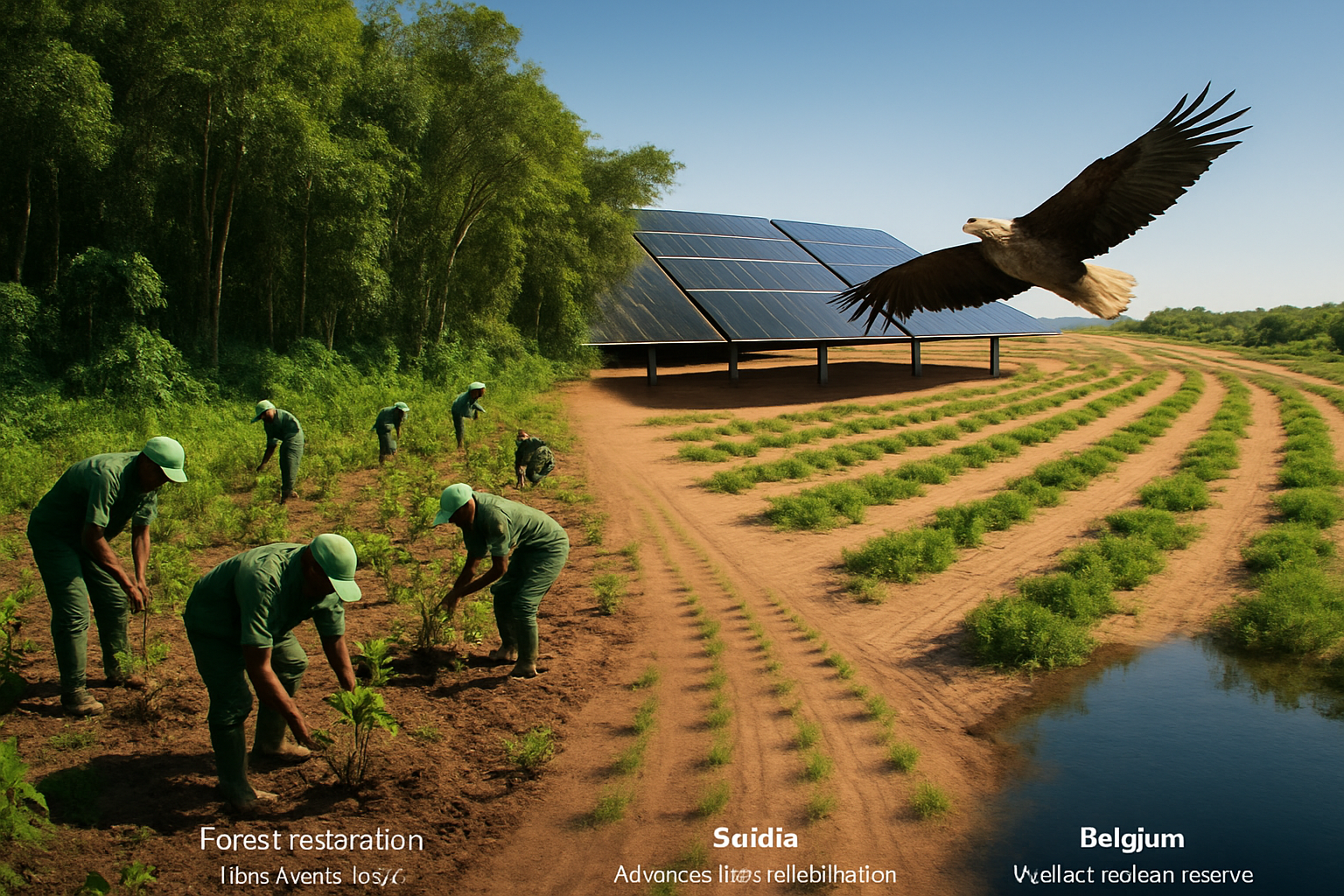
A remarkable convergence of environmental conservation initiatives across Saudi Arabia, Gabon, and Belgium demonstrates unprecedented global momentum in habitat protection and restoration, even as the planet experiences its 22nd consecutive month of temperatures exceeding 1.5°C above pre-industrial levels.
From the Arabian Peninsula's ambitious land rehabilitation projects to Central Africa's community-driven forest management and Northern Europe's wildlife recovery success stories, these parallel efforts represent what environmental scientists are calling a "conservation renaissance" during Earth's most challenging climate period.
Saudi Arabia's Historic Land Restoration Achievement
Saudi Arabia has achieved a remarkable milestone in environmental restoration, successfully rehabilitating over 614,000 hectares of the 2.5 million hectares projected for completion by 2030, according to the King Abdulaziz Royal Reserve Development Authority. This represents more than 60% of the Kingdom's first one million hectare target for vegetated land recovery.
Maher Al Qothmi, CEO of the King Abdulaziz Royal Reserve Development Authority, emphasized that this accomplishment reflects "the scale of systematic work in achieving environmental sustainability targets." The rehabilitated area of 614,312.92 hectares demonstrates the efficiency of implementation plans and their ability to create tangible environmental impact on the ground.
"The field efforts carried out by the authority reached this result through cooperating with relevant entities and the local community, focusing on protecting natural habitats and reducing environmental degradation."
— King Abdulaziz Royal Reserve Development Authority
This achievement positions Saudi Arabia as a regional leader in large-scale environmental restoration, demonstrating how oil-producing nations can pivot toward comprehensive environmental stewardship while maintaining economic development goals.
Gabon's Sustainable Forest Champions Initiative
In Central Africa, Gabon has launched an innovative program creating "national champions of sustainable forests" through the PFABO initiative. This groundbreaking approach represents a fundamental shift from top-down conservation policies to community-driven forest management, empowering local populations to become active environmental stewards.
The program, developed by Gabon's Ministry of Entrepreneurship, Commerce and SMEs in collaboration with environmental organizations, focuses on sustainable forest practices while creating economic opportunities for local communities. This model has attracted significant international attention as it demonstrates how developing nations can become environmental solution providers rather than aid recipients.
Gabon's forests cover approximately 85% of the country's territory, making it one of the most forest-dense nations on Earth and a crucial component of global climate regulation. The sustainable forest champions program combines traditional ecological knowledge with modern conservation science, creating comprehensive frameworks that respect cultural autonomy while leveraging global technological capabilities.
Belgium's Wildlife Recovery Success
Meanwhile, in Northern Europe, Belgium has celebrated a significant wildlife conservation victory with the rare sighting of a white-tailed eagle at Lake Het Vinne, part of the provincial nature reserve in Zoutleeuw, Flemish Brabant. Philippe Smets of the East Brabant Bird Working Group confirmed this as "a rare sighting in our region to spot this eagle, which has a wingspan of around 2.4 metres."
The appearance of this magnificent bird of prey in Belgian territory represents years of habitat restoration and environmental protection efforts across Europe. White-tailed eagles, once nearly extinct in many European regions, have been recovering through coordinated conservation programs that combine advanced monitoring technologies with traditional wildlife management practices.
This sighting demonstrates the success of Europe's broader environmental protection network, including the Natura 2000 system, which has created interconnected protected areas allowing wildlife populations to recover and expand their territories.
Technology Meets Tradition in Global Conservation
A common thread across these three conservation initiatives is the sophisticated integration of cutting-edge technology with traditional ecological knowledge and community-based management. This represents a fundamental evolution in conservation methodology, moving beyond purely technological or traditional approaches toward comprehensive frameworks that combine scientific rigor with cultural sensitivity.
Saudi Arabia's restoration projects employ satellite monitoring and environmental DNA sampling alongside regional expertise in desert ecology. Gabon's forest champions program utilizes GPS tracking and advanced mapping while respecting centuries-old forest stewardship wisdom. Belgium's wildlife monitoring combines sophisticated bird tracking technology with traditional European ornithological knowledge.
Conservation as Economic Development Strategy
These initiatives demonstrate a crucial shift in how nations approach environmental protection – not as a regulatory burden, but as an economic development strategy. Countries implementing comprehensive environmental protection consistently show greater economic resilience and attract sustainable investment across multiple sectors.
Saudi Arabia's land restoration supports the Kingdom's vision of economic diversification while positioning it as a leader in environmental technology and sustainable development. Gabon's sustainable forestry programs attract international climate finance and research partnerships while preserving invaluable ecosystems. Belgium's wildlife conservation enhances its environmental credentials and supports a thriving eco-tourism sector.
Economic analyses consistently show that ecosystem services from intact natural systems often deliver greater long-term benefits than resource extraction activities. Restored landscapes prevent billions in flood damage, regulate water and climate patterns, and support biodiversity worth hundreds of billions annually through pharmaceutical research and sustainable tourism.
Climate Crisis Context
These conservation victories emerge during Earth's most challenging environmental period in recorded history. January 2026 marked the hottest month on record, extending a streak of 22 consecutive months where global temperatures exceeded the critical 1.5°C threshold above pre-industrial levels. This sustained warming has completely overridden natural climate variability, including La Niña cooling effects that typically moderate temperatures.
The ongoing climate crisis creates compound environmental effects that traditional conservation approaches struggle to address effectively. Rising sea levels threaten coastal ecosystems, changing precipitation patterns affect forest regeneration, and increased extreme weather frequency disrupts marine food chains and terrestrial habitats.
Yet the success of these diverse conservation initiatives demonstrates remarkable human adaptive capacity in protecting essential environmental systems during unprecedented challenges. The coordinated nature of these efforts – spanning from desert restoration to forest management to wildlife recovery – shows that effective environmental action is possible even under extreme climate stress.
International Cooperation Framework
The success of these geographically diverse initiatives highlights the critical importance of international cooperation in addressing transnational environmental challenges. Ocean currents, atmospheric systems, and species migrations cross political boundaries, making unilateral conservation efforts insufficient for long-term success.
Knowledge sharing between these programs creates global networks that strengthen local capacity while contributing to planetary sustainability. Saudi Arabia's desert restoration techniques inform similar projects across arid regions worldwide. Gabon's community forest management models influence tropical conservation programs throughout Africa and beyond. Belgium's wildlife recovery successes provide templates for European biodiversity protection efforts.
This represents an evolution from traditional North-South aid relationships toward peer-to-peer cooperation, recognizing that developing nations are increasingly becoming environmental solution providers with locally-adapted innovations that can be scaled globally.
Critical Action Window
Environmental scientists emphasize that the window for effective conservation action is narrowing rapidly, as ecological systems approach critical thresholds that could trigger irreversible changes affecting global food security, climate stability, and human settlements. The choice facing the international community is between reactive crisis management and proactive ecosystem service management.
The tools, knowledge, and cooperation frameworks for comprehensive environmental protection exist and are demonstrated by these successful initiatives. However, success depends on implementation at sufficient speed and coordination to match the scale and pace of environmental challenges.
Implementation challenges include funding sustainability, particularly for developing nations where immediate economic pressures can override long-term environmental considerations. Technical capacity building requires sustained investment in education, training, and institutional development. Climate change continues to disrupt project timelines, requiring adaptive management approaches that can respond to rapidly changing conditions.
Future Implications
The environmental developments of April 2026 are potentially decisive for conservation approaches in the decades ahead, influencing global biodiversity protection, climate adaptation, and sustainable development strategies for generations. These initiatives provide practical templates for scaling environmental protection globally through coordinated approaches that address multiple challenges while building local capacity and fostering international cooperation.
The integration of cutting-edge technology with traditional ecological wisdom creates adaptable frameworks that respect cultural diversity while leveraging global capabilities. Success in maintaining planetary habitability during this unprecedented environmental challenge period depends on humanity's ability to organize and implement solutions rapidly enough to protect the natural systems upon which human prosperity depends.
As we witness the convergence of innovation, cooperation, and political commitment across continents, these conservation initiatives offer hope and practical guidance for the massive coordinated effort required to maintain planetary habitability during what may prove to be the most environmentally challenging period in recorded history.
The conservation renaissance of 2026 demonstrates that even during the longest sustained warming streak in human history, remarkable environmental achievements remain possible through scientific excellence, community engagement, and international cooperation – providing a foundation for decisive climate action in the crucial decade ahead.