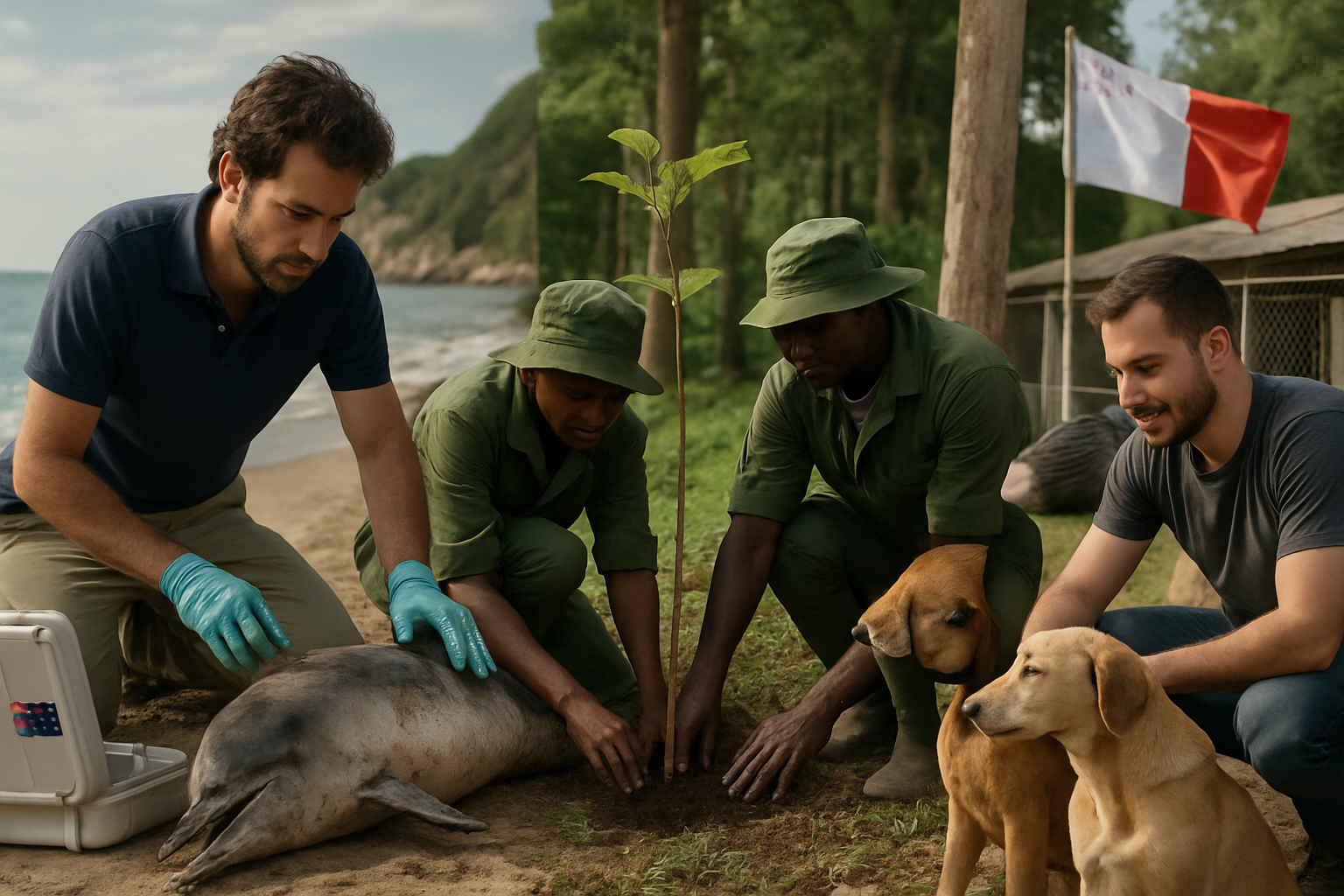
A remarkable surge in environmental conservation efforts across five continents is demonstrating humanity's evolving capacity to protect biodiversity while addressing the climate crisis, as documented by major initiatives in Iceland, Ireland, Estonia, New Zealand, and Cyprus during the 19th consecutive month of global temperatures exceeding critical climate thresholds.
From Iceland's first protected urban wildlife sanctuary to New Zealand's groundbreaking marine protection enforcement, March 2026 is emerging as a pivotal moment in global environmental protection, with nations implementing sophisticated approaches that combine cutting-edge technology with traditional ecological knowledge.
Urban Biodiversity Breakthrough in Iceland
Iceland has taken a historic step forward in urban conservation with Minister Jóhann Páll Jóhannsson declaring Grafarvogur in Reykjavík a protected area. The designation, covering approximately half a square kilometer of bay area inside Gullinbrú, represents a crucial evolution in environmental protection philosophy.
"It is important not only to protect remote wilderness areas but also beautiful places here in the urban environment," Minister Jóhannsson emphasized. "We have relatively undisturbed mudflats here. This is an important breeding area for birds, including species that are endangered."
The protection initiative, developed through collaboration with Reykjavíkurborg (City of Reykjavík) and Náttúruverndarstofnun (Icelandic Institute of Natural History), demonstrates how urban areas can serve as critical biodiversity refuges. The mudflats provide essential habitat for endangered bird species while maintaining ecological corridors within one of the world's northernmost capitals.
Marine Conservation Victory in Ireland
In Ireland, a long-running campaign for beach access has achieved a breakthrough that extends far beyond public rights of way. The "Save Our Beach at Castlegoland" movement has successfully restored access to the popular destination while establishing a new framework for sustainable coastal management.
Beach access campaigners in Narin and Portnoo are celebrating the restoration of public rights of way to Castlegoland Beach, which attracts visitors from across the region. The resolution, involving new management at Narin and Portnoo Golf Links under Carr Golf, represents a model for balancing recreational access with environmental protection.
Following a high-profile dispute that saw the High Court order the removal of a locked gate in 2024, the new management approach emphasizes "mutual respect" between conservation needs, recreational access, and community safety.
Wildlife Documentation Success in Estonia
Estonia's conservation efforts received an unexpected boost when a forestry worker in Lääne-Viru County successfully filmed the rare sight of a lynx bringing down a roe deer. The footage, reported by Maaleht, provides valuable scientific documentation of predator-prey relationships in Baltic ecosystems.
The rare wildlife encounter demonstrates the recovering health of Estonia's forest ecosystems and highlights the importance of community involvement in conservation monitoring. Such documentation provides critical data for wildlife management decisions and helps build public support for predator conservation programs.
New Zealand's Marine Protection Enforcement
New Zealand continues to demonstrate global leadership in marine conservation enforcement, with recent penalties highlighting the country's commitment to protecting endangered species. An Otago fisher was fined $5000 and required to pay for the return of his vessel after accidentally killing a Hector's dolphin and attempting to conceal the incident from officials.
The case reveals both the effectiveness of New Zealand's monitoring systems and the ongoing challenges facing marine conservation. Hector's dolphins, found only in New Zealand waters, remain critically endangered, making each individual loss significant for species recovery.
Conservation groups have noted that while the fine represents a step forward in enforcement, the relatively modest penalty may not provide sufficient deterrent effect for commercial operators, highlighting the need for stronger legal frameworks to protect marine biodiversity.
Cyprus Wildlife Education Initiative
Cyprus has launched an innovative environmental education program focusing on wildlife welfare as a cultural indicator. The initiative, centered in Chloraka, emphasizes the connection between wildlife prosperity and civilizational values.
The program demonstrates how environmental education can be integrated into broader cultural and social development initiatives, positioning wildlife protection not just as an ecological necessity but as a reflection of community values and cultural sophistication.
Technology Meets Traditional Knowledge
Across all these initiatives, a common theme emerges: the successful integration of advanced technology with traditional ecological knowledge and community-based management approaches. Iceland's protected area designation utilized both scientific surveys and local community knowledge, while Ireland's beach access resolution balanced modern tourism needs with traditional coastal management practices.
Estonia's wildlife documentation exemplifies how citizen science and community engagement can contribute valuable data to conservation science. New Zealand's enforcement capabilities demonstrate how technological monitoring systems can support legal frameworks for marine protection.

Economic Dimensions of Conservation
The economic implications of these conservation initiatives extend far beyond immediate environmental benefits. Iceland's urban protected area enhances the country's reputation as an environmental leader, supporting its significant eco-tourism sector. Ireland's beach access resolution protects tourism assets while demonstrating sustainable coastal management.
New Zealand's marine enforcement, despite short-term costs to individual operators, protects the long-term viability of marine ecosystems that support both tourism and sustainable fisheries worth hundreds of millions annually. Cyprus's education programs position the country as a regional leader in environmental education and sustainable development.
Climate Context and Global Significance
These conservation victories occur against the backdrop of unprecedented global climate challenges. March 2026 marks the 19th consecutive month of global temperatures exceeding 1.5°C above pre-industrial levels, with January 2026 confirmed as the hottest month in recorded history.
The sustained temperature elevation demonstrates that human-induced climate change has fundamentally altered Earth's atmospheric systems beyond natural recovery mechanisms, making coordinated conservation action more critical than ever.
"This represents a fundamental shift from reactive crisis management to proactive ecosystem service management," noted a leading environmental policy analyst. "We're seeing nations recognize environmental protection not as a regulatory burden, but as essential infrastructure for human prosperity and planetary sustainability."
— Dr. Elena Vasquez, International Conservation Policy Institute
International Cooperation Framework
The success of these diverse initiatives highlights the critical importance of international cooperation in addressing transnational environmental challenges. Wildlife migrations, ocean currents, and atmospheric systems cross political boundaries, making unilateral conservation efforts insufficient for long-term success.
The diversity of approaches—from urban habitat protection to marine enforcement, from wildlife education to community access rights—provides resilience against the limitations of single-solution conservation strategies. This diversity offers multiple pathways for addressing the complex, interconnected challenges facing global ecosystems.
Implementation Challenges and Opportunities
Despite these successes, significant implementation challenges remain. Funding sustainability is particularly critical for developing nations, where immediate economic pressures often override long-term environmental considerations. Technical capacity building requires sustained investment in education, training, and institutional development.
Climate change itself disrupts project timelines and operational conditions, requiring adaptive management approaches that can respond to rapidly changing environmental conditions. However, the diversity of successful approaches demonstrated across these five nations provides valuable templates for scaling conservation efforts globally.
Emerging Conservation Renaissance
The coordinated emergence of these conservation initiatives represents what researchers are calling an "environmental conservation renaissance." This movement is characterized by the integration of scientific innovation with community engagement, economic viability with environmental protection, and local action with global cooperation.
Key success factors consistently include community ownership and engagement, transparent governance frameworks, economic incentives that make protection financially viable, and the integration of traditional ecological knowledge with modern conservation science.
Looking Forward: Critical Action Window
Environmental experts emphasize that March 2026 represents a critical juncture in global environmental protection efforts. The choice between reactive crisis management and proactive ecosystem service management may determine whether conservation efforts can keep pace with accelerating environmental change during this decisive climate action decade.
The environmental action window is narrowing as ecological systems approach critical thresholds that could trigger irreversible changes. However, the tools, knowledge, and cooperation frameworks exist for comprehensive environmental protection, as demonstrated by these diverse international initiatives.
Success will depend on sustained international cooperation, enhanced multi-sector coordination, and increased financial commitments that recognize environmental protection as essential infrastructure for human prosperity and planetary sustainability.
Templates for Global Scaling
The conservation initiatives spanning Iceland, Ireland, Estonia, New Zealand, and Cyprus provide practical templates for scaling environmental protection efforts globally. Each demonstrates how local contexts can be addressed through internationally-supported, scientifically-informed, community-engaged conservation strategies.
These examples show that effective conservation requires not just scientific knowledge or community engagement or technological innovation in isolation, but rather the sophisticated synthesis of all these approaches in locally-appropriate combinations.
As the climate crisis intensifies and biodiversity loss accelerates, these conservation successes offer both hope and practical guidance for the massive coordinated effort required to maintain planetary habitability. The window for effective action continues to narrow, but the diverse experiences across these five nations demonstrate that coordinated international action can achieve remarkable conservation results even under the most challenging environmental conditions.
The emerging conservation renaissance of 2026 may prove to be a decisive turning point in humanity's relationship with the natural world, providing the foundation for a sustainable future that balances human prosperity with planetary ecological health.