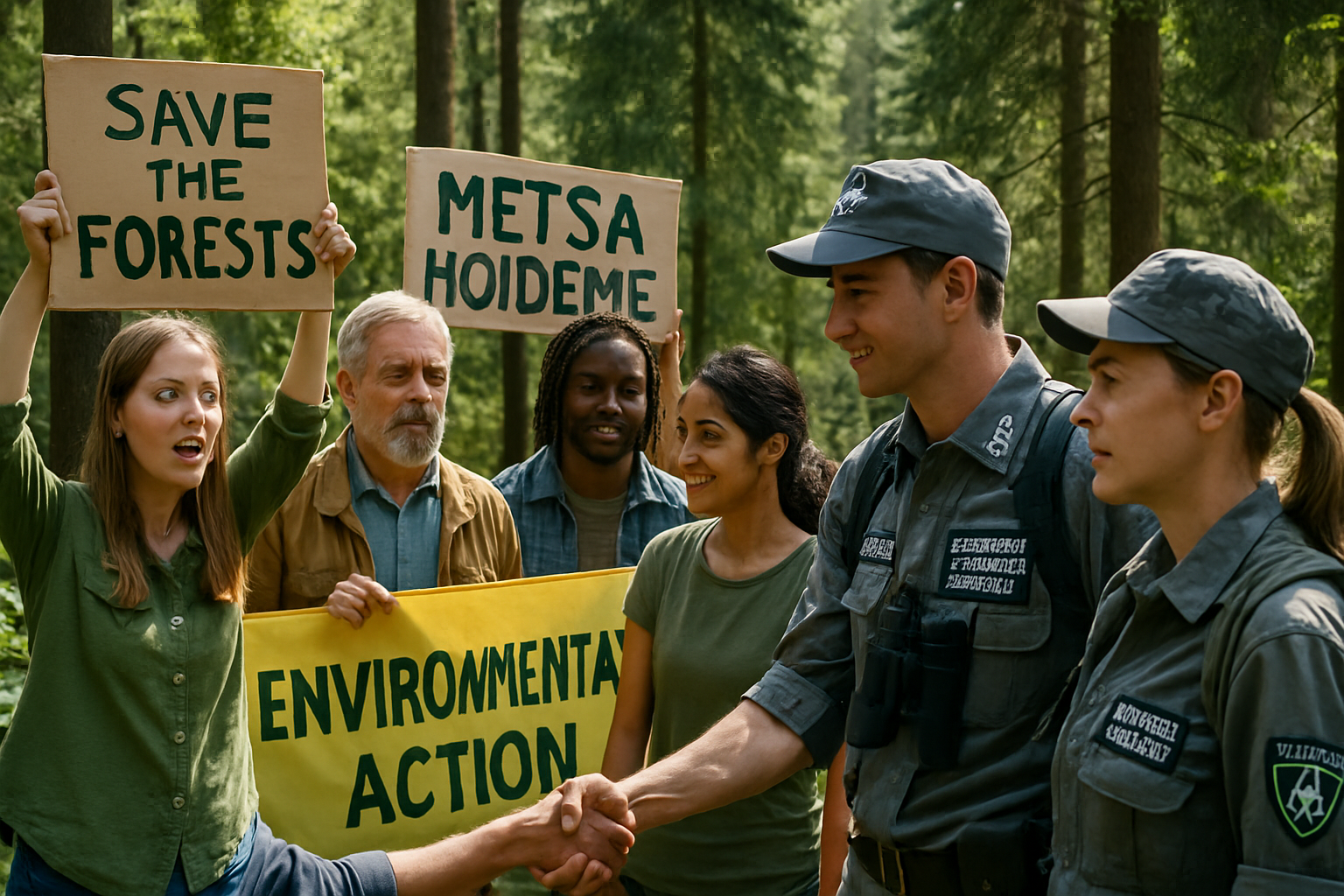
Environmental conservation efforts are intensifying across Europe, with forest protection demonstrations in Estonia and wildlife conservation initiatives in Italy signaling a broader global movement toward ecosystem preservation during humanity's most challenging environmental period.
The demonstrations come at a critical juncture as the world continues to experience unprecedented climate conditions, with global temperatures having exceeded 1.5°C pre-industrial levels for 24 consecutive months—the longest sustained warming streak in recorded history. Against this backdrop, grassroots conservation movements are emerging as powerful forces for environmental protection.
Estonian Forest Conservation Takes Center Stage
In Estonia's capital Tallinn, environmental activists gathered Saturday afternoon to draw urgent attention to the need for greater forest conservation efforts throughout the Baltic nation. The demonstration, documented in a photo gallery by Estonia's ERR news service, represents growing public awareness of forest protection as an essential climate solution.
Estonia's forests cover approximately 50% of the country's territory, making forest conservation crucial for both national biodiversity and global climate regulation. These forests serve as vital carbon sinks, absorbing millions of tons of CO2 annually while providing essential ecosystem services including water filtration, soil protection, and wildlife habitat.
The Estonian demonstration reflects broader European conservation momentum, building on successful initiatives across the continent. Recent conservation victories include Croatia's record griffon vulture populations, Sweden's advanced forest seed centers, and Finland's comprehensive woodland restoration programs.
Italian Wildlife Protection Crisis Demands Action
Meanwhile, in Italy's Abruzzo, Lazio and Molise National Park, a devastating wildlife crisis has sparked urgent conservation mobilization. The discovery of 18 wolves killed across different areas of the park has prompted investigations to identify perpetrators and triggered widespread conservation advocacy to protect the remaining population.
The systematic killing of wolves—Italy's apex predators crucial for ecosystem balance—represents a significant blow to decades of conservation work. Wolves play an essential role in maintaining healthy forest ecosystems by controlling deer populations and preventing overgrazing that can damage forest regeneration.
"Each wolf lost represents not just an individual tragedy, but a setback for entire ecosystem health."
— Conservation Biologist, Italian Wildlife Protection Society
The incident has galvanized Italian conservation organizations, environmental institutions, and government agencies into coordinated action. Emergency measures are being implemented to enhance wolf protection protocols while investigations proceed to bring perpetrators to justice.
Technology-Tradition Integration Revolution
Modern conservation efforts demonstrate sophisticated integration of cutting-edge technology with traditional ecological knowledge and community-based management systems. This represents a fundamental evolution in conservation methodology, moving beyond purely technological or traditional approaches toward comprehensive frameworks that combine scientific rigor with cultural sensitivity.
Estonian forest monitoring employs environmental DNA sampling, satellite imagery, and AI-powered analysis while respecting traditional Baltic forest stewardship practices. Italian wolf conservation utilizes GPS tracking, genetic analysis, and advanced monitoring systems combined with centuries-old knowledge of Apennine ecosystem relationships.
Economic Development Through Environmental Protection
Countries implementing comprehensive environmental protection consistently demonstrate greater economic resilience and attract sustainable investment across multiple sectors. Estonia's forest conservation enhances its clean technology reputation and eco-tourism appeal, positioning the nation as a regional environmental leader.
Italy's wildlife protection efforts support substantial eco-tourism revenue—nature-based tourism generates over €10 billion annually for the Italian economy. Intact wolf populations serve as flagship species attracting international visitors to Italian national parks and wilderness areas.

Economic analyses reveal that ecosystem services from intact natural systems often deliver greater long-term benefits than resource extraction activities. Forests provide water regulation, carbon sequestration, and climate stability worth billions annually, while biodiversity conservation supports pharmaceutical research and premium eco-tourism.
Global Conservation Renaissance
The Estonian and Italian conservation efforts are part of an unprecedented global conservation renaissance characterized by scientific innovation, community engagement, economic viability, and international cooperation integration. Recent conservation successes worldwide include:
- Ecuador's reintroduction of 158 giant tortoises to Floreana Island after a 150-year absence
- Zimbabwe's world-first DNA forensic wildlife crime prosecutions
- New Zealand's Otago Peninsula achieving possum-free status
- Gabon's revolutionary community forest management programs
- Costa Rica's breakthrough forest recovery methodologies
This represents a fundamental evolution from reactive crisis management to proactive ecosystem service management, emphasizing community participation and technological integration while respecting local cultural autonomy and traditional management systems.
Climate Crisis Context
Conservation initiatives are emerging during Earth's most challenging environmental period in recorded history. January 2026 was confirmed as the hottest month ever recorded, extending a pattern that has completely overridden natural climate variability, including La Niña cooling effects that typically moderate global temperatures.
Climate change creates compound environmental effects that traditional conservation approaches struggle to address effectively. Rising sea levels threaten coastal ecosystems, changing precipitation patterns affect forest regeneration, and increased extreme weather frequency disrupts both marine food chains and terrestrial habitats.
International Cooperation Imperative
Environmental challenges transcend political boundaries through ocean currents, atmospheric systems, and species migrations that connect ecosystems globally, making unilateral conservation efforts insufficient. Success requires unprecedented coordination through shared policy frameworks, collaborative monitoring systems, joint enforcement efforts, and innovative financing mechanisms.
Knowledge sharing creates global networks that strengthen local capacity while contributing to planetary sustainability. The evolution from traditional North-South aid relationships toward peer-to-peer cooperation positions developing nations as environmental solution providers leveraging local innovation and indigenous knowledge systems.
"Environmental protection requires coordinated global action, but it starts with local communities standing up for their forests and wildlife."
— Estonian Environmental Activist
Critical Action Window
Environmental scientists warn that the window for effective conservation action is narrowing rapidly as ecological systems approach critical thresholds that could trigger irreversible changes affecting global food security, climate stability, and human settlements.
April 2026 represents a critical juncture between reactive crisis management and proactive ecosystem service management. The choice made now will determine whether conservation efforts can keep pace with accelerating environmental change during this decisive climate action decade.
Tools, knowledge, and cooperation frameworks for comprehensive environmental protection exist, as demonstrated by the diverse international initiatives achieving remarkable results during Earth's most challenging environmental period. However, success depends on sustained international cooperation, enhanced multi-sector coordination, and increased financial commitments recognizing environmental protection as essential infrastructure for human prosperity and planetary sustainability.
Implementation Success Factors
Effective conservation consistently requires several critical elements: community ownership and engagement in conservation planning and implementation; transparent governance frameworks ensuring accountability and sustainable funding; economic incentives that make protection financially viable for local communities; and sophisticated integration of traditional ecological knowledge with modern conservation science.
Challenges include funding sustainability, particularly for developing nations where immediate economic pressures often override long-term environmental considerations. Technical capacity building requires sustained investment in education, training, and institutional development. Climate change continues disrupting project timelines, requiring adaptive management approaches that can respond to rapidly changing conditions.
Strategic Significance
The environmental developments across Estonia and Italy in April 2026 are potentially decisive for conservation approaches in the decades ahead, influencing global biodiversity protection, climate adaptation, and sustainable development strategies for generations to come.
Integration of cutting-edge technology with traditional ecological wisdom creates adaptable frameworks that respect cultural diversity while leveraging global technological capabilities for maximum conservation impact. Success depends on humanity's ability to organize and implement solutions rapidly enough to protect the natural systems that human prosperity depends upon during this unprecedented environmental challenge period.
The window for effective environmental action is narrowing, but the convergence of innovation, cooperation, and political commitment offers hope for maintaining planetary habitability during the most environmentally challenging period in recorded history. The choice to act decisively now will determine conservation outcomes for generations, making current environmental activism not just important, but historically crucial for humanity's future.