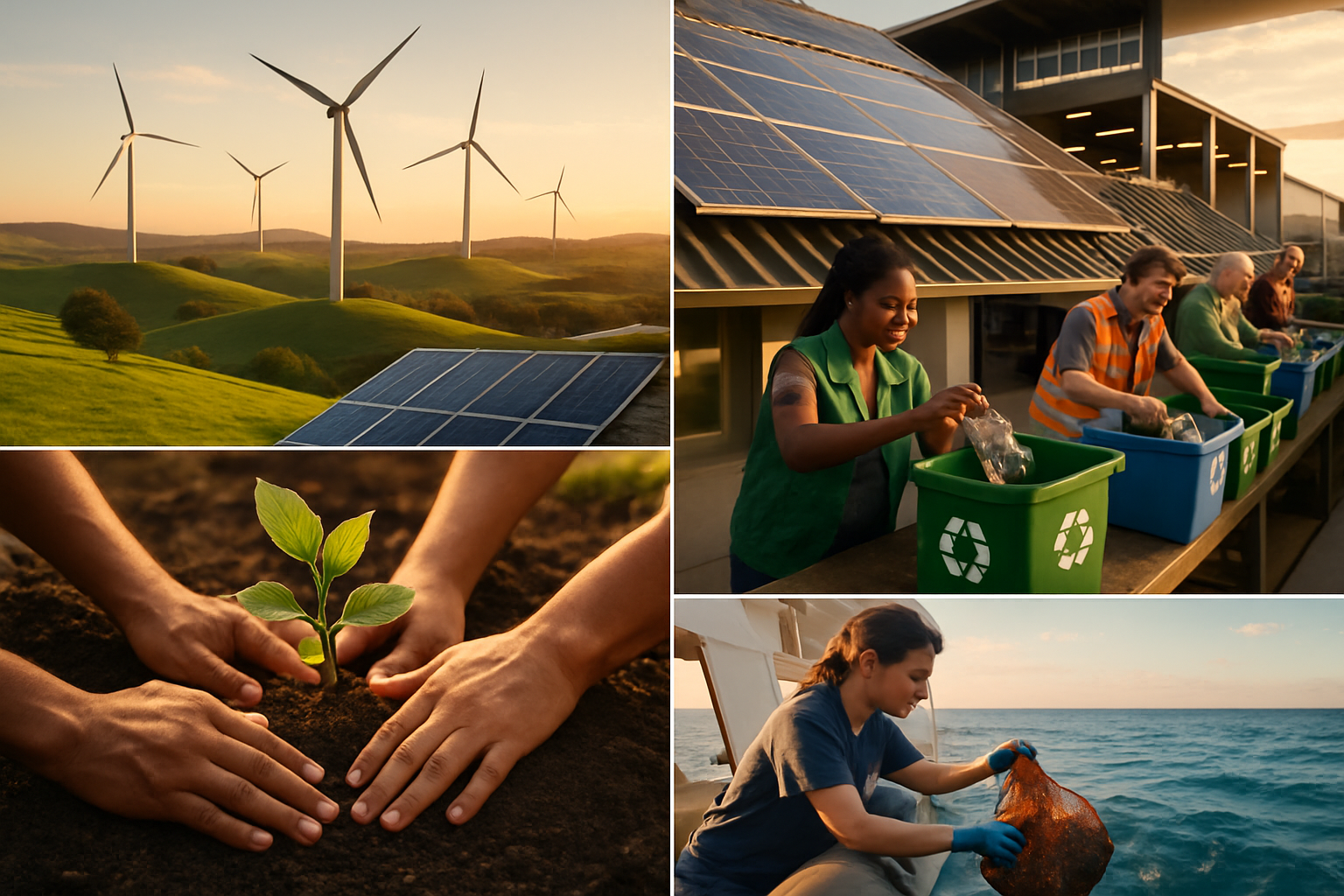
A wave of innovative environmental conservation efforts is sweeping across four nations, demonstrating unprecedented global cooperation in addressing climate change through groundbreaking technology and community-centered approaches that could reshape the future of environmental protection.
From China's deployment of the world's most powerful offshore wind turbine to Sweden's push for critical mineral recycling and Cyprus's urban greening initiatives, governments worldwide are implementing sophisticated strategies that combine technological innovation with traditional conservation approaches. These developments come as climate scientists confirm January 2026 as the hottest month in recorded history, with 18 of the past 19 months exceeding 1.5°C above pre-industrial levels.
Revolutionary Wind Energy Breakthrough in China
China Three Gorges Corporation (CTG) has achieved a major technological milestone by successfully connecting the world's first 20 MW offshore wind turbine to the electrical grid off the coast of southeast China. Located in the phase II Liuao offshore wind farm, this colossal turbine represents a quantum leap in renewable energy capacity, generating enough electricity to power thousands of homes while demonstrating China's continued leadership in clean energy innovation.
The turbine's deployment comes amid global supply chain challenges that have seen China maintain control over 60% of critical mineral production and 90% of refining capacity essential for renewable energy infrastructure. This technological advancement positions China at the forefront of the global energy transition while highlighting the strategic importance of domestic clean energy manufacturing capabilities.
"This represents not just a technological achievement, but a fundamental shift in how we approach offshore renewable energy capacity."
— Industry analyst, speaking on condition of anonymity
Sweden's Critical Mineral Recycling Initiative
In a complementary approach to renewable energy challenges, Sweden's Green Party (Miljöpartiet) has proposed establishing a national coordinator for recycling critical metals and minerals. Party spokesperson Daniel Helldén emphasized the urgent need to address the massive waste of valuable materials currently being discarded despite their essential role in renewable energy infrastructure.
"We produce enormous amounts of goods that contain critical raw materials and minerals that we throw away," Helldén explained, highlighting the environmental and economic inefficiency of current material cycles. The initiative aims to reduce Sweden's dependence on imported critical minerals while building a more sustainable circular economy for essential materials.
This proposal comes as European Union auditors have warned that climate goals are threatened by critical materials shortages, making domestic recycling capabilities increasingly vital for energy transition success. The Swedish initiative could serve as a model for other European nations seeking to reduce dependency on volatile international supply chains.
Cyprus Leads Urban Climate Adaptation
Cyprus Agriculture Minister Maria Panayiotou demonstrated hands-on environmental leadership by personally planting trees near Nicosia's Kaloyeros river, emphasizing that such actions "send a substantial message for the protection of the environment." Her initiative represents a growing recognition that urban greenery has evolved beyond aesthetic considerations to become a critical tool for climate adaptation.
"Urban greenery is no longer just an aesthetic element, but a critical tool for adapting to climate change, as trees contribute to reducing extreme temperatures, improving air quality, and protecting public health," Panayiotou explained. The minister highlighted that Cyprus is experiencing more intense heatwaves and increased pressure on water resources as direct results of climate change.
The Kaloyeros river project exemplifies how relatively small-scale local initiatives can contribute to broader climate resilience strategies. By enhancing urban greenery along this "valuable natural axis within the urban fabric" of Nicosia, Cyprus is creating a "living ecological corridor with significant biodiversity" that improves the local microclimate while providing essential ecosystem services.
Innovative Wildlife Management in North America
While large-scale technological solutions dominate headlines, Canada is pioneering an unexpected approach to climate-related environmental challenges: rodent birth control. As warming temperatures create conditions for increased rat populations and potential disease transmission, scientists and municipal governments are exploring reproductive control methods as alternatives to traditional extermination approaches.
The initiative reflects growing recognition that climate change is creating complex new challenges requiring innovative solutions beyond conventional environmental protection methods. Rising temperatures not only affect traditional ecosystems but also urban pest dynamics, requiring adaptive management strategies that address both immediate public health concerns and longer-term environmental sustainability.
This approach demonstrates how effective environmental conservation increasingly requires interdisciplinary thinking that connects climate science, public health, urban planning, and wildlife management in comprehensive strategies addressing multiple environmental pressures simultaneously.
Global Context and Historical Perspective
These developments occur within a broader context of accelerating environmental initiatives worldwide. Recent months have seen major conservation breakthroughs including Zimbabwe's wetland restoration projects, Romania's solar expansion at airports, and the Caribbean's innovative marine conservation agreements that transform traditional fishing communities into protection partners.
The timing is particularly significant as climate scientists confirm that warming trends are now overriding natural climate variability, even during La Niña periods that historically provided global cooling. This fundamental shift emphasizes the urgency for the types of innovative approaches being demonstrated across these four nations.
Historical analysis reveals that current environmental initiatives represent an evolution from reactive crisis management to proactive ecosystem service management. Projects increasingly emphasize community participation, technological integration, and economic viability rather than relying solely on regulatory restrictions or awareness campaigns.
Economic and Strategic Implications
The economic dimensions of these conservation initiatives extend far beyond immediate environmental benefits. China's 20 MW turbine technology positions the nation to capture significant market share in the rapidly expanding offshore wind sector, with potential export opportunities worth billions of dollars annually.
Sweden's critical mineral recycling initiative could reduce import dependencies worth hundreds of millions of euros while creating new domestic industries around materials recovery and processing. Cyprus's urban greening programs provide measurable benefits including reduced energy costs for cooling, improved property values, and enhanced tourism appeal.
Even Canada's rodent control research, while seemingly modest in scope, addresses public health costs and urban infrastructure protection that could save municipalities millions in damage prevention and healthcare expenses.
Innovation and Technology Integration
A common thread across these initiatives is the sophisticated integration of cutting-edge technology with traditional conservation approaches. China's offshore wind deployment incorporates advanced materials science, digital monitoring systems, and robotics assembly techniques that represent the latest in renewable energy engineering.
Sweden's recycling coordination proposal relies on advanced sorting technologies, materials tracking systems, and automated processing capabilities that make complex mineral recovery economically viable. Cyprus combines traditional ecological knowledge about native species selection with modern urban planning techniques and climate modeling to optimize tree placement and species selection.
This technology-tradition synthesis reflects a maturing understanding that effective environmental protection requires both scientific innovation and deep appreciation for natural systems that have sustained human communities for millennia.
Implementation Challenges and Opportunities
Despite promising developments, significant challenges remain for scaling these approaches globally. Funding sustainability represents a persistent obstacle, particularly for developing nations that face competing development priorities alongside environmental protection needs.
Technical capacity building requirements mean that successful initiatives in one country cannot simply be transferred elsewhere without substantial investment in education, infrastructure, and institutional development. Climate change itself disrupts project timelines and requires adaptive management capabilities that many organizations are still developing.
However, opportunities for international cooperation are expanding rapidly. The diversity of approaches being demonstrated provides resilience against single-solution dependence, while South-South cooperation networks enable knowledge sharing and technical assistance between nations facing similar environmental challenges.
Technology transfer mechanisms are accelerating, particularly in renewable energy sectors where commercial incentives align with environmental objectives. Financial mechanism evolution is enabling more experimental and locally-adapted solutions through innovative funding structures that recognize ecosystem service value.
Future Trajectory and Global Implications
The strategic significance of these developments extends beyond their immediate environmental benefits. They represent a fundamental shift toward energy independence and supply chain diversification that could reshape global environmental geopolitics for decades to come.
Success in implementing these diverse approaches depends on sustained international cooperation, enhanced coordination between different scales of environmental action, and increased financial commitments that recognize environmental protection as essential infrastructure rather than optional expenditure.
As the window for effective climate action continues to narrow, the innovative approaches being demonstrated across these four nations provide templates for the type of rapid scaling and adaptive implementation required for global environmental protection success.
The combination of technological breakthrough, community engagement, economic viability, and international cooperation visible in these initiatives suggests that effective global environmental protection is not only possible but may be emerging as a new model for sustainable development in the climate change era.
These developments demonstrate that environmental conservation has evolved from reactive crisis management to proactive ecosystem service management, offering hope that coordinated global action can still achieve the rapid environmental protection scaling required for planetary sustainability.