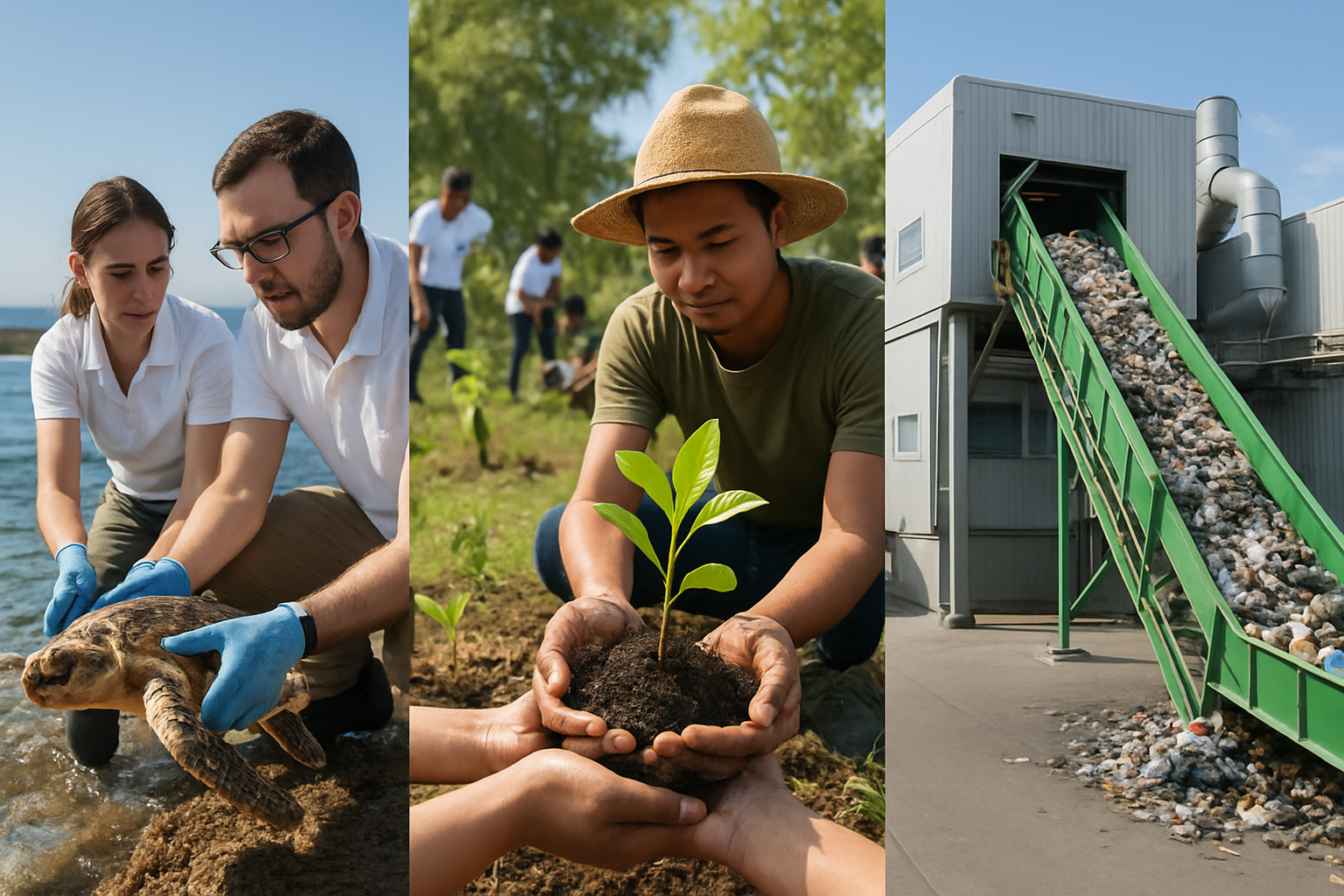
A coordinated surge of environmental conservation initiatives across Colombia, Kazakhstan, the Netherlands, and Uganda demonstrates an unprecedented global commitment to biodiversity protection as the planet endures its 19th consecutive month of temperatures exceeding 1.5°C above pre-industrial levels.
Four distinct yet interconnected conservation strategies reveal how nations are pioneering innovative approaches to environmental protection during a critical climate juncture, combining cutting-edge technology with traditional ecological knowledge to address accelerating environmental challenges.
Colombia's Wildlife Liberation Initiative
In Cali, Colombia, environmental authorities marked World Wildlife Day with a symbolic but significant wildlife release program at the COP16 Biodiversity Ecopark. The initiative, coordinated by DAGMA (Departamento Administrativo de Gestión del Medio Ambiente), in partnership with Colombia's Environmental Police and Cali's Public Prosecutor's Office, successfully returned several rescued animals to their natural habitats.
This release program represents a broader evolution in Colombia's approach to wildlife conservation, moving from reactive rescue operations to proactive ecosystem management. The timing coincides with March 3rd's World Wildlife Day, emphasizing Colombia's positioning as a regional leader in biodiversity protection within one of the world's most biodiverse nations.
Kazakhstan's National Biodiversity Strategy
Kazakhstan has approved an ambitious "Concept for the Conservation and Sustainable Use of Biological Diversity" for 2026-2035, as announced by the Ministry of Ecology and Natural Resources on March 3rd. This comprehensive ten-year framework defines state policy in nature protection, ecosystem restoration, and sustainable biodiversity use.
The strategy demonstrates Kazakhstan's commitment to international environmental obligations while addressing the unique conservation challenges of Central Asian steppes. The program integrates traditional Kazakh ecological knowledge with modern conservation science, incorporating satellite monitoring and environmental DNA sampling with centuries-old steppe management practices.
"This represents a fundamental shift toward proactive ecosystem service management," explains conservation analysts familiar with the program. The strategy supports Kazakhstan's existing conservation successes, including the remarkable Przewalski's horse reintroduction program, which has achieved steady adaptation to steppe environments with new foals expected in 2026.
Netherlands Marine Research Crisis
Dutch scientists are launching an urgent investigation into the declining common seal population in the Wadden Sea, a UNESCO World Heritage site. The Wadden Sea Heritage Centre (WEC) and University of Utrecht collaboration represents a critical response to concerning population trends in one of Europe's most important marine ecosystems.
The investigation employs advanced marine biology techniques, including environmental DNA sampling and satellite tracking, to understand factors contributing to seal population decline. Early findings suggest complex interactions between climate change, food source availability, and human maritime activities affecting traditional breeding and feeding patterns.
This research occurs as the Netherlands maintains its commitment to marine conservation, having recently rejected destructive seabed mining proposals in favor of precautionary ecosystem protection approaches that prioritize long-term ecological health over extractive industry development.
Uganda's Medicinal Plant Protection Challenge
Uganda faces a critical but overlooked conservation challenge: protecting medicinal plants that form the backbone of traditional healthcare systems while supporting millions of livelihoods. Environmental analyst Michael Wambi highlights how these vital species receive significantly less attention than iconic wildlife despite their crucial ecological and cultural importance.
The Warburgia ugandensis, a powerful medicinal plant featured in recent conservation photography, exemplifies the conservation challenge. This species faces severe pressure from overharvesting, habitat loss, and limited regulatory protection, despite its essential role in traditional medicine and ecosystem health.
Uganda's approach emphasizes community-based conservation management, recognizing that sustainable medicinal plant protection requires economic alternatives for communities dependent on traditional harvesting while maintaining cultural knowledge systems developed over generations.
Technology-Tradition Integration
Across all four nations, successful conservation demonstrates sophisticated integration of cutting-edge technology with traditional ecological knowledge. Colombia combines scientific wildlife management with Indigenous stewardship practices, Kazakhstan employs satellite monitoring enhanced by traditional steppe knowledge, the Netherlands utilizes environmental DNA sampling alongside maritime community expertise, and Uganda integrates modern conservation science with ancestral medicinal plant wisdom.
This synthesis represents the maturation of environmental protection strategies beyond purely technological or traditional approaches toward comprehensive, culturally sensitive frameworks that leverage the strengths of both knowledge systems.
Climate Crisis Context
These conservation initiatives emerge during an unprecedented period of global environmental stress. January 2026 marked the hottest month in recorded history, extending a streak of 19 consecutive months where global temperatures have exceeded the critical 1.5°C threshold above pre-industrial levels.
This sustained warming pattern overrides natural climate variability, including La Niña cooling effects that typically moderate global temperatures. Human-induced climate change has fundamentally altered Earth's atmospheric systems beyond natural recovery mechanisms, creating compound environmental effects that pressure wildlife populations while disrupting traditional conservation approaches.
Economic Development Strategy
Modern conservation increasingly functions as an economic development strategy rather than a regulatory burden. Colombia's wildlife programs support eco-tourism and international environmental leadership, Kazakhstan's biodiversity strategy attracts climate finance and research partnerships, the Netherlands' marine research enhances environmental credentials for sustainable investment, and Uganda's medicinal plant conservation preserves traditional knowledge systems while creating opportunities for pharmaceutical partnerships.
Countries implementing comprehensive environmental protection demonstrate greater economic resilience and consistently attract sustainable development investment across sectors from green technology manufacturing to nature-based tourism.
International Cooperation Framework
Success across these diverse conservation initiatives depends on unprecedented international cooperation. Environmental challenges transcend political boundaries—atmospheric systems, ocean currents, and species migrations connect ecosystems globally, making unilateral conservation efforts insufficient.
The diversity of approaches provides resilience against single-solution dependencies, offering multiple adaptation pathways for addressing complex environmental challenges. Knowledge sharing, technology transfer, and innovative financing enable smaller nations to implement sophisticated conservation programs that contribute to global environmental stability.
Implementation Challenges and Solutions
Common challenges across all four nations include funding sustainability, particularly for developing countries where immediate economic pressures often override long-term environmental considerations. Technical capacity building requires sustained investment in education, training, and institutional development, while climate change disrupts project timelines, demanding adaptive management approaches that can respond to rapidly changing environmental conditions.
Success factors consistently include community ownership and engagement, transparent governance frameworks, economic incentives that make conservation financially viable, and integration of traditional ecological knowledge with modern scientific approaches.
Strategic Global Significance
March 2026 represents a critical juncture for global environmental protection, presenting a choice between reactive crisis management and proactive ecosystem service management. The conservation initiatives across Colombia, Kazakhstan, the Netherlands, and Uganda demonstrate that coordinated international action can achieve remarkable environmental protection results even during Earth's most environmentally challenging period.
The environmental action window is narrowing rapidly as ecological systems approach critical thresholds that could trigger irreversible changes. However, the tools, knowledge, and cooperation frameworks exist for comprehensive environmental protection, as demonstrated by these diverse international initiatives.
Success depends on rapid scaling of these proven approaches through enhanced international cooperation, sustained financial commitments, and recognition of environmental protection as essential infrastructure for human prosperity and planetary sustainability. These four nations provide templates for comprehensive conservation that addresses climate adaptation, community resilience, and sustainable development simultaneously—a blueprint urgently needed as the world navigates the decisive climate action decade ahead.