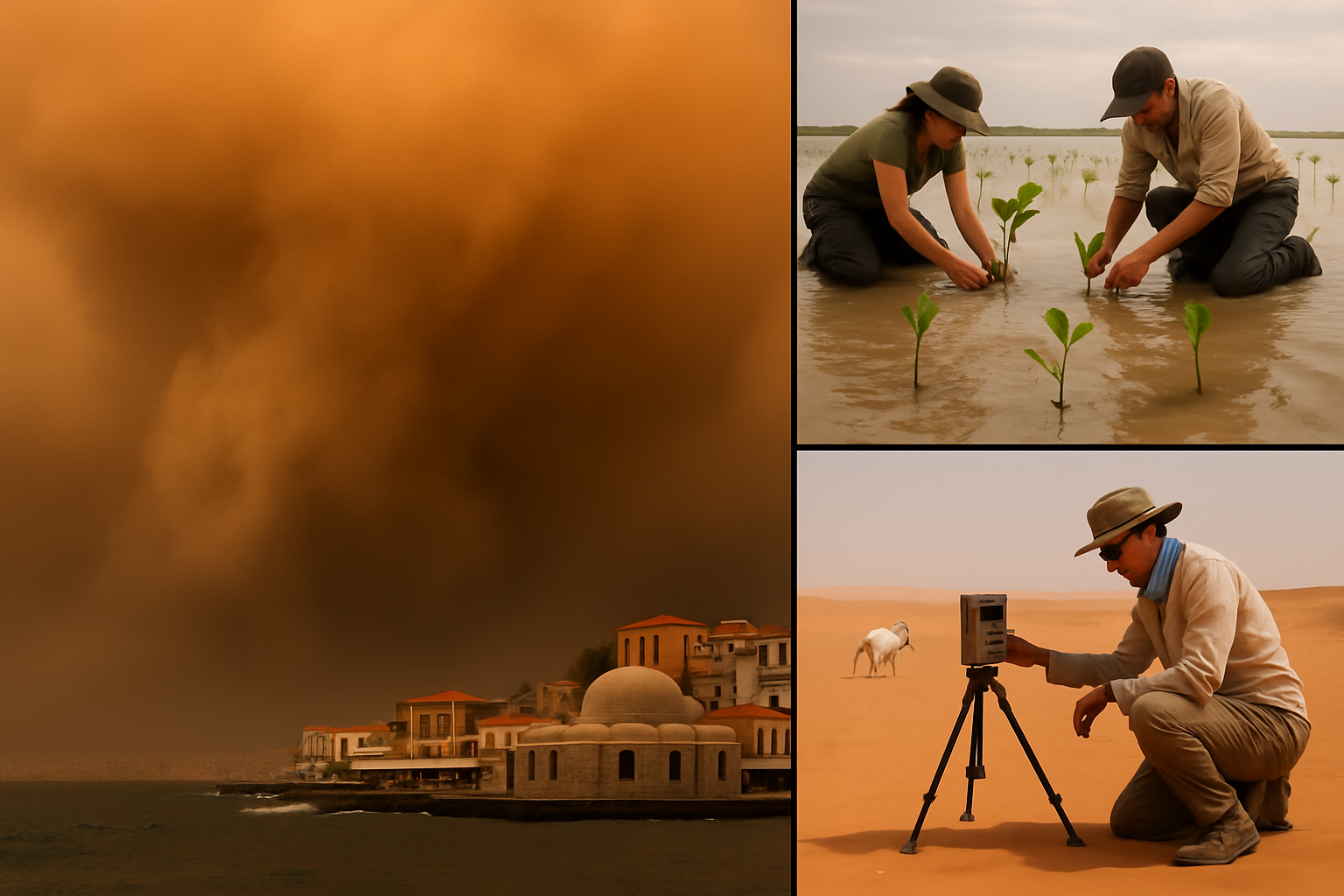
A toxic cloud of Sahara dust has paralyzed Greece's largest island while conservation breakthroughs across the globe reveal both the accelerating environmental crisis and unprecedented efforts to address it during what scientists confirm is the longest sustained warming period in recorded history.
Record quantities of Sahara dust have engulfed the Greek island of Crete, reducing visibility to under 500 meters in many areas as fine particle concentrations reached dangerous levels of 1,000 micrograms per cubic meter—20 times above World Health Organization safety standards. Nikos Kazantzakis International Airport in Heraklion reported significant delays and diversions to Athens due to hazardous landing conditions.
The orange-red fog that has transformed Crete's landscape represents just one manifestation of increasingly extreme weather patterns affecting multiple continents simultaneously. Serbian media reports describe the phenomenon as creating "tornado and chaos in aviation traffic" while Bulgarian authorities warn of unprecedented health risks from the prolonged dust exposure.
Caribbean Climate Investment Breakthrough
Amid the crisis, the Bahamas has secured a landmark $65.2 million investment to strengthen water systems against climate change impacts through financing from the Caribbean Development Bank and Green Climate Fund. This major funding represents a significant step in protecting island nations from mounting environmental pressures.
The initiative demonstrates the evolution from reactive disaster response to proactive infrastructure adaptation. As small island developing states face disproportionate climate impacts despite minimal contribution to global emissions, this investment model provides a template for climate finance mechanisms supporting the most vulnerable populations.
Wildlife Conservation Amidst Crisis
Conservation efforts across Latin America reveal both environmental destruction and remarkable recovery stories. In Bolivia, a female condor has returned to soar above La Paz skies after two months of intensive rehabilitation. Found dehydrated and disoriented in February, the bird's successful recovery at Bioparque Vesty Pakos illustrates the critical importance of wildlife rescue infrastructure.
"She arrived dehydrated, with low weight and disoriented. She was in very bad conditions," said Omar Rocha, director of Bioparque Vesty Pakos.
— Omar Rocha, Bioparque Director
Meanwhile, Colombia faces a conservation emergency as an injured Harpy Eagle weighing over 8 kilograms undergoes surgery in Pereira after being found with a fractured wing in Meta province. The female eagle, discovered in Las Delicias village in La Macarena municipality, represents the urgent need for wildlife protection infrastructure as habitat destruction forces dangerous human-wildlife encounters.
Finland's Digital Conservation Innovation
Finland's World Wildlife Fund has reopened its popular osprey camera, now featuring enhanced public engagement capabilities. Viewers can report nest activities and track observations made by others through WWF's website, representing the evolution of citizen science in conservation monitoring. This technology-community integration exemplifies how traditional wildlife observation combines with digital platforms to create comprehensive monitoring networks.
Such initiatives reflect a global conservation renaissance characterized by sophisticated synthesis of cutting-edge technology with traditional ecological knowledge and community-based management systems.
Climate Crisis Context
These environmental challenges unfold during what meteorologists confirm as unprecedented global warming. The current period represents the 22nd consecutive month of temperatures exceeding 1.5°C above pre-industrial levels—the longest sustained warming streak in recorded history, overriding natural cooling mechanisms including La Niña effects.
The convergence of extreme weather events, from Mediterranean dust storms to Caribbean water security threats to Latin American wildlife displacement, illustrates the interconnected nature of global environmental systems. Ocean currents, atmospheric patterns, and species migrations transcend political boundaries, making coordinated international responses essential.
Technology-Tradition Integration
Successful environmental protection increasingly depends on sophisticated integration of modern technology with traditional ecological knowledge. The Bahamas water security project employs advanced engineering while respecting traditional Caribbean water management practices. Bolivia's condor rehabilitation combines veterinary science with Indigenous bird knowledge, while Finland's digital osprey monitoring builds on decades of traditional birdwatching expertise.
This hybrid approach represents a fundamental evolution in environmental protection methodology, moving beyond either purely technological or traditional solutions toward comprehensive frameworks that combine scientific rigor with cultural sensitivity and community ownership.
Economic Dimensions of Environmental Action
Environmental protection increasingly functions as economic development strategy rather than regulatory burden. The Bahamas investment positions the nation as a regional leader in climate adaptation infrastructure, attracting additional sustainable investment. Bolivia's wildlife rehabilitation supports eco-tourism revenue while building international research partnerships. Finland's citizen science initiatives enhance the country's environmental technology sector reputation.
Countries implementing comprehensive environmental protection consistently demonstrate greater economic resilience, attract sustainable investment across multiple sectors, and reduce long-term infrastructure costs through natural disaster prevention and ecosystem service preservation.
Critical Action Window
Environmental scientists warn that the action window for effective climate response is rapidly narrowing as ecological systems approach critical thresholds that could trigger irreversible changes affecting global food security, climate stability, and human settlements. However, the coordinated initiatives across Greece's dust storm response, the Caribbean's climate adaptation, Latin America's wildlife conservation, and Finland's digital innovation demonstrate that comprehensive environmental protection is achievable through sustained international cooperation.
The current environmental convergence—combining extreme weather events with sophisticated conservation responses—represents a critical juncture between reactive crisis management and proactive ecosystem service management. Success depends on scaling these innovative approaches through enhanced international cooperation, increased financial commitments, and recognition of environmental protection as essential infrastructure for human prosperity and planetary sustainability.
Future Implications
The simultaneous occurrence of environmental crises and conservation breakthroughs in April 2026 may prove decisive for conservation approaches in the decades ahead. The integration of emergency response capabilities, long-term species management programs, community engagement initiatives, and international cooperation provides global templates that can be adapted while respecting local conditions and cultural priorities.
As the longest warming streak in human history continues, the choices made in responding to current challenges will influence environmental protection strategies for generations. The tools, knowledge, and cooperation frameworks exist for comprehensive environmental protection, but success depends on implementing solutions rapidly enough to match the pace of environmental change while protecting the natural systems upon which human prosperity depends.