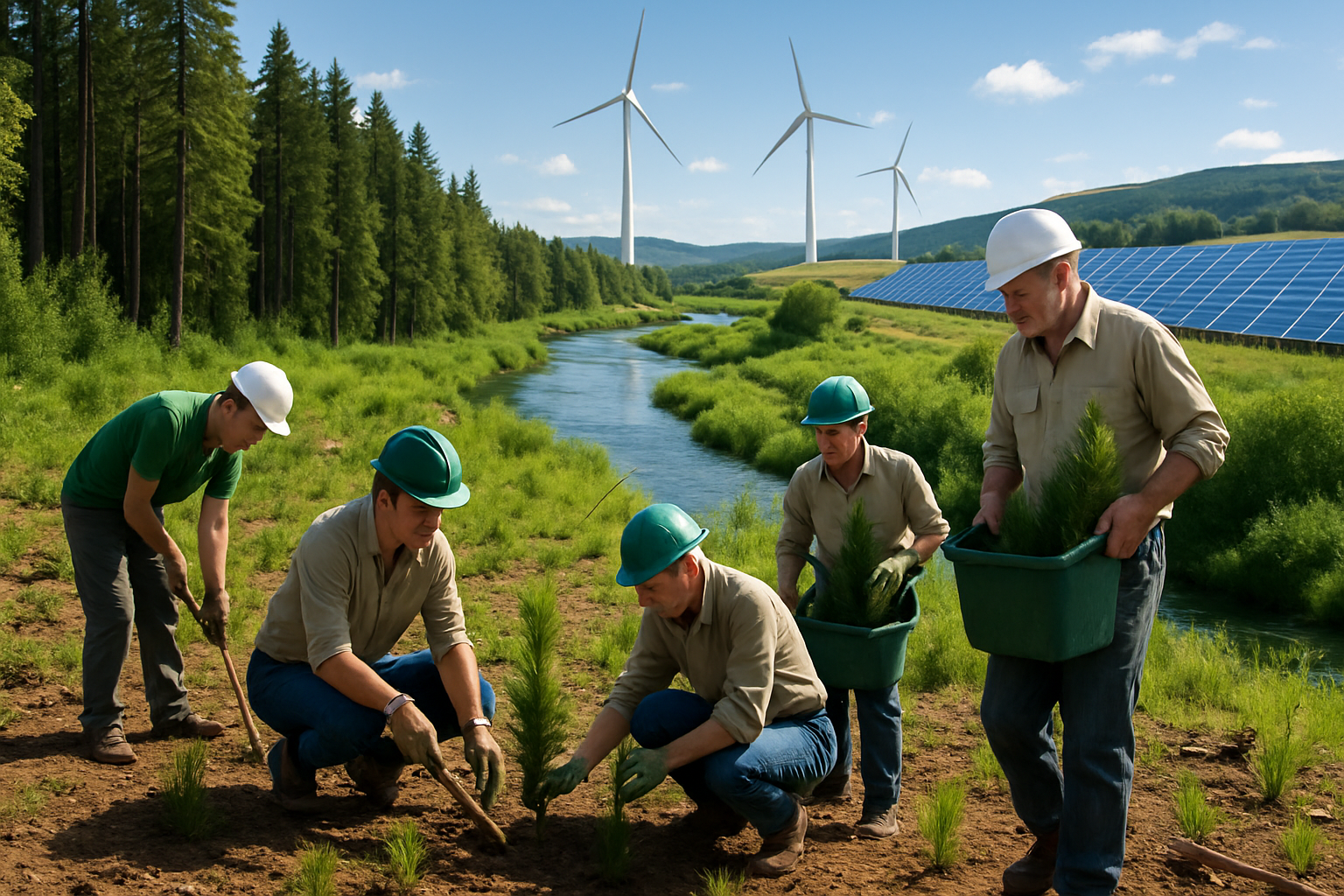
A coordinated surge in environmental protection policies across four nations demonstrates unprecedented global commitment to conservation amid accelerating climate challenges, as Malaysia expands forest reserves, Argentina addresses strategic environmental agendas, Belize halts river extraction, and Bangladesh confronts severe air pollution.
The wave of environmental initiatives spans continents and approaches, from Malaysia's groundbreaking 216,000-hectare forest expansion to Argentina's recognition of critical environmental-energy-food security intersections, representing the most comprehensive multinational environmental response during what scientists confirm as Earth's hottest recorded period.
Malaysia's Historic Forest Conservation Breakthrough
Sabah Chief Minister Datuk Seri Hajiji Noor announced Malaysia's most ambitious forest protection expansion, adding 216,000 hectares of new Totally Protected Areas through gazettement of commercial forest reserves and state land. This milestone achievement brings Sabah's protected areas to 2.227 million hectares, representing 30.06 percent of the state's total land area and exceeding the international conservation target of 30 percent.
"This milestone not only allows the 30 per cent TPA target to be met but also boosts Sabah's image as the State with the largest TPA in Malaysia," Hajiji declared during the Sabah Forestry Department's Excellent Service Awards ceremony. The expansion positions Malaysia as a regional conservation leader, demonstrating how developing nations can balance economic development with environmental protection.
The achievement represents sophisticated conservation planning that integrates traditional ecological knowledge with modern forest management techniques. Sabah's success provides a template for tropical nations facing pressure to balance immediate economic needs with long-term environmental sustainability, particularly as global demand for palm oil and timber continues to grow.
Argentina's Environmental Strategic Framework
Argentina's environmental discourse has evolved to recognize the critical intersection of food security, energy security, and environmental protection as three interconnected strategic agendas. This holistic approach, emerging from high-level policy discussions, acknowledges that environmental policies cannot be isolated from broader economic and security considerations.
The Argentine perspective, articulated through major policy forums, emphasizes that environmental protection must be understood within the context of global food systems and energy transitions. This integrated approach contrasts with traditional environmental policy that often treated conservation as separate from economic development, suggesting a maturing understanding of sustainability challenges.
Argentina's framework becomes particularly significant given the nation's role as a major agricultural exporter and its potential for renewable energy development. The country's vast agricultural lands and renewable energy potential position it as a critical player in global efforts to address climate change while maintaining food security.
Belize's Precautionary River Protection
Belize's government implemented immediate protective measures for the North Stann Creek River, halting all new sand and gravel extraction permits for 2026 and ordering comprehensive technical reassessment to determine safe extraction limits. The decision responds to years of advocacy by the Southern Workers Union, which argued that extraction activities threaten both communities and ecosystems in the region.
"Year after year for the past fifty years this place has been dredged, extraction of sand and moreover the painful reality is that many parts of Dangriga need landfill. Much poor people can't afford a load of sand to fill their yard," stated Mason Lewis, a Southern Workers Union member, highlighting the complex intersection of environmental protection and economic needs.
The moratorium demonstrates how small developing nations are implementing precautionary principles in environmental protection, prioritizing long-term ecosystem health over short-term economic benefits. The technical reassessment scheduled for the second quarter of 2026 will establish science-based extraction limits that balance environmental protection with local economic needs.
Bangladesh's Air Pollution Emergency
Bangladesh faces a severe environmental crisis as Dhaka ranks as the world's fifth-worst city for air pollution, with an Air Quality Index (AQI) of 194 indicating dangerous levels of particulate matter. This pollution crisis represents a critical public health emergency affecting millions of residents in one of the world's most densely populated urban areas.
The air pollution emergency in Bangladesh illustrates the complex environmental challenges facing rapidly developing nations, where industrial growth and urbanization often outpace environmental protection infrastructure. Dhaka's pollution levels reflect broader regional air quality issues affecting South Asian megacities, where coal-fired power plants, vehicle emissions, and industrial activities combine to create dangerous atmospheric conditions.
Bangladesh's pollution crisis contrasts sharply with the proactive conservation measures being implemented in Malaysia, Argentina, and Belize, demonstrating the varying stages of environmental awareness and response capacity across developing nations. The situation underscores the urgent need for international cooperation and technology transfer to address transboundary pollution challenges.
Climate Context and Global Implications
These environmental initiatives emerge during January 2026, confirmed as the hottest month in recorded history—the 18th consecutive month exceeding 1.5°C above pre-industrial levels. This unprecedented warming pattern overrides natural climate variability, including La Niña cooling effects, demonstrating that human-induced climate change has fundamentally altered Earth's atmospheric systems.
The coordination across diverse geographical and economic contexts—from Malaysia's tropical forests to Argentina's agricultural landscapes, Belize's coastal rivers to Bangladesh's urban centers—reflects an evolution from reactive crisis management toward proactive ecosystem service management. This shift represents sophisticated understanding that environmental protection requires integration of technological innovation, community engagement, and economic viability.
The convergence of climate change acceleration with environmental policy innovation creates both unprecedented challenges and opportunities. Nations implementing comprehensive environmental protection demonstrate greater economic resilience and attract sustainable development investment, while those failing to adapt face mounting costs from environmental degradation.
Technology and Traditional Knowledge Integration
Successful environmental protection across these four nations requires sophisticated synthesis of cutting-edge technology with traditional conservation knowledge. Malaysia's forest management combines satellite monitoring with indigenous forest stewardship practices. Argentina integrates advanced agricultural science with traditional farming knowledge. Belize balances modern environmental assessment with community-based resource management.
This technology-tradition integration represents a maturing approach to environmental protection that recognizes no single solution exists for complex environmental challenges spanning biological, physical, and human systems. Remote sensing, satellite tracking, and environmental monitoring provide real-time data supporting strategic planning, but remain insufficient without community engagement and traditional ecological knowledge systems.
Economic Development as Environmental Strategy
The February 2026 environmental initiatives demonstrate environmental protection functioning as economic development strategy rather than regulatory burden. Malaysia's forest expansion supports eco-tourism and international recognition. Argentina's integrated approach positions the country for sustainable agricultural and energy exports. Belize's river protection maintains long-term tourism and fishing industry viability.
This economic-environmental nexus shows that countries implementing comprehensive environmental protection policies demonstrate greater economic resilience and attract sustainable investment. Environmental protection creates job opportunities in conservation, monitoring, sustainable agriculture, and eco-tourism while reducing long-term costs from environmental degradation, health impacts, and climate adaptation.
Implementation Challenges and Success Factors
Despite significant progress, implementation challenges remain substantial across all four nations. Funding sustainability proves particularly challenging for developing countries where immediate economic pressures often override long-term environmental considerations. Technical capacity building requires sustained investment in education, training, and institutional development. Climate change disrupts traditional project timelines, requiring adaptive management capabilities.
Success factors identified across these initiatives include community ownership of environmental protection efforts, transparent governance frameworks, economic incentives that make conservation financially viable, and international cooperation providing technical assistance and knowledge sharing. The diversity of approaches provides resilience against single-solution dependencies while offering multiple pathways for adaptation.
Strategic Significance for Global Conservation
The February 2026 environmental protection surge represents a critical juncture demonstrating both the urgency of environmental challenges and the capacity for innovative human responses. The coordination across Malaysia's forest protection, Argentina's strategic integration, Belize's precautionary measures, and recognition of Bangladesh's pollution crisis provides templates for comprehensive environmental protection addressing multiple challenges while building local capacity.
The window for effective environmental action continues narrowing rapidly as climate impacts intensify, but the tools and knowledge for successful conservation exist through coordinated international response. These four nations' approaches—ranging from proactive expansion to precautionary protection to crisis recognition—offer crucial lessons for scaling environmental protection efforts globally.
The success of these initiatives depends on sustained international cooperation, enhanced coordination across scales and sectors, and increased financial commitments recognizing environmental protection as essential infrastructure for human prosperity and planetary sustainability. As climate challenges accelerate, the coordinated response emerging in February 2026 may determine whether conservation efforts can keep pace with environmental change during this critical decade for global climate action.