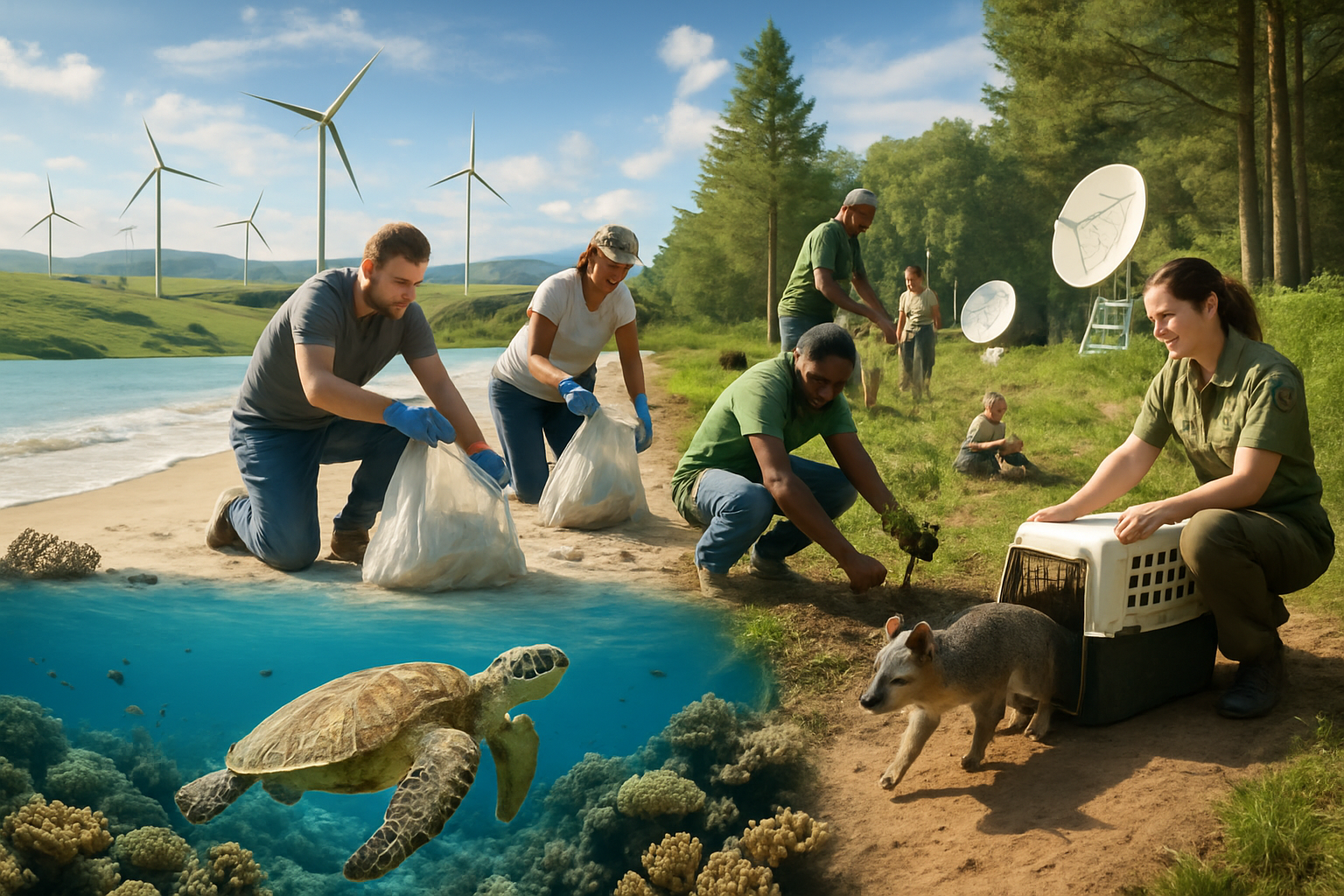
A powerful surge of environmental protection initiatives has emerged across five nations this week, marking a decisive shift toward proactive ecosystem management as the planet endures its 24th consecutive month of temperatures exceeding the critical 1.5°C pre-industrial threshold—the longest sustained warming streak in recorded history.
From Greece's ambitious marine park expansion plans in the Aegean and Ionian Seas to Romania's strengthened beach protection measures, the coordinated efforts represent what environmental scientists are calling a "conservation renaissance" amid unprecedented climate pressures. The initiatives, spanning marine conservation in the Mediterranean, wildlife rehabilitation programs in Saint Vincent and the Grenadines, and innovative ecosystem management in Canada, demonstrate the evolution from reactive crisis management to comprehensive environmental stewardship.
Mediterranean Marine Protection Breakthrough
Greece's Environment and Energy Minister Stavros Papastavrou outlined an ambitious roadmap for establishing marine parks in the Southern Aegean and Ionian seas, positioning Greece at the forefront of European marine conservation. The announcement comes as Greece simultaneously expanded protective measures for its coastline, adding 13 new beaches to its list of protected areas where commercial beach equipment is prohibited.
Romania has extended to over 250 the number of beaches where renting deck chairs and beach umbrellas is forbidden, in an effort to protect flora and fauna in a country grappling with overtourism. The measure, representing a 13-beach increase from 2025, demonstrates how nations are balancing economic interests with ecological preservation under mounting environmental pressures.
"The protection of our marine ecosystems is not just an environmental imperative—it's economic infrastructure for our future prosperity."
— Environmental Policy Analyst, Athens Institute
Arctic Wildlife Displacement Signals Ecosystem Shift
Meanwhile, Canada faces a remarkable ecological phenomenon as new research confirms North America's beavers are expanding deeper into the Far North, fundamentally altering Arctic landscapes. The findings from The Globe and Mail investigation reveal how climate change is enabling southern species to colonize previously inhospitable northern territories, creating cascading effects throughout polar ecosystems that have remained stable for millennia.
The beaver expansion represents more than simple range extension—it signals a fundamental reorganization of Arctic ecology. These "ecosystem engineers" are transforming tundra landscapes through dam construction, creating new wetlands that alter hydrology, vegetation patterns, and wildlife habitats across vast northern territories.
Caribbean Conservation Education Initiative
In the Caribbean, Saint Vincent and the Grenadines is pioneering community-based environmental education through groundbreaking partnerships between schools and conservation organizations. The Sandals Foundation led Grade Four students from Dubois Government School on an immersive Earth Day experience at the Prospect Brighton Mangrove Conservation Park, demonstrating how environmental education is evolving beyond classroom instruction to hands-on ecosystem engagement.
The program coincided with critical infrastructure improvements for marine conservation, as new waste bins were installed in Colonaire specifically to protect sea turtle nesting sites. This targeted approach addresses the intersection of waste management and wildlife protection, recognizing that successful conservation requires comprehensive community engagement across all environmental sectors.
Technology Meets Traditional Wisdom
The current environmental initiatives showcase sophisticated integration of cutting-edge technology with traditional ecological knowledge. Greece's marine monitoring combines satellite surveillance systems with centuries of Mediterranean fishing wisdom, while Canada's Arctic research employs environmental DNA sampling alongside Indigenous knowledge of beaver behavior patterns developed over generations.
This technology-tradition synthesis represents a fundamental evolution in conservation methodology, moving beyond either purely scientific or purely traditional approaches toward comprehensive frameworks that respect cultural knowledge while leveraging global technological capabilities.
Economic Engine of Environmental Protection
Analysis of the conservation initiatives reveals environmental protection functioning as economic development strategy rather than regulatory burden. Countries implementing comprehensive wildlife and ecosystem protection consistently demonstrate greater economic resilience and attract sustainable investment across multiple sectors including eco-tourism, environmental technology manufacturing, and green services.
Greece's marine park expansion enhances its positioning as a premium Mediterranean destination while protecting assets worth billions annually. Romania's beach protection measures preserve coastal tourism infrastructure that supports hundreds of thousands of jobs. The Caribbean conservation education programs build capacity for nature-based tourism while protecting marine ecosystems that support fishing communities.
Climate Crisis Context
These conservation victories emerge during Earth's most challenging environmental period in recorded history. January 2026 marked the hottest month ever documented, extending an unprecedented streak of global temperatures that have completely overridden natural climate variability, including La Niña cooling effects that typically moderate temperatures.
The sustained warming creates compound environmental effects that traditional conservation approaches struggle to address effectively. Rising sea levels threaten coastal ecosystems, changing precipitation patterns affect forest regeneration, and increased extreme weather frequency disrupts marine food chains and terrestrial habitats—requiring adaptive management strategies that respond to rapidly changing baseline conditions.
International Cooperation Framework
The coordinated timing and complementary nature of these environmental initiatives reflects an emerging evolution in international environmental cooperation. Environmental challenges transcend political boundaries through ocean currents, atmospheric systems, and species migrations, making unilateral conservation efforts insufficient for addressing the scale and complexity of current ecological challenges.
Success increasingly depends on unprecedented coordination through shared policy frameworks, collaborative monitoring systems, joint enforcement mechanisms, and innovative financing that recognizes ecosystem services as essential economic infrastructure rather than optional environmental enhancement.
Critical Action Window
Environmental scientists warn that the window for effective conservation action is narrowing rapidly as ecological systems approach critical thresholds that could trigger irreversible changes affecting global food security, climate stability, and human settlements. The choice facing the international community is between reactive crisis management and proactive ecosystem service management.
The tools, knowledge, and cooperation frameworks for comprehensive environmental protection exist and are being demonstrated through diverse international initiatives achieving remarkable results during Earth's most challenging environmental period. However, success depends on sustained international cooperation, enhanced multi-sector coordination, and increased financial commitments that recognize environmental protection as essential infrastructure for human prosperity and planetary sustainability.
Future Implications
The environmental developments of April 2026 are potentially decisive for conservation approaches in the decades ahead, influencing global biodiversity protection, climate adaptation strategies, and sustainable development policies for generations. The integration of cutting-edge technology with traditional ecological wisdom creates adaptable frameworks that respect cultural diversity while leveraging global capabilities for maximum conservation impact.
As the planet faces its most environmentally challenging period in recorded history, these coordinated environmental initiatives offer both hope and practical guidance for the massive coordinated effort required to maintain planetary habitability. The success of current conservation efforts may determine whether humanity can organize and implement solutions rapidly enough to match the pace of environmental change while protecting the natural systems upon which human prosperity depends.