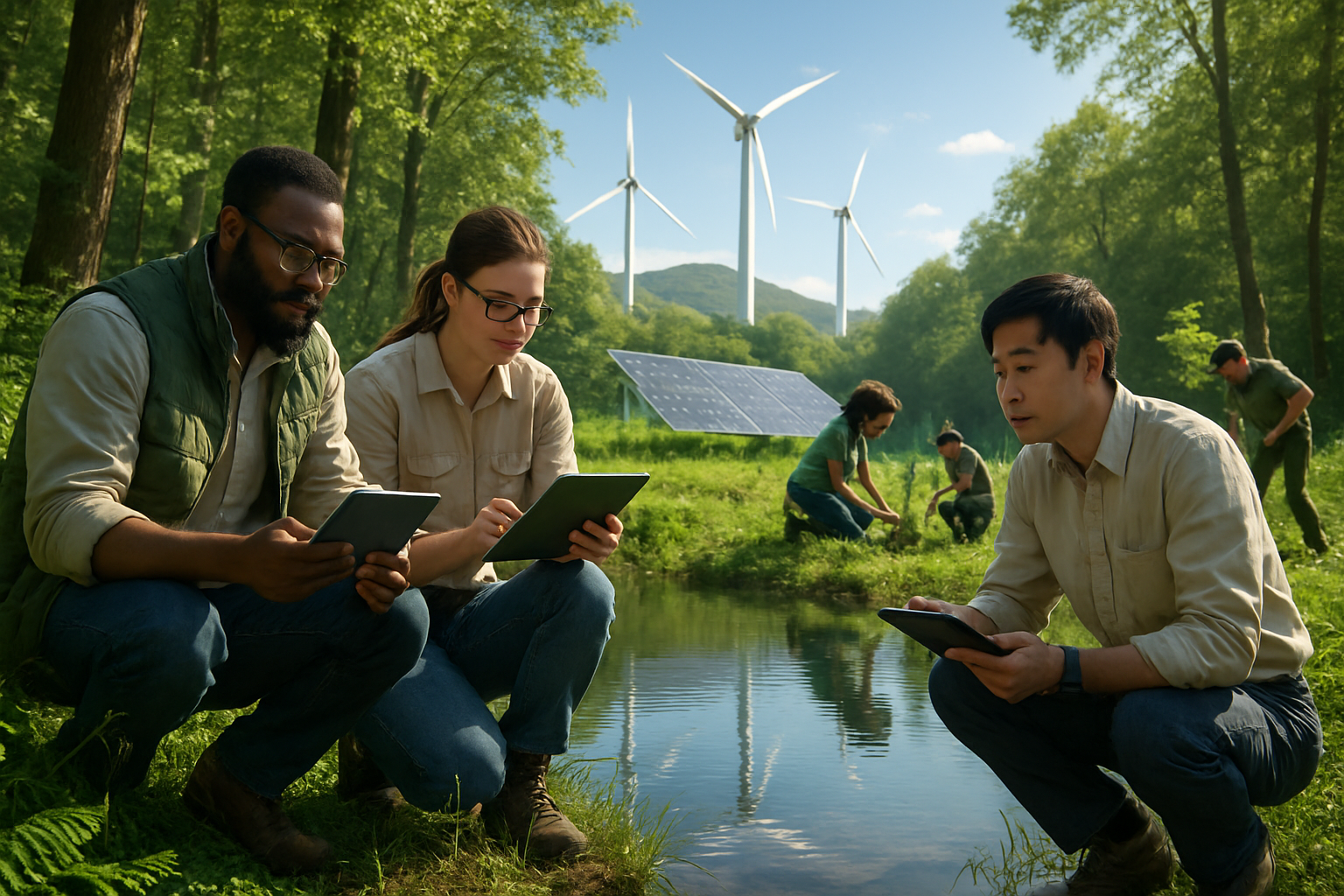
A remarkable surge of environmental initiatives spanning from Vienna's climate education tours to Guyana's groundbreaking health-climate research reveals an unprecedented global conservation renaissance, emerging precisely as the world enters its 22nd consecutive month of temperatures exceeding critical 1.5°C thresholds above pre-industrial levels.
Five distinct but interconnected conservation breakthroughs across Austria, Guyana, Latvia, Sweden, and Papua New Guinea demonstrate how communities worldwide are responding to the climate crisis through innovative synthesis of cutting-edge technology with traditional ecological knowledge, marking what environmental scientists increasingly call a decisive turning point in global environmental protection.
Vienna Pioneers Urban Climate Education Revolution
Austria's "Wiener Klima-Tour 2026" launched its new season at the Danaupark Butterfly Meadow, representing a fundamental evolution in environmental education. The mobile climate tour integrates biodiversity awareness with urban environmental engagement, transforming Vienna's green spaces into living laboratories for climate adaptation strategies.
The initiative reflects Austria's broader environmental leadership, building on recent achievements including comprehensive energy transitions in Styria region with 18 new wind zones and advancing geothermal renaissance technologies. This sophisticated integration of urban conservation with renewable energy demonstrates how European cities are pioneering comprehensive environmental frameworks addressing multiple climate challenges simultaneously.
"Environmental protection increasingly functions as economic development strategy versus regulatory burden, with countries implementing comprehensive protection showing greater economic resilience and sustainable investment attraction."
— Environmental Analysis, March 2026
Guyana Breaks New Ground in Climate-Health Research
The official launch of EarthMedic/EarthNurse (EM&EN) in Guyana on April 21 at the University of Guyana's College of Medical Sciences represents a revolutionary approach to understanding the climate-health nexus. This regional organization deepens scientific understanding of the growing links between climate change and public health, positioning Guyana as a leader in tropical climate medicine research.
The initiative builds on Guyana's remarkable environmental momentum, including breakthrough mangrove restoration research by Dr. Mark Ram, whose four-year marine ecology project provides crucial models for mangrove restoration worldwide. The methodology combines environmental DNA sampling, satellite monitoring, and community-based management while respecting traditional ecological knowledge.
Baltic Innovation in Species Management
Latvia's innovative approach to invasive species management demonstrates sophisticated ecosystem protection strategies. Cēsis Municipality's intensified campaign against Spanish slugs (Arion vulgaris) represents proactive ecosystem management addressing biological invasions that threaten native biodiversity.
Simultaneously, Sweden advances protective frameworks for native species, with hedgehogs and eels newly proposed for protection status by the Swedish Environmental Protection Agency. These initiatives reflect broader Nordic leadership in conservation methodology evolution, moving beyond reactive crisis management toward comprehensive ecosystem service management.
Sweden Confronts Pollen Season Reality
Sweden's acknowledgment of intensifying birch pollen seasons provides sobering evidence of climate change impacts on human health and ecosystem relationships. Pollen expert Björn Gedda's warning that "this week will be troublesome" reflects how even a single birch tree can release billions of pollen particles, demonstrating climate change's far-reaching effects on seasonal patterns that have remained stable for millennia.
The pollen crisis intersects with broader conservation challenges as warming temperatures disrupt traditional ecological relationships, affecting everything from pollinator timing to forest regeneration cycles that Nordic countries depend upon for both economic and environmental stability.
Papua New Guinea's Global Conservation Leadership
Papua New Guinea emerges as a global conservation innovation leader, containing 6% of global biodiversity within just 0.5% of world's land area. This extraordinary biodiversity concentration creates unparalleled tropical conservation expertise that PNG conservation leaders share through international partnerships, research collaborations, and technical assistance programs.
The nation's 800+ languages represent diverse cultural systems providing invaluable community-based conservation lessons worldwide, combining traditional ecological knowledge with modern conservation science. This synthesis represents fundamental conservation methodology evolution beyond purely technological or traditional approaches toward comprehensive frameworks respecting cultural sensitivity while leveraging scientific rigor.
Technology-Tradition Synthesis Drives Success
The most successful environmental initiatives consistently demonstrate sophisticated integration of cutting-edge technology with traditional ecological knowledge and community-based management. Austria's climate tours combine modern environmental monitoring with historical urban planning wisdom, while Guyana's research leverages advanced medical technology with traditional Caribbean health practices.
This synthesis represents a fundamental departure from either purely technological or traditional approaches toward comprehensive frameworks that combine scientific rigor with cultural sensitivity and community ownership. Environmental DNA sampling, satellite monitoring, and AI-powered analysis work alongside traditional tracking techniques, indigenous resource management systems, and generations of accumulated ecological wisdom.
Economic Development Through Environmental Protection
These environmental initiatives demonstrate how protection functions as economic development strategy rather than regulatory burden. Countries implementing comprehensive environmental protection consistently show greater economic resilience and attract sustainable investment across multiple sectors including eco-tourism, green technology manufacturing, and environmental services.
Economic analyses consistently show that ecosystem services from intact natural systems often deliver greater long-term benefits than resource extraction activities. Wetlands prevent billions in flood damage, forests regulate water and climate patterns, and biodiversity hotspots support pharmaceutical research and eco-tourism worth hundreds of billions annually.
Climate Crisis Context
These conservation breakthroughs emerge during Earth's most challenging environmental period in recorded history. January 2026 marked the hottest month ever recorded, extending an unprecedented streak of sustained warming that has completely overridden natural climate variability, including La Niña cooling effects that typically moderate global temperatures.
Human-induced climate change has fundamentally altered atmospheric systems beyond natural recovery mechanisms, creating compound environmental effects that traditional conservation approaches struggle to address. Rising sea levels threaten coastal ecosystems, changing precipitation patterns affect forest regeneration, and increased extreme weather frequency disrupts marine food chains and terrestrial habitats.
Critical Action Window Narrowing
Environmental scientists warn that the action window for effective climate intervention is rapidly narrowing as ecological systems approach critical thresholds that could trigger irreversible changes affecting global food security, climate stability, and human settlements. However, the tools, knowledge, and cooperation frameworks exist for comprehensive environmental protection, as demonstrated by these diverse international initiatives.
Success depends on sustained international cooperation, enhanced multi-sector coordination, and increased financial commitments that recognize environmental protection as essential infrastructure for human prosperity and planetary sustainability. The convergence of innovation, cooperation, and political commitment emerging in April 2026 provides a foundation for hope regarding humanity's capacity to protect the environmental systems upon which all life depends.
International Cooperation Evolution
The coordinated timing of these complementary environmental initiatives reflects an evolution in international environmental cooperation. Success increasingly depends on knowledge sharing that creates global networks, strengthening local capacity while contributing to planetary sustainability. This represents a shift from traditional North-South aid relationships toward peer-to-peer cooperation, recognizing that developing nations are increasingly becoming environmental solution providers.
The diversity of approaches provides resilience against single-solution dependencies, offering multiple adaptation pathways for complex environmental challenges that span biological, physical, and human systems. From Vienna's urban climate education to Papua New Guinea's biodiversity expertise, each initiative contributes essential pieces to a global conservation puzzle.
Future Implications
These April 2026 environmental developments may prove decisive for conservation approaches in the decades ahead, potentially influencing global biodiversity protection, climate adaptation, and sustainable development strategies for generations. The integration of cutting-edge technology with traditional ecological wisdom creates adaptable frameworks that respect cultural diversity while leveraging global technological capabilities.
The success or failure of current environmental initiatives may determine humanity's adaptive capacity for protecting the essential natural systems upon which life depends during this unprecedented environmental challenge period. The emerging "conservation renaissance" offers both inspiration and practical templates for the massive coordinated effort required to maintain planetary habitability during the most environmentally challenging period in recorded history.