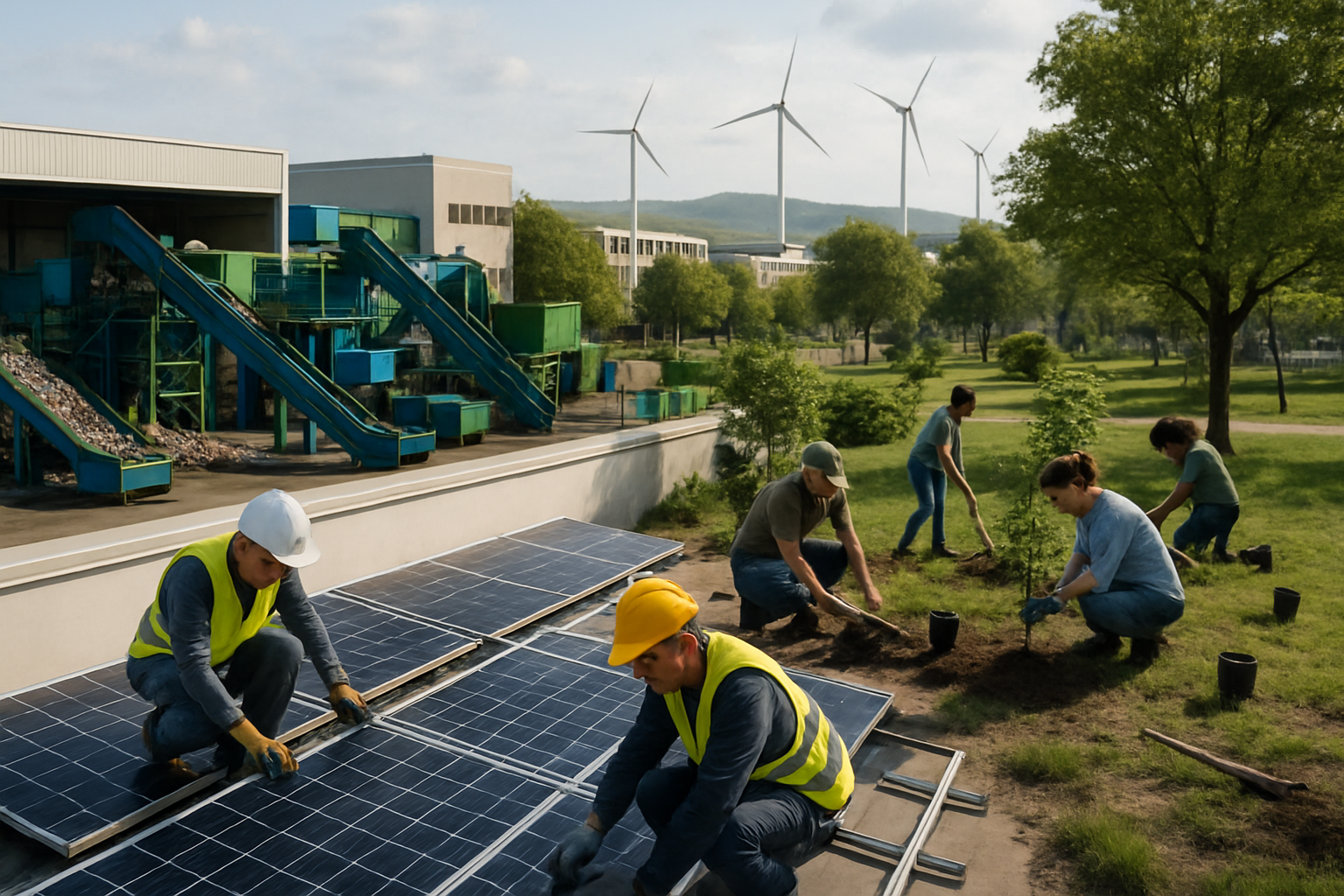
Environmental initiatives are accelerating worldwide as Austria advances multi-stakeholder innovation workshops for sustainable transport packaging, Nicaragua expands recycling networks across Managua, and Portugal launches a nationwide bottle deposit system—all part of an unprecedented global environmental renaissance occurring during Earth's most challenging climate period in recorded history.
The convergence of environmental action across four nations demonstrates a fundamental shift from reactive crisis management to proactive ecosystem service management, as temperatures continue to exceed critical climate thresholds for the 21st consecutive month. These developments build on a remarkable pattern of international environmental cooperation that has emerged throughout 2026, with over 50 nations implementing comprehensive sustainability programs during a period of accelerating climate change.
Austria's Climate Lab Revolution
Austria is pioneering multi-stakeholder innovation workshops through its Climate Lab initiative, focusing on "reusable transport packaging" and "sustainable procurement" as key drivers of economic transformation. The program represents a sophisticated evolution from traditional environmental regulations to collaborative market-based solutions that treat sustainability as an economic opportunity rather than a regulatory burden.
The initiative demonstrates Austria's commitment to accelerating the economic transition through systematic innovation workshops that bring together businesses, researchers, and policymakers. This approach has attracted international attention as a template for transforming industrial practices while maintaining economic competitiveness. Austrian companies participating in the program report significant cost savings while reducing their environmental footprint through innovative packaging solutions.
"The Climate Lab represents our vision for Austria as a leader in sustainable business practices, showing that environmental protection and economic growth are not just compatible—they're mutually reinforcing."
— Austrian Climate Lab Director
Enzyme Innovation Transforms Waste Management
In a parallel development, Austrian researcher Dr. Sara Vecchiato has received the National "Net Zero Industries" Award for groundbreaking work in enzyme-based diaper recycling. This innovation addresses one of the most challenging waste streams in modern society, transforming what was previously non-recyclable material into valuable resources through sophisticated biotechnology.
The enzyme recycling technology represents a breakthrough in circular economy applications, offering solutions for materials that have traditionally ended up in landfills. Dr. Vecchiato's research has attracted international partnerships and investment, positioning Austria at the forefront of biotechnology applications for environmental challenges.
Nicaragua's Urban Recycling Expansion
Walmart has significantly expanded its recycling network in Managua with five new stations, promoting waste reduction and responsible consumption among the Nicaraguan population. This initiative represents a major corporate commitment to environmental sustainability in Central America, providing accessible recycling infrastructure for urban communities.
The expansion demonstrates how international corporations are adapting their environmental strategies to local contexts while supporting national sustainability goals. The new recycling stations are strategically located to serve diverse neighborhoods, making participation convenient for residents across economic levels. The program includes educational components to increase public awareness about waste reduction and the importance of responsible consumption patterns.
Nicaragua's recycling infrastructure development aligns with broader Central American environmental initiatives, including regional cooperation on marine conservation and sustainable agriculture. The program has already shown measurable results in waste diversion from landfills and increased community participation in environmental protection activities.
Portugal's Revolutionary Bottle Deposit System
Portugal has implemented a nationwide bottle deposit system where plastic bottles can be returned for a 10-cent refund, representing the most comprehensive container deposit program in Southern Europe. The system became operational across the entire country, marking a significant milestone in Portugal's circular economy transformation.

The deposit system addresses multiple environmental challenges simultaneously: reducing plastic waste, decreasing landfill pressure, and creating economic incentives for environmental behavior. Early implementation data shows remarkable public participation rates, with collection points reporting steady streams of returns throughout the day.
Portuguese environmental authorities estimate the system could divert millions of plastic bottles from waste streams annually while generating employment in collection, processing, and recycling industries. The program builds on Portugal's broader circular economy initiatives, which have positioned the country as a regional leader in sustainable waste management.
Global Climate Context and Environmental Urgency
These environmental initiatives emerge during an unprecedented climate period, with January 2026 marking the hottest month in recorded history and the 21st consecutive month that global temperatures have exceeded 1.5°C above pre-industrial levels. This sustained warming has fundamentally altered atmospheric systems beyond natural recovery mechanisms, creating compound environmental effects that traditional conservation approaches struggle to address.
The persistence of extreme temperatures has overridden natural climate variability, including La Niña cooling effects that typically moderate global temperatures. Scientists report that human-induced climate change has fundamentally altered Earth's atmospheric systems, making rapid environmental action more crucial than ever before.
Technology-Tradition Integration Success
The most successful environmental programs consistently demonstrate sophisticated synthesis of cutting-edge technology with traditional ecological knowledge and community-based management. Austria's innovation workshops combine advanced materials science with established business practices, while Nicaragua's recycling expansion builds on existing community networks and traditional resource conservation values.
Portugal's bottle deposit system leverages digital tracking technology while respecting traditional recycling behaviors that have existed in Portuguese communities for generations. This integration approach has proven superior to purely technological solutions that ignore local contexts and community needs.
Economic Development Through Environmental Protection
Modern environmental protection increasingly functions as an economic development strategy rather than a regulatory burden. Countries implementing comprehensive environmental programs demonstrate greater economic resilience and attract sustainable investment across multiple sectors, including eco-tourism, green technology manufacturing, and environmental services.
The economic benefits extend beyond direct environmental sectors. Austria's packaging innovations create specialized employment in design and engineering, Nicaragua's recycling expansion generates jobs in waste management and logistics, and Portugal's deposit system supports new industries in collection and processing technologies.
"Environmental protection has become our competitive advantage. Companies worldwide want to partner with nations that can demonstrate real environmental leadership."
— Portuguese Environment Minister
International Cooperation and Knowledge Sharing
Success in environmental protection requires unprecedented international cooperation, as atmospheric systems, ocean currents, and species migrations cross political boundaries, making unilateral efforts insufficient. The diversity of approaches demonstrated by Austria, Nicaragua, and Portugal provides resilience against single-solution dependencies and offers multiple adaptation pathways for different economic and cultural contexts.
Knowledge sharing networks have emerged among participating nations, creating global frameworks for successful environmental approaches that can be adapted to different contexts while respecting local conditions and cultural priorities. This represents an evolution from traditional North-South aid relationships toward peer-to-peer cooperation that recognizes developing nations as environmental solution providers.
Implementation Challenges and Success Factors
Environmental initiatives face common implementation challenges, particularly regarding funding sustainability in developing nations where immediate economic pressures can override long-term environmental considerations. Technical capacity building requires sustained investment in education, training, and institutional development that extends beyond initial program launches.
Climate change itself disrupts project timelines and operational conditions, requiring adaptive management approaches that can respond to rapidly changing environmental circumstances. However, the diversity of successful approaches provides resilience through multiple complementary strategies that reinforce each other's effectiveness.
Success factors consistently include community ownership and engagement, transparent governance frameworks, economic incentives that make environmental protection financially viable, and sophisticated integration of traditional ecological knowledge with modern environmental science.
Critical Action Window and Future Implications
April 2026 represents a critical juncture in global environmental protection, with the choice between reactive crisis management and proactive ecosystem service management determining whether conservation efforts can keep pace with accelerating environmental change during this decisive climate action decade.
The environmental action window is narrowing rapidly as ecological systems approach critical thresholds that could trigger potentially irreversible changes affecting global food security, climate stability, and human settlement patterns. However, the tools, knowledge, and cooperation frameworks for comprehensive environmental protection exist, as demonstrated by these diverse initiatives.
Global Scaling Potential
The integration of cutting-edge technology with traditional ecological wisdom creates adaptable frameworks that respect cultural diversity while leveraging global capabilities. The environmental renaissance of 2026 offers practical templates for rapid scaling of environmental protection efforts globally, providing hope for maintaining planetary habitability during Earth's most challenging environmental period in recorded history.
These initiatives provide comprehensive blueprints for addressing environmental challenges through coordinated approaches that build local capacity while fostering international cooperation. Success depends on sustained international cooperation, enhanced coordination across multiple sectors and scales, and increased financial commitments that recognize environmental protection as essential infrastructure for human prosperity and planetary sustainability.
As the world faces the decisive climate action decade, the coordinated environmental response demonstrated by Austria, Nicaragua, and Portugal offers templates for the kind of comprehensive action required to address environmental challenges at the speed and scale demanded by our current crisis. The window for effective environmental action is narrowing, but the convergence of innovation, cooperation, and commitment demonstrated in April 2026 provides a foundation for hope in humanity's capacity to protect the environmental systems upon which all life depends.