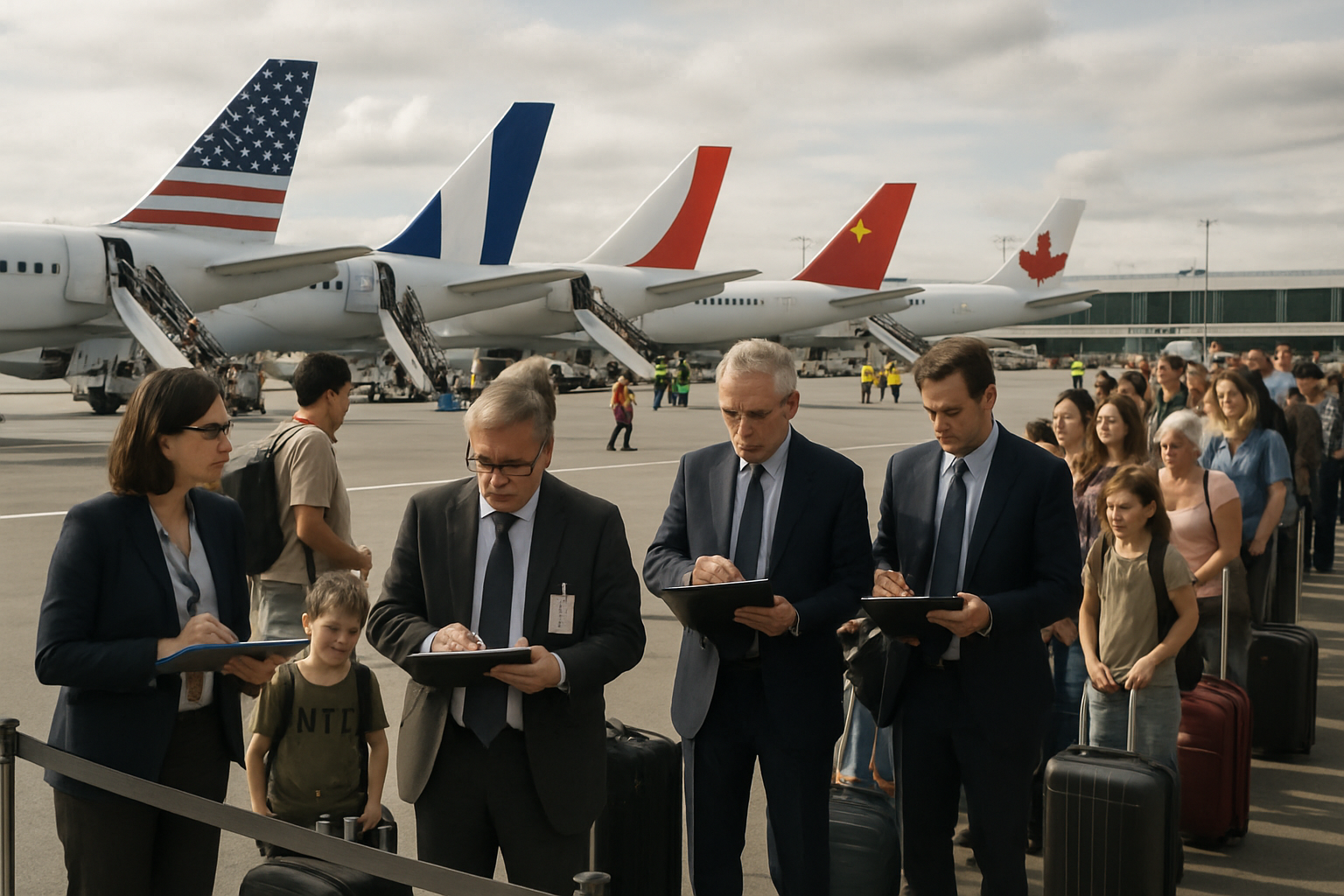
In what marks the largest coordinated international evacuation operation since the Arab Spring of 2011, multiple nations are conducting emergency repatriation flights to extract hundreds of thousands of citizens from Middle East conflict zones, with operations intensifying as the regional crisis enters its seventh day.
The evacuations come as eight countries—Iran, Iraq, Israel, UAE, Qatar, Syria, Kuwait, and Bahrain—maintain simultaneous airspace closures following the escalation that began March 1, 2026. Dubai International Airport, the world's busiest with over 86 million passengers annually, remains completely shut down after sustaining missile damage, creating cascading effects across global aviation networks.
Major Evacuation Operations
Multiple countries have activated emergency protocols to extract their nationals from the affected region:
- Estonia: The first two evacuation flights carrying Estonian tourists from Oman and Dubai landed at Tallinn Airport in the early hours of Saturday morning, marking a successful beginning to the Baltic nation's repatriation efforts.
- Latvia: airBaltic operated multiple repatriation flights from Dubai to Riga, with the country's Ministry of Foreign Affairs coordinating the operations in cooperation with the national airline due to the ongoing military conflict.
- Malta: A coordinated evacuation flight from the UAE brought home 187 Maltese nationals, with Foreign Minister Ian Borg confirming the group's safe arrival and thanking diplomatic teams involved in the mission.
- Australia: An estimated 500 Australians arrived overnight, with many more exploring alternative routes as the country faces the challenge of evacuating over 115,000 nationals trapped in the region.
- New Zealand: Emirates flight EK448 from Dubai arrived at Auckland Airport to applause at 11:30 AM Saturday, bringing relief to stranded citizens.
- South Korea: A chartered plane is scheduled to evacuate South Koreans from the UAE on Sunday, according to government ministry sources.
European Coordination Efforts
The European Union has demonstrated unprecedented coordination in managing the crisis, with Cyprus activating its ESTIA evacuation plan for the first time in history. This national evacuation protocol is designed to coordinate the extraction of European and third-country nationals from crisis zones.
Cyprus Foreign Minister Kombos has been coordinating emergency EU Foreign Affairs Council sessions, managing the evacuation of over 2,000 registered nationals from the UAE in coordination with British authorities. This represents a watershed moment in EU crisis management, demonstrating coordinated response capabilities that could serve as a template for future emergencies.
"This is the first implementation of our ESTIA plan, and it shows how European nations can work together to protect our citizens during international crises."
— Constantinos Kombos, Cyprus Foreign Minister
Other European nations have also mobilized significant resources:
- Germany: Launched specialized flights to extract approximately 30,000 stranded tourists
- Norway: Operating Oman-Oslo flights with priority given to families, pregnant women, and those with medical needs
- Sweden and Serbia: Ordered immediate evacuations from Iran citing "extremely uncertain" security conditions
- Luxembourg: Evacuated 104 passengers via Muscat flights
Aviation Crisis Context
The evacuation operations are taking place against the backdrop of the most extensive global aviation disruption since the COVID-19 pandemic. Over 18,000 flights have been cancelled worldwide, with major carriers including Emirates, Air France-KLM, Wizz Air, and Bulgaria Air suspending operations indefinitely.
The simultaneous closure of multiple Middle Eastern airspaces has eliminated critical Europe-Asia hub connections, forcing airlines to implement emergency protocols including enhanced fuel loading, complex rerouting through alternative paths, and dramatically increased operational costs.
Energy and Economic Implications
The crisis has created parallel disruptions in global energy markets, with oil prices surging over 10% to above $80 per barrel as Iran declared the Strait of Hormuz—through which 40% of global oil transit flows—"unsafe" for shipping. Natural gas prices have increased by 24% in Europe and 78% in the United States.
Major shipping companies Maersk and MSC have suspended operations in the Persian Gulf, leaving over 150 oil and LNG tankers stranded with billions of dollars worth of cargo. Qatar has halted LNG production, affecting approximately 20% of global exports.
Diplomatic Background
The current crisis stems from the complete collapse of US-Iran nuclear negotiations, despite achieving what diplomats called a "broad agreement on guiding principles" in Geneva—the most progress since the JCPOA framework collapsed in 2018. Fundamental disagreements over scope proved insurmountable, with Iran excluding ballistic missiles and regional proxies as "red lines" while the US demanded a comprehensive approach including missiles, armed groups, and human rights.
This diplomatic breakdown led to Operation Epic Fury, described as the largest US-Israeli coordinated military operation since 2003, which has triggered massive Iranian retaliation operations across the region.
Regional Coalition Under Strain
The crisis has severely tested an unprecedented diplomatic consensus among Saudi Arabia, UAE, Qatar, and Egypt that had been supporting diplomatic solutions. Iranian retaliation has directly targeted territories of coalition members, with casualties reported in the UAE (1 civilian killed in Abu Dhabi), Kuwait (32 injured in airport strikes), and Qatar (8 injured while intercepting 65 missiles and 12 drones).
Egyptian President Sisi has condemned attacks on "sisterly Arab countries," warning of "comprehensive chaos" if the situation continues to escalate.
Individual Stories of Evacuation
Behind the large-scale numbers are individual stories of citizens caught in the crisis. Swedish traveler Emily Grosser reportedly paid $6,000 for alternative routing from Paris to Australia, highlighting the extreme costs faced by stranded passengers. Twenty-eight Romanian students were blocked at Dubai airport, while various diplomatic missions have worked around the clock to assist their nationals.
The human dimension of the crisis extends beyond logistical challenges to emotional reunions, as demonstrated by the applause that greeted arriving passengers at Auckland Airport and the relief expressed by families successfully evacuated from the conflict zones.
Historical Significance
Security analysts describe the current evacuation operations as the most significant international civilian protection effort since the Arab Spring of 2011. The scale and complexity of the operation—with multiple nations simultaneously activating emergency protocols across numerous Middle Eastern countries—represents an unprecedented test of international crisis management capabilities.
The success or failure of these coordination efforts is likely to influence diplomatic and crisis management approaches for decades, potentially serving as a template for future international emergency responses in an increasingly volatile multipolar world.
Recovery Timeline Uncertain
Unlike weather-related disruptions that typically have predictable recovery timelines, the current crisis depends entirely on the resolution of military operations and diplomatic tensions. Airlines are conducting daily operational reviews but cannot make long-term scheduling decisions while airspace remains closed and security conditions unstable.
Even when normal operations resume, aviation industry experts estimate that clearing the backlog of stranded passengers and cancelled flights could take weeks, with fundamental questions being raised about over-dependence on Middle Eastern hub airports for global connectivity.
The crisis has exposed vulnerabilities in modern transportation networks and international supply chains, forcing a reconsideration of route planning, risk assessment procedures, and enhanced contingency planning for geopolitical volatility in strategic regions.
Looking Forward
As evacuation operations continue, the international community faces its greatest test of multilateral cooperation and crisis management in the modern era. The decisions made in the coming days and weeks will reverberate through international relations for decades, potentially determining whether diplomatic or military solutions become the preferred approach to conflict resolution in the 21st century.
The current evacuation efforts demonstrate both the capacity for rapid international mobilization and the critical importance of pre-existing diplomatic relationships and coordination mechanisms. Success in safely extracting hundreds of thousands of civilians could provide a valuable framework for future emergency responses, while failure could fundamentally reshape approaches to civilian protection in an increasingly interconnected yet volatile world.