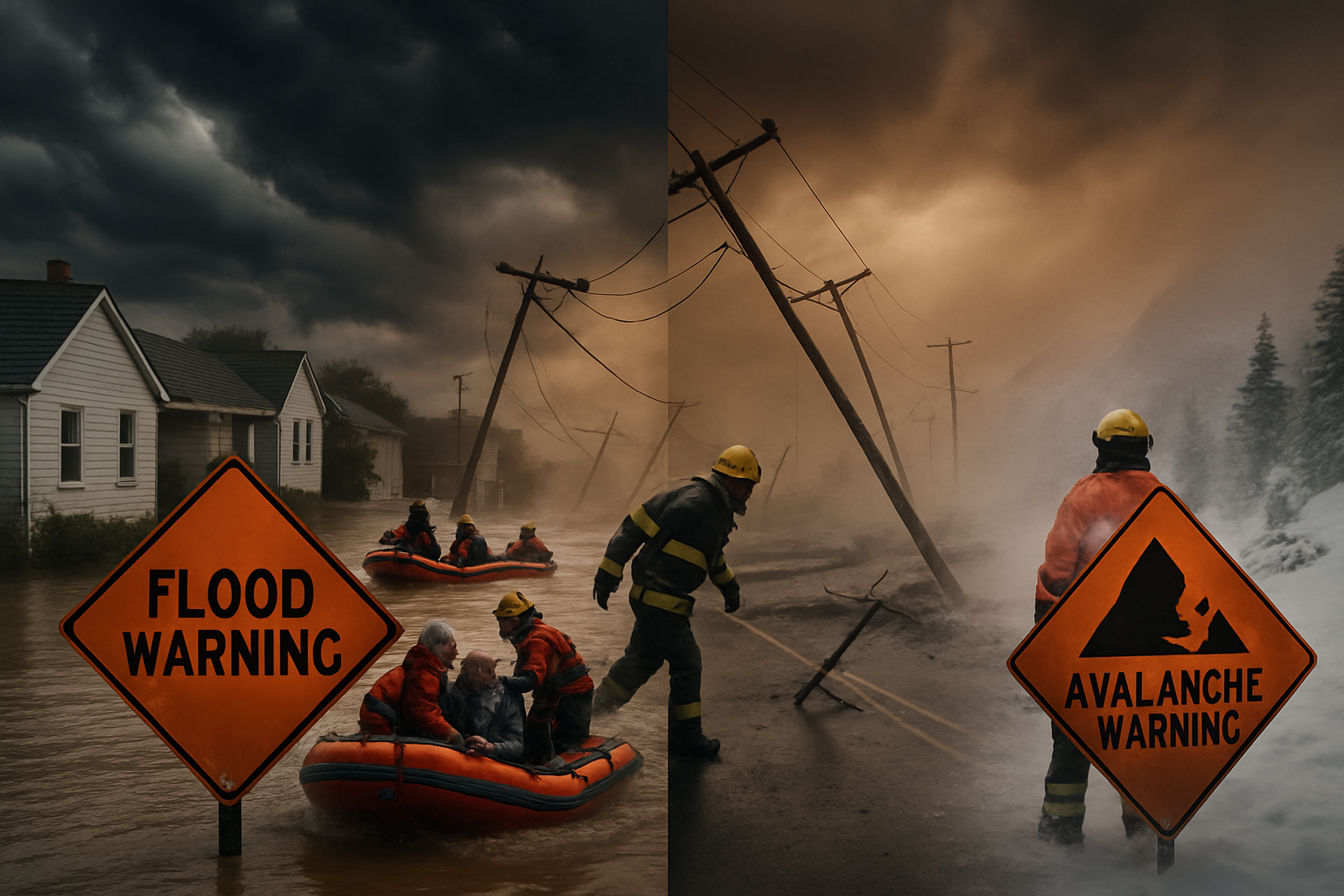
In an unprecedented display of climate volatility, eleven nations across four continents are simultaneously battling extreme weather disasters during what scientists confirm is the 23rd consecutive month of global temperatures exceeding the critical 1.5°C pre-industrial threshold – the longest sustained extreme warming period in recorded human history.
The coordinated chaos unfolding from the Democratic Republic of Congo to Ireland represents a fundamental shift in how extreme weather operates, with traditional emergency response systems designed for sequential disasters now overwhelmed by concurrent multi-continental crises that are straining international cooperation frameworks to their breaking point.
Europe Under Siege: Storm Dave and Avalanche Emergencies
Iceland's meteorological services have issued yellow warnings across the entire country as a severe blizzard system threatens to paralyze the island nation through Tuesday night. The Icelandic Met Office warns of winds reaching 18-28 metres per second with gusts potentially exceeding 40 m/s in southern regions, accompanied by heavy snowfall that could create "considerable traffic disruptions and worsening driving conditions."
"People are urged to exercise caution and monitor weather forecasts, but many people can be expected on the way home after Easter."
— Icelandic Meteorological Office Warning
In Ireland, Storm Dave has unleashed devastating flooding across County Donegal, with the N56 highway near Gortahork completely inundated as of Saturday evening. Local councillor Michael McClafferty praised emergency response efforts despite "terrible conditions," while the national status yellow wind warning remains in effect until Sunday morning.
The crisis extends across Scandinavia, where Norway's meteorological services have issued dangerous wind warnings for southern regions, leaving 8,000 households without power and forcing authorities to warn against visiting parks due to falling tree hazards.
Super El Niño Threatens Unprecedented Heat Wave
Adding to the immediate crisis, climate scientists are raising alarms about the potential emergence of a "Super El Niño" phenomenon that could drive global temperatures to previously unrecorded levels. Bosnia and Herzegovina's meteorological experts warn that this climate pattern could bring "unbearable heat waves" that surpass even the extreme conditions witnessed during recent months.
The World Meteorological Organization maintains a 50-60% probability of El Niño development during July-September 2026, which would combine with the current unprecedented baseline warming to create what climatologists describe as a "climate volatility paradox" – where sustained global warming enables both temperature records and devastating regional extremes through disrupted atmospheric circulation patterns.
African Nations Battle Triple Weather Threats
The Democratic Republic of Congo is experiencing severe infrastructure damage in Bikoro province, where violent winds accompanied by torrential rainfall have destroyed multiple schools and residential buildings in the villages of Nkoso 1 and Nkoso 2. Local civil society organizations are urgently calling for humanitarian assistance as the affected communities face displacement and loss of essential services.
Meanwhile, Bulgaria is managing a complex weather transition as meteorologists predict a shift to warm, dry conditions following days of saturated ground that cannot absorb additional precipitation. The National Institute of Meteorology and Hydrology reports that while rainfall is expected to decrease, the region faces ongoing challenges from rapid weather pattern changes that are becoming increasingly difficult to predict using traditional models.
Emergency Response Systems at Breaking Point
The scale and simultaneity of these disasters is exposing critical vulnerabilities in global emergency response infrastructure. Traditional mutual aid mechanisms, designed around the assumption that stable regions could assist those facing isolated emergencies, are proving inadequate when multiple continents experience disasters simultaneously.
Transportation networks, power grids, and communication systems designed for historical climate patterns are repeatedly failing as extreme weather exceeds operational parameters. The European Union's Civil Protection Mechanism has been activated multiple times, with Sweden and Denmark providing €246 million in assistance – representing the largest coordinated European weather response on record, yet still insufficient for the scale and simultaneity of current challenges.
Recovery timelines have fundamentally shifted from traditional expectations of weeks to months or even years, representing a transformative change in disaster response approaches. The concept of "building back better" with climate-resilient infrastructure has evolved from an optional enhancement to an essential survival strategy for communities facing repeated extreme weather events.
Agricultural and Economic Devastation Mounts
The timing of these weather disasters during critical agricultural seasons is creating cascading economic effects across global supply chains. Agricultural operations are facing billions in losses as extreme weather destroys crops and disrupts supply chains during crucial growing periods. The tourism industry is experiencing extended cancellations and infrastructure damage during what should be peak revenue seasons.
Mental health services are reporting increased demand as communities cope with climate anxiety and repeated trauma from successive extreme weather events. Families are facing the prospect of losing generational properties multiple times within a decade, while small businesses confront existential threats from recurring natural disasters that traditional insurance and recovery systems were never designed to handle.
International Cooperation Under Unprecedented Strain
Environmental challenges are transcending national boundaries as atmospheric and ocean systems transport climate effects globally, making unilateral adaptation strategies insufficient for comprehensive resilience. The simultaneity of disasters is testing international cooperation mechanisms that were developed around the assumption of sequential regional emergencies requiring mutual assistance.
Success in managing these unprecedented challenges requires enhanced coordination frameworks, sustained financial commitments, and recognition that environmental protection functions as essential infrastructure for human prosperity and planetary sustainability. The tools, knowledge, and cooperation frameworks exist for comprehensive environmental protection, but implementation requires unprecedented speed and coordination sustained through international cooperation and political commitment.
March 2026: A Watershed Moment for Climate Adaptation
Climate scientists and emergency management experts are identifying March 2026 as a potential watershed moment in global climate preparedness, representing a choice between reactive crisis management and transformative infrastructure adaptation approaches. Traditional seasonal patterns that have guided infrastructure design, agricultural planning, and emergency preparedness for centuries are no longer reliable frameworks for managing current climate volatility.
"Current conditions provide a preview of routine 2030s circumstances without immediate climate adaptation investment. The window for effective climate action is narrowing as ecological systems approach critical thresholds that could trigger irreversible changes."
— International Climate Emergency Response Council
Additional weather systems developing across the Atlantic and Pacific regions suggest that current crisis conditions may persist for weeks, potentially establishing a "new normal" of extreme weather frequency and intensity that permanently challenges traditional emergency response frameworks.
The Path Forward: Transformation or Crisis
The convergence of extreme weather events, infrastructure vulnerabilities, and emergency response limitations demands urgent coordinated international action. The choices made in the coming months regarding adaptation strategies, infrastructure investment, and international cooperation may prove decisive for global climate resilience affecting emergency response approaches and climate adaptation strategies for generations ahead.
The question is no longer whether transformative climate action is needed, but whether humanity can organize and implement solutions rapidly enough to maintain planetary habitability during what is shaping up to be Earth's most environmentally challenging period in recorded history. The current crisis provides both a preview of the 2030s and a test of human capacity to respond effectively to unprecedented environmental change during what experts are calling the decisive decade for climate action.