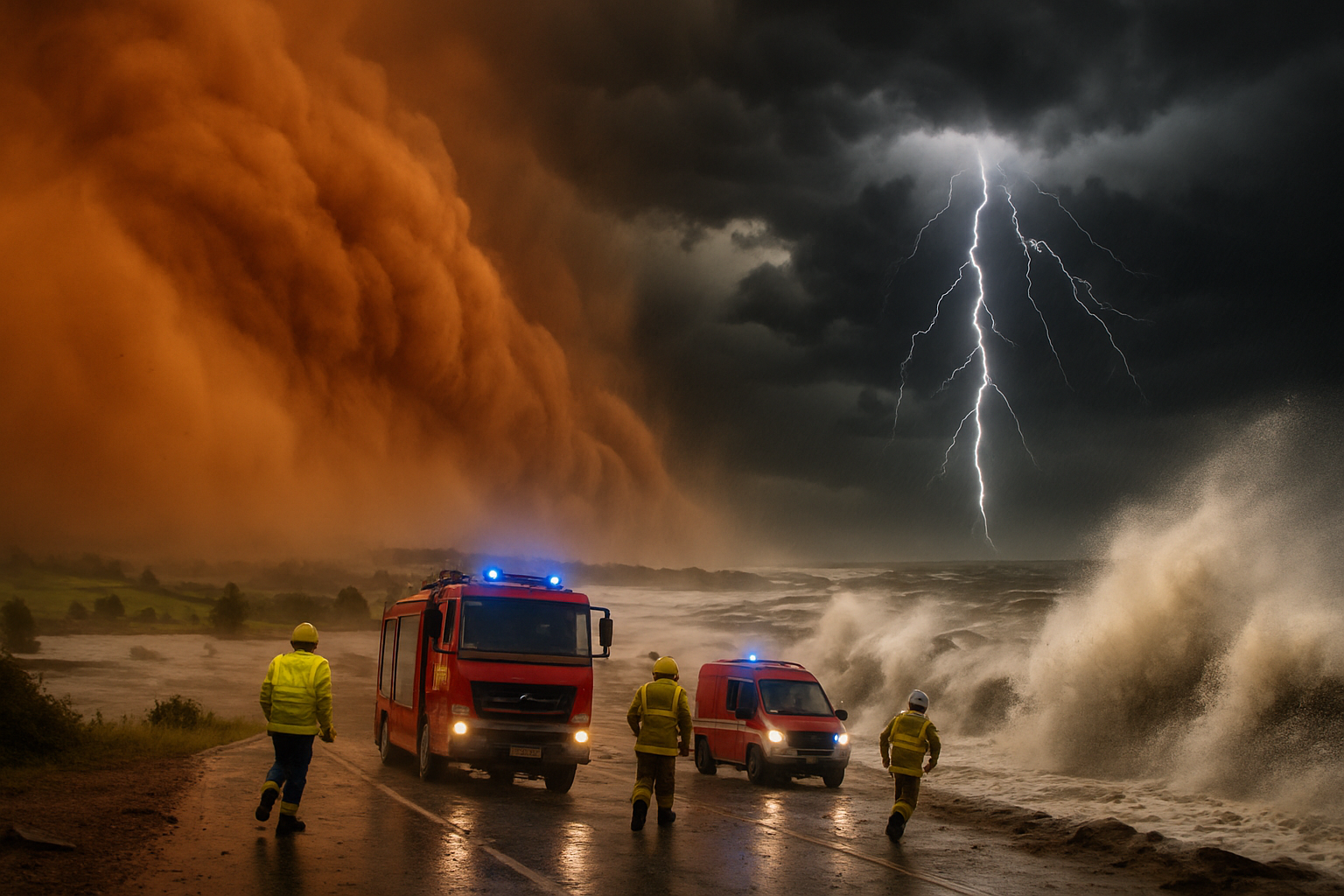
A catastrophic convergence of extreme weather events is battering multiple continents simultaneously as April 2026 marks the 23rd consecutive month of global temperatures exceeding 1.5°C above pre-industrial levels—the longest sustained period of extreme warming in recorded human history.
From the Mediterranean islands of Crete and Cyprus to the storm-lashed coasts of Ireland and the United Kingdom, emergency services are stretched beyond capacity as what meteorologists describe as an unprecedented "compound disaster" scenario unfolds across vast geographic regions.
Mediterranean Engulfed by Historic Saharan Dust Storm
The crisis reached critical levels as massive Saharan dust clouds transformed the skies above Crete into an apocalyptic orange-red landscape, with dust concentrations reaching 1,000 micrograms per cubic meter—more than 20 times the World Health Organization's safe limits. The Greek island's Nikos Kazantzakis Airport was forced to divert flights to Athens as visibility plummeted below 500 meters.
"The atmospheric conditions are suffocating. We have activated all civil protection mechanisms to protect our citizens,"
— Nikos Syrigonakis, Deputy Governor of Heraklion
Schools across Crete were closed and health advisories issued for vulnerable populations as the dust storm—described by French media as extending over 1,300 miles from southern Morocco to the Canary Islands—created dangerous respiratory conditions throughout the eastern Mediterranean.
The University of Crete's monitoring systems recorded dust concentrations so extreme they overwhelmed measurement equipment, with readings 75 times above safe thresholds. The dust storm coincided with Storm Erminio, which brought intense thunderstorms and heavy mountain snowfall to northern Greece, creating a dual environmental emergency that authorities described as unprecedented for the region.
Storm Dave Unleashes Fury Across British Isles
Meanwhile, Storm Dave—the fourth named storm of 2026—delivered devastating winds of up to 90 mph across Scotland, Northern Ireland, Wales, and northern England. Met Éireann issued status yellow wind warnings for all Irish counties as the storm brought very strong southerly winds that veered westerly by evening, accompanied by severe coastal gales.
In County Donegal, authorities warned of potential fallen trees, wave overtopping, and difficult traveling conditions as the storm system tracked across the North Atlantic. The timing—during the Easter weekend—compounded the emergency response challenges as tourism infrastructure faced severe testing.
"Storm Dave will bring very strong southerly winds, veering westerly by the evening with severe gusts and coastal gales. This is not weather to be taken lightly."
— Met Éireann Spokesperson
Israel and Cyprus Face Dangerous Air Quality Crisis
The dust storm's reach extended far beyond Greece, with Israel's Environmental Protection Ministry issuing urgent warnings as gray skies blanketed the country during Passover celebrations. Sensitive populations were advised to reduce physical activity as air pollution levels spiked dramatically across major population centers.
Cyprus meteorological services reported the unusual combination of dust storms and isolated thunderstorms, with forecasters warning of continuing atmospheric instability through the weekend. The dual threat of respiratory hazards and severe weather highlighted the compound nature of the current crisis.
Portugal Battles Dual Weather Threats
Portugal found itself confronting the deadly intersection of Mediterranean dust storms and Atlantic storm systems, with at least one death reported as Storm Erminio battered the Greek mainland while dozens of homes were inundated by flash flooding. The Portuguese emergency services, still recovering from the devastating February 2026 storm succession that claimed over 35 lives and required 26,500 emergency personnel—the largest peacetime operation in the country's history—faced renewed pressure from the ongoing climate emergency.
Climate Scientists Sound Urgent Alarms
The current crisis represents a fundamental shift in global weather patterns, according to climate researchers who have been tracking the unprecedented 23-month streak of extreme warming. January 2026 remains the hottest month ever recorded, with human-induced climate change now completely overriding natural cooling mechanisms, including La Niña effects that historically moderated global temperatures.
The World Meteorological Organization has indicated a 50-60% probability of El Niño development during July-September 2026, potentially driving global temperatures into unprecedented territory by combining baseline warming with natural cycle amplification.
Emergency Response Systems at Breaking Point
The simultaneous nature of current disasters has exposed critical vulnerabilities in international emergency response systems designed for sequential rather than concurrent global crises. Traditional mutual aid mechanisms—where stable regions assist disaster-affected areas—are failing as multiple continents face extreme weather simultaneously.
The European Union's Civil Protection Mechanism has been repeatedly activated, with the €246 million assistance provided to Sweden and Denmark representing the largest coordinated European weather response on record. However, officials acknowledge this scale of response is insufficient for the simultaneity of current challenges.
Transportation networks, power grids, and communication systems designed around historical climate patterns are operating beyond their intended parameters, creating cascading infrastructure failures that compound primary weather impacts.
Economic and Social Devastation Mounting
The economic toll continues to mount as agricultural sectors report billions in losses from damaged crops and disrupted supply chains during critical growing seasons. Tourism industries face extended cancellations and infrastructure damage during peak revenue periods, while mental health services report increased demand for climate anxiety and repeated trauma counseling.
Recovery timelines have fundamentally shifted from the traditional expectation of weeks to months or years, representing a permanent change in disaster response approaches. Families are losing generational homes to repeated extreme weather events, while businesses face extinction from continuous disruptions.
The "Climate Volatility Paradox"
Scientists have identified what they term the "climate volatility paradox"—where sustained global warming enables both temperature records and devastating regional extremes through disrupted atmospheric circulation and polar vortex patterns. This phenomenon explains how record global heat can coincide with severe regional storms, dust emergencies, and flooding across different geographic areas simultaneously.
The current crisis builds upon the devastating February 2026 European storm succession of Kristin, Leonardo, Marta, Nils, and Pedro, which required the largest coordinated emergency response in European history but proved insufficient for current conditions.
International Cooperation Under Unprecedented Strain
Environmental challenges are transcending political boundaries as atmospheric systems and ocean currents transport climate effects globally, regardless of borders. The simultaneity of current disasters is testing cooperation mechanisms that were developed assuming stable regions could assist isolated emergencies.
Success now requires unprecedented international cooperation, enhanced coordination across multiple sectors and scales, and financial commitments that recognize environmental protection as essential infrastructure for human prosperity and planetary sustainability.
Adaptation: Reactive Crisis or Transformative Infrastructure?
April 2026 represents what climate scientists describe as a "watershed moment" in global climate preparedness, forcing a critical choice between reactive crisis management and transformative infrastructure adaptation. The concept of "building back better" with climate-resilient infrastructure has evolved from an optional enhancement to an essential survival strategy.
Traditional seasonal patterns that have guided infrastructure design, agricultural planning, and emergency preparedness for centuries are no longer reliable frameworks in the current era of permanent climate volatility.
Looking Forward: The Narrowing Window for Action
Current conditions are providing a preview of what could become routine by the 2030s without comprehensive climate adaptation investment. The window for effective climate action is rapidly narrowing as ecological systems approach critical thresholds that could trigger irreversible changes affecting global food security, climate stability, and human settlements.
Additional weather systems are developing across the Atlantic and Pacific regions, with authorities maintaining high alert status globally. The persistence of current crisis conditions may establish a "new normal" of extreme weather frequency and intensity that permanently challenges traditional emergency response frameworks.
The fundamental question facing humanity is whether we can organize and implement solutions rapidly enough to maintain planetary habitability during what is clearly the most environmentally challenging period in recorded history.
Tools, knowledge, and cooperation frameworks exist for comprehensive environmental protection, but success depends on unprecedented speed of coordination, sustained international cooperation, and political commitment to treating environmental protection as essential infrastructure for planetary sustainability.
As Storm Dave continues its destructive path across the British Isles, dust storms choke the Mediterranean, and emergency services worldwide operate beyond capacity, April 2026 stands as a defining moment in humanity's response to accelerating climate change—one that will determine the resilience strategies available to future generations.