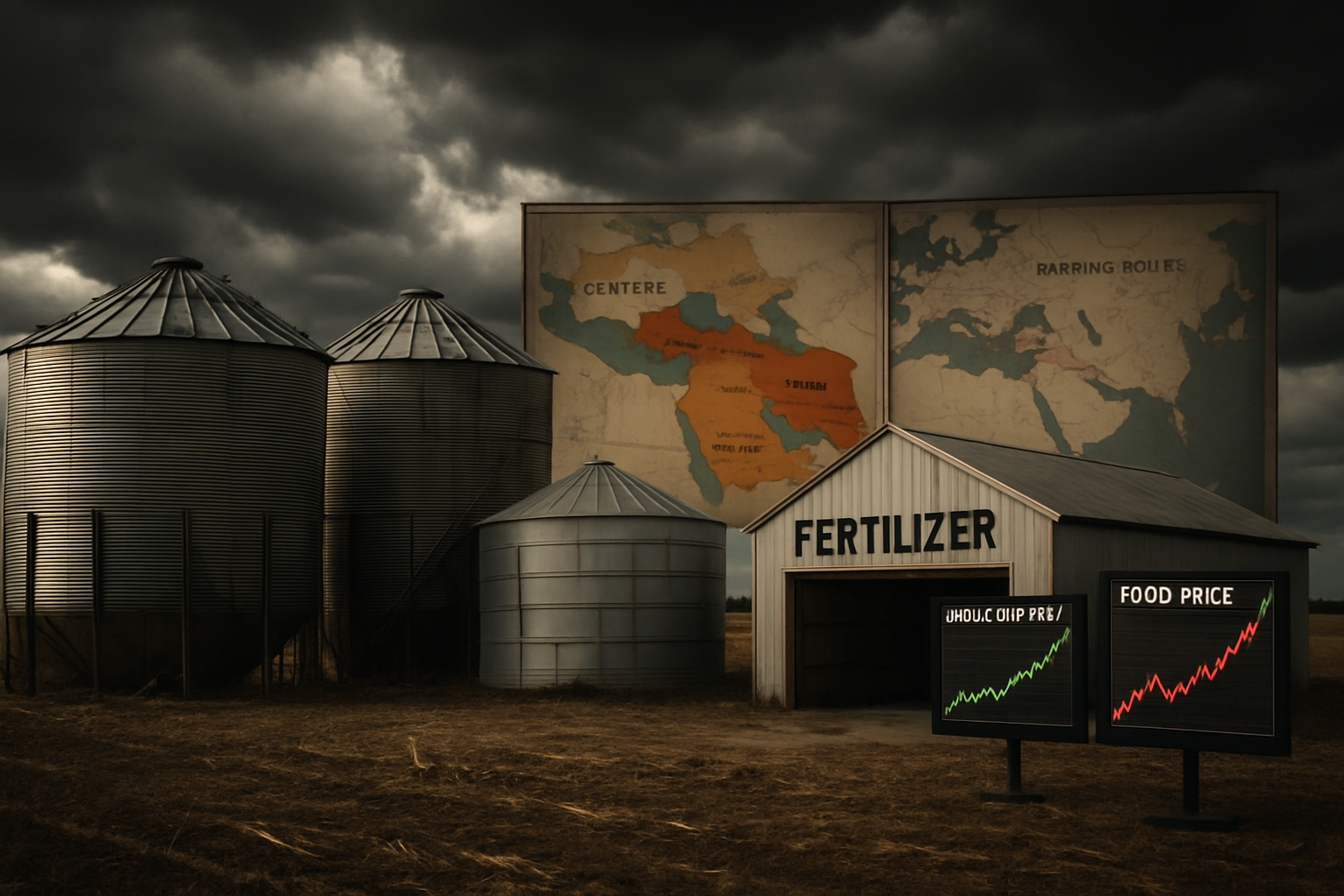
Global agricultural systems face their most severe crisis in decades as fertilizer prices surge to unprecedented levels following the closure of the Strait of Hormuz and escalating Middle East conflicts, threatening food security across multiple continents.
The crisis, which began intensifying in early March 2026, has created a perfect storm of agricultural challenges combining geopolitical disruptions, supply chain vulnerabilities, and climate pressures during the 19th consecutive month of global temperatures exceeding 1.5°C above pre-industrial levels.
Middle East Conflicts Drive Fertilizer Price Crisis
Austrian agricultural experts warn of an impending agricultural crisis as fertilizer prices have skyrocketed following Iran's effective closure of the Strait of Hormuz, which handles 40% of global seaborne oil transit. The waterway closure, part of Iran's "Operation True Promise 4" retaliation against US-Israeli strikes, has created severe disruptions to energy-intensive fertilizer production and distribution.
According to Austrian agricultural specialists, fertilizer costs have increased dramatically since the Revolutionary Guard declared the strategic waterway "unsafe for shipping" on March 1, 2026. The crisis affects not only Austria but agricultural systems across Europe that depend on fertilizer imports from regions now affected by conflict.
Latvian farmers and agricultural experts confirm that conflicts in the Middle East could drive mineral fertilizer price increases and create additional risks to supply chains, which would increase food production costs and affect food prices throughout the region.
Supply Chain Vulnerabilities Exposed
The current crisis has exposed critical vulnerabilities in global agricultural supply chains that extend far beyond fertilizer production. The Persian Gulf serves as a critical trade hub affecting not just energy supplies but also agricultural inputs, industrial materials, and consumer goods worldwide.
Major shipping companies including Maersk and MSC have suspended operations in the Persian Gulf, leaving over 150 oil and LNG tankers stranded with billions of dollars in cargo. Alternative Arabian Peninsula routes offer inadequate capacity with significant time and cost penalties, creating bottlenecks that ripple through agricultural supply networks.
Natural gas prices, essential for fertilizer production, have exploded by 24% in Europe and 78% in the United States, reaching €47.32/MWh in Europe - the highest levels since February 2025. Qatar, which supplies approximately 20% of global LNG exports, has halted production at its Ras Laffan and Mesaid facilities following Iranian drone attacks.
Food Security Implications Across Europe
The ripple effects of the Middle East crisis are being felt across European agricultural systems. Energy costs directly impact fertilizer production, with natural gas serving as both a feedstock and energy source for nitrogen-based fertilizers. The dramatic price increases threaten to make fertilizer prohibitively expensive for many farmers, potentially reducing crop yields and threatening food security.
Agricultural policy experts note that the timing could not be worse, coming during the critical spring planting season when farmers make decisions about fertilizer application rates. Reduced fertilizer use could lead to significantly lower crop yields later in 2026, creating food availability and affordability issues.
The crisis highlights Europe's dependence on global supply chains for essential agricultural inputs. Unlike energy markets, where strategic reserves can provide temporary buffers, fertilizer shortages directly translate to reduced agricultural productivity with impacts that may not be fully realized until harvest time.
Climate Change Compounds Agricultural Stress
The fertilizer crisis unfolds against the backdrop of unprecedented climate stress. January 2026 marked the 19th consecutive month of global temperatures exceeding 1.5°C above pre-industrial levels, creating additional challenges for agricultural systems already struggling with supply chain disruptions.
Climate change is disrupting traditional growing seasons and increasing the stress on agricultural systems worldwide. Higher temperatures, changing precipitation patterns, and more frequent extreme weather events require adaptive management responses that often depend on timely access to agricultural inputs like fertilizers and pesticides.
The combination of climate stress and input shortages creates a compound crisis for agricultural systems. Farmers facing difficult growing conditions need reliable access to inputs to maintain productivity, but supply chain disruptions are making those inputs either unavailable or prohibitively expensive.
Global Energy Crisis Impacts Agriculture
The broader energy crisis stemming from Middle East conflicts affects agriculture in multiple ways beyond fertilizer production. Oil prices have surged past $80 per barrel with analysts predicting potential increases to $100 or higher, driving up transportation costs for agricultural inputs and products.
The aviation industry crisis, with over 18,000 flights cancelled worldwide, affects the transportation of time-sensitive agricultural products and inputs. Eight countries have simultaneously closed their airspace, creating complex logistics challenges for agricultural supply chains that depend on air transport for certain products and inputs.
Energy-intensive agricultural operations, including greenhouse production, food processing, and cold storage, face mounting cost pressures. The 24% increase in European natural gas prices directly impacts greenhouse operations that depend on gas for heating and climate control.
Strategic Food Security Considerations
The current crisis has prompted renewed discussions about strategic food security and the need for more resilient agricultural systems. European governments are reassessing their agricultural policies and considering measures to reduce dependence on volatile geopolitical regions for essential inputs.
Unlike energy markets, where strategic petroleum reserves can provide temporary buffers during supply disruptions, agricultural systems require longer-term planning and different types of resilience strategies. Fertilizer stockpiling requires significant storage capacity and careful inventory management due to the seasonal nature of agricultural demand.
Agricultural policy experts emphasize the need for supply chain diversification and regional production capacity for essential inputs. The crisis demonstrates the risks of over-dependence on single regions or transportation routes for critical agricultural supplies.
Nuclear Diplomacy Collapse Context
The agricultural crisis stems from the broader breakdown of international diplomacy, particularly the collapse of US-Iran nuclear negotiations despite what had been described as "broad agreement on guiding principles" - the most progress since the JCPOA collapse in 2018.
The fundamental scope disagreement proved insurmountable, with Iran maintaining that ballistic missiles and proxy relationships were "red lines" in nuclear-only negotiations, while the US demanded comprehensive agreements including missiles, armed groups, and human rights issues.
This diplomatic breakdown led to "Operation Epic Fury," described as the largest US-Israeli coordinated military operation since 2003, and subsequent Iranian retaliation through "Operation True Promise 4," which has effectively closed critical shipping routes and disrupted global supply chains.
Regional Coalition Strain
The agricultural implications extend beyond supply chain disruptions to include the strain on regional coalitions that had previously supported diplomatic solutions. An unprecedented Saudi Arabia, UAE, Qatar, and Egypt consensus supporting diplomacy has been severely tested by Iranian retaliation targeting coalition member territories.
Regional agricultural cooperation agreements and trade relationships are being disrupted by the broader geopolitical crisis. Food import agreements and agricultural trade flows are being affected as countries prioritize immediate security concerns over longer-term agricultural cooperation.
Long-term Agricultural Implications
The current crisis represents more than a temporary supply chain disruption; it may fundamentally reshape global agricultural systems and food security planning. The vulnerability of agricultural inputs to geopolitical disruptions has created new imperatives for agricultural resilience and supply chain diversification.
Recovery timelines remain uncertain because unlike weather disruptions, the current crisis depends on military operations resolution and diplomatic normalization. Traditional agricultural planning cycles are being disrupted by the inability to secure reliable input supplies or predict future availability.
The crisis highlights the need for fundamental restructuring of global agricultural supply chains to reduce dependence on volatile geopolitical regions. This may accelerate discussions about regional fertilizer production capacity, alternative production methods, and strategic stockpiling of agricultural inputs.
Template-Setting Crisis Management
Agricultural experts describe the current situation as a template-setting moment for 21st-century crisis management in agricultural systems. The rapid transition from diplomatic breakthrough to military confrontation demonstrates the fragility of modern crisis management mechanisms in a multipolar era.
Success in containing the broader crisis could provide a framework for future agricultural crisis resolution, while failure may accelerate trends toward agricultural autarky and reduced international cooperation in food systems. The stakes include not just immediate food security but the long-term evolution of global agricultural governance and cooperation mechanisms.
The greatest test of multilateral cooperation in crisis management in the modern era is determining whether international agricultural systems can maintain resilience and cooperation despite broader geopolitical disruptions. The decisions made in coming weeks may reverberate through agricultural policy and international cooperation for decades.
As the crisis continues to unfold, the agricultural sector finds itself at the center of broader questions about global supply chain resilience, energy security, and the intersection of geopolitics with essential human needs. The outcome will likely influence agricultural policy and international cooperation approaches well beyond the current crisis period.