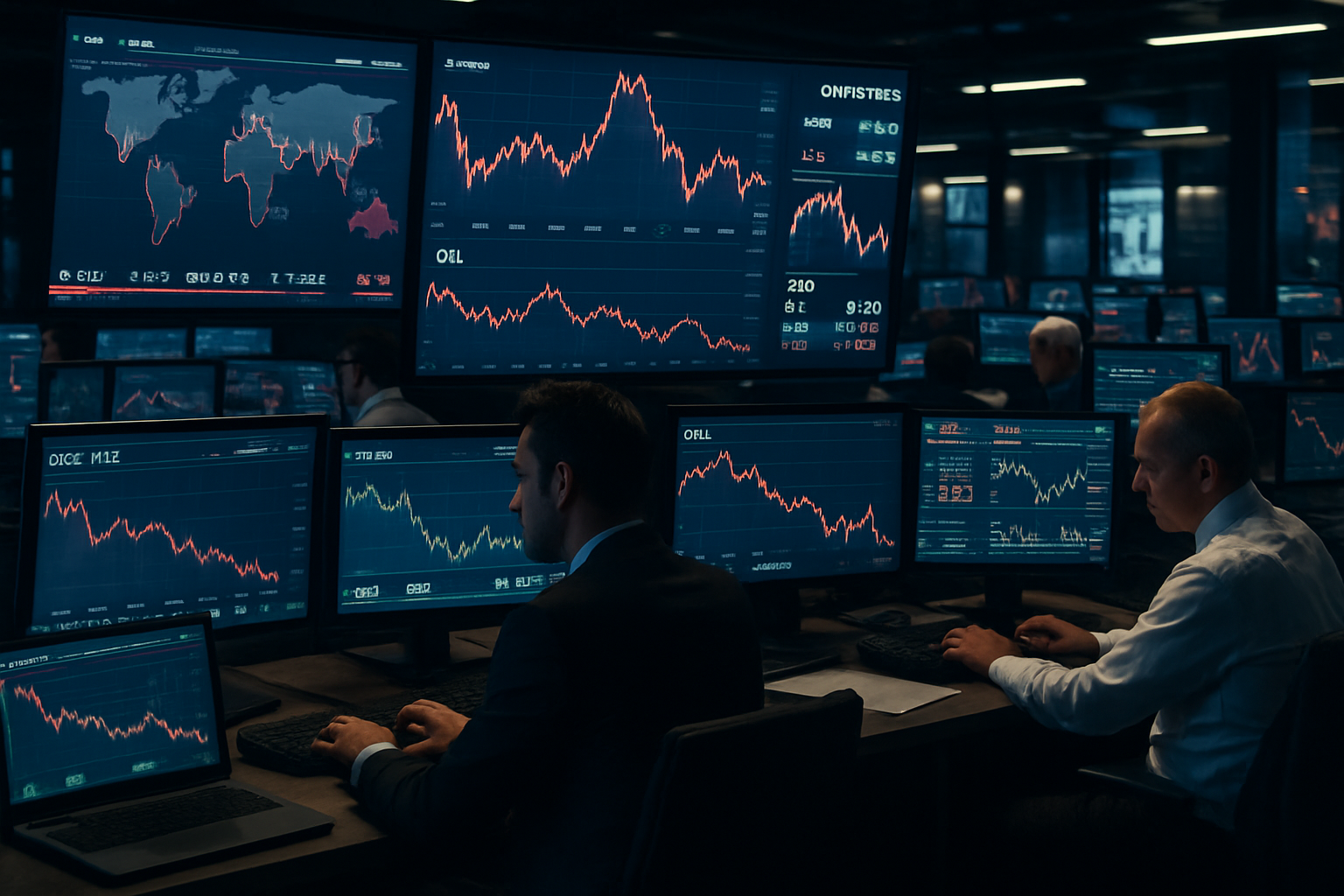
Global financial markets demonstrated stark regional divergence on March 5, 2026, as Pakistan's benchmark KSE-100 index soared over 5,400 points while German logistics giant DHL faced significant selling pressure, highlighting the increasingly complex and localized nature of international finance amid ongoing geopolitical tensions and monetary policy fragmentation.
The Pakistan Stock Exchange delivered one of its most remarkable single-day performances in recent history, with the KSE-100 index gaining 5,433.46 points to close at 161,210.67, representing a substantial 3.49% increase from its previous close of 155,777.21 points. This dramatic recovery follows what market analysts describe as the most spectacular rebound in the exchange's recent history.
Pakistan's Remarkable Market Recovery
"Momentum gathered strength as the session progressed," noted analysts at Topline Securities, describing the performance as more than just a technical bounce. The index gained over 2,000 points by 10:30 AM, extending to 3,815.48 points by 11:37 AM, and reached 4,954.54 points by 1:02 PM before closing with additional gains.
Trading activity remained robust throughout the session, with total volume recorded at 402.5 million shares and healthy market participation across multiple sectors. The recovery was characterized by what analysts called "decisive accumulation and broad-based strength," suggesting institutional confidence rather than speculative activity.
Pakistan's foreign exchange position also strengthened, with the State Bank of Pakistan reporting liquid foreign reserves of $21.43 billion as of February 27, 2026. The central bank's reserves specifically increased by $87 million to $16.30 billion during the week, while commercial banks held $5.13 billion in net foreign reserves.
German Market Pressures and Corporate Challenges
In stark contrast to Pakistan's surge, German markets faced headwinds as DHL emerged as one of the DAX's biggest losers. The logistics giant's shares came under significant selling pressure as investors reacted negatively to a corporate outlook marked by geopolitical uncertainty.
The decline occurred on what was otherwise a relatively positive day for the broader DAX index, highlighting how company-specific factors increasingly override general market sentiment. DHL's challenges reflect broader concerns about global supply chain disruptions and the impact of international tensions on logistics operations.
This divergence underscores the growing trend of market fragmentation, where regional and sector-specific factors have begun to outweigh traditional correlations between major global indices.
Regulatory Changes and Policy Divergence
The financial landscape continues to be shaped by significant regulatory developments, including recent changes in Pakistan's banking sector. The State Bank of Pakistan revoked the foreign exchange authorization of Riaz Exchange Company (Pvt.) Ltd following the company's own request after ceasing operations.
"Authorization of the company to deal in foreign exchange business has been revoked from the date of closure of its operations," the central bank stated, demonstrating continued regulatory oversight in the foreign exchange sector.
"The markets are showing increasing signs of maturation toward fundamental analysis rather than speculation. This represents a healthy evolution in emerging market finance."
— Senior Market Analyst, Topline Securities
US Trade Policy Developments
Meanwhile, significant developments in US trade policy continue to reshape global investment patterns. Wall Street has been closely monitoring potential changes to tariff structures following recent Supreme Court rulings, with hedge funds increasingly betting on tariff refund opportunities.
The complex interplay between trade policy, legal challenges, and market dynamics has created new arbitrage opportunities for sophisticated investors. When previous tariff structures faced legal challenges, it created uncertainty about refund timelines, prompting financial firms to offer immediate liquidity to importers in exchange for future refund claims.
Central Bank Policy Divergence Intensifies
The global monetary landscape continues to fragment as central banks pursue increasingly divergent policies based on domestic economic conditions. Historical context shows this represents a significant departure from the post-2008 synchronized approach that characterized international monetary policy for over a decade.
The European Central Bank has maintained its 2% deposit rate while other major economies have adopted different approaches, creating complex currency dynamics and capital flow patterns. This fragmentation reflects the growing recognition that one-size-fits-all monetary policies may not be suitable for economies facing different challenges.
Pakistan's monetary authorities have demonstrated particular sophistication in managing both domestic and external financial pressures. The country's ability to maintain foreign exchange stability while facilitating equity market growth represents a template for emerging market central banking in an era of reduced international coordination.
Technology and Infrastructure Investment
The ongoing global memory chip crisis, with semiconductor prices experiencing sixfold increases, continues to impact financial markets and corporate investment decisions. However, countries and companies that have invested in alternative technologies and diversified supply chains are showing greater resilience.
Pakistan's financial sector has particularly benefited from digital transformation initiatives, with significant growth in electronic payment systems and digital banking services. This technological advancement has provided stability to the financial system during periods of global volatility.
Regional Market Leadership Emergence
The performance patterns observed in March 2026 suggest a fundamental shift in global financial market dynamics. Rather than following traditional center-periphery models, regional markets are increasingly driven by local fundamentals, institutional quality, and policy effectiveness.
Pakistan's dramatic market recovery, occurring amid challenging global conditions, demonstrates how countries with strong institutional frameworks and sound economic policies can outperform regardless of broader international sentiment. This trend is evident across multiple emerging markets that have invested in governance improvements and economic diversification.
Investment Strategy Evolution
Market participants are adapting to this new environment by developing more nuanced, country-specific investment approaches. The days of broad regional or emerging market strategies are giving way to careful analysis of individual countries' institutional capabilities, policy frameworks, and economic fundamentals.
Successful investment strategies now require deep understanding of local conditions, regulatory environments, and political dynamics. This shift has rewarded investors who have developed sophisticated country analysis capabilities while challenging those relying on traditional geographic or sector-based approaches.
Looking Forward: Sustainable Growth Models
The current market dynamics suggest that sustainable growth in the global financial system will increasingly depend on countries' ability to develop resilient institutions, maintain policy credibility, and adapt to changing international conditions while preserving domestic stability.
Pakistan's recent market performance, combined with its improving foreign exchange position and regulatory effectiveness, provides a template for how emerging markets can thrive in an environment characterized by reduced international coordination and increased geopolitical complexity.
As global financial markets continue to evolve, the premium on institutional quality, policy consistency, and economic fundamentals is likely to increase, creating opportunities for countries that have invested in these capabilities while challenging those that have relied primarily on external factors for growth.