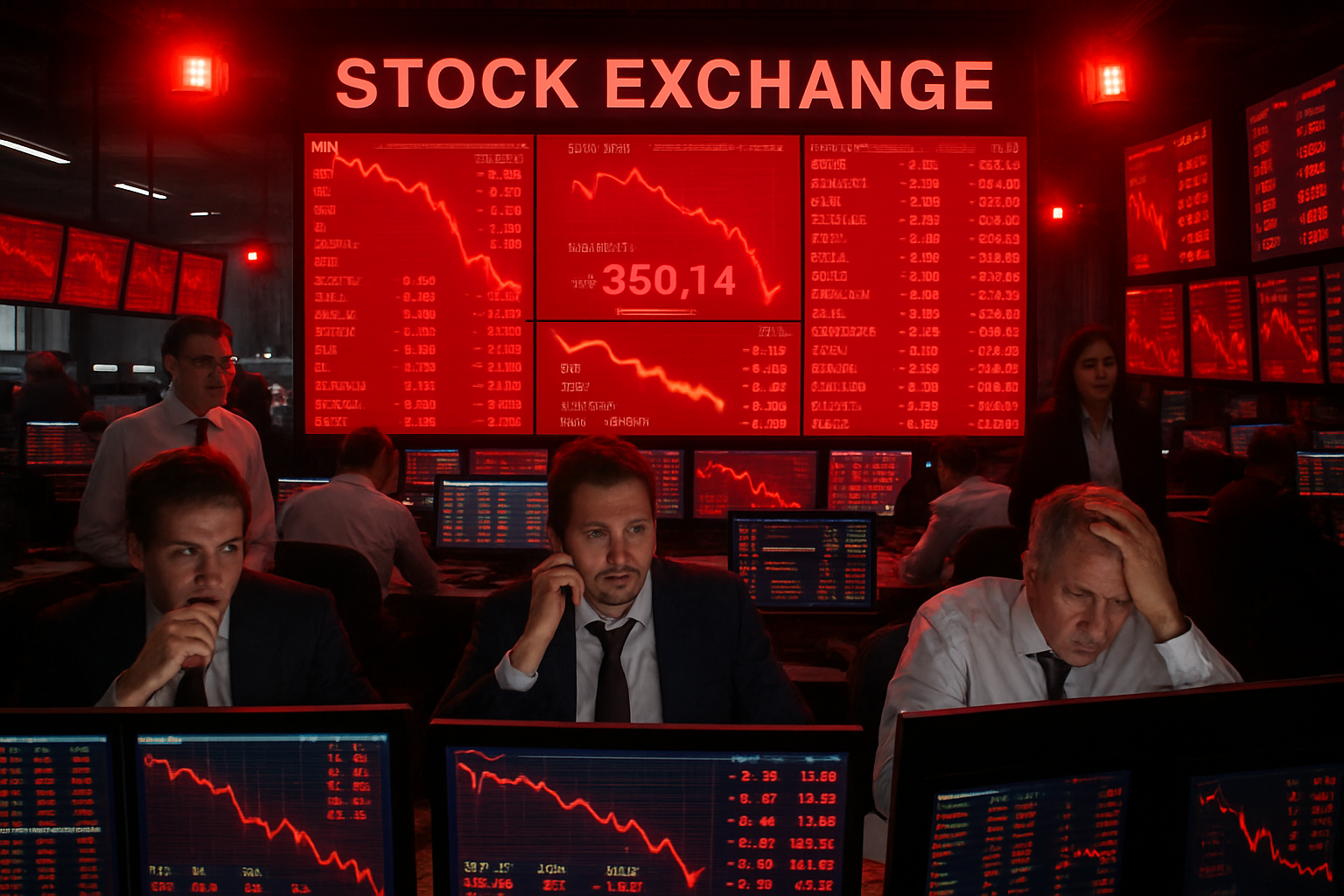
Global financial markets are experiencing their most severe disruption in years as escalating Middle East conflicts trigger unprecedented volatility, with major indices plummeting while oil prices surge past $80 per barrel amid the effective closure of the Strait of Hormuz.
The crisis, which began following the US-Israeli "Operation Epic Fury" and subsequent Iranian retaliation "Operation True Promise 4," has sent shockwaves through international markets. The Pakistan Stock Exchange KSE-100 index crashed by an unprecedented 15,071 points (-8.97%), marking the largest single-day decline in the exchange's history and forcing trading suspensions.
Asian Markets Lead Global Selloff
Asian markets bore the brunt of the initial panic, with South Korea's KOSPI plunging 12% in what analysts describe as the worst single-day drop on record. Circuit breakers were activated on both KOSPI and KOSDAQ markets, halting trading for 20 minutes as the Korean won hit a 17-year low. Fast-money investors and foreign capital fled previously strong AI and memory chip positions, with portfolio strategist Damien Boey noting the conflict was "going to go a little longer than what people thought initially."
Japan's Nikkei fell 2.5% for a third straight session, while Chinese markets opened sharply lower. The selloff quickly spread westward, with US Dow futures dropping 400-570 points overnight and S&P 500 futures declining over 1%.
Energy Crisis Fuels Market Panic
The immediate trigger for the global market meltdown stems from Iran's Revolutionary Guard declaring the Strait of Hormuz "unsafe," effectively closing a chokepoint that handles 40% of global seaborne oil transit. Brent crude surged 12% weekly to $81.40 per barrel, while European gas prices rocketed 50% to €47.32 per MWh—the highest levels since February 2025.
Natural gas prices exploded by 24% in Europe and 78% in the United States as Qatar halted LNG production at its Ras Laffan and Mesaid facilities, affecting approximately 20% of global LNG exports. Major shipping companies Maersk and MSC suspended Persian Gulf operations, leaving over 150 oil and LNG tankers stranded in the Persian Gulf, representing billions in cargo value.
"This is the most severe energy security crisis in decades, with single-chokepoint vulnerabilities now fully exposed,"
— Samuel Ciszuk, Energy Analyst
Aviation Industry in Crisis
The financial turmoil coincides with the most extensive global aviation disruption since the COVID-19 pandemic. Over 18,000 flights have been cancelled worldwide as eight Middle Eastern countries—Iran, Iraq, Israel, UAE, Qatar, Syria, Kuwait, and Bahrain—simultaneously closed their airspace.
Dubai International Airport, the world's busiest with over 86 million passengers annually, remains completely shut down after sustaining missile damage. Emirates and Etihad Airways face operational collapse, while Air France-KLM, Wizz Air, and Bulgaria Air have suspended operations indefinitely, affecting hundreds of thousands of passengers globally.
Central Bank Emergency Response
Central banks across major economies have coordinated emergency liquidity provisions to prevent broader financial contagion. The European Central Bank and Bank of Japan are leading efforts to stabilize markets, while traditional monetary policy tools face limitations in addressing structural infrastructure and geopolitical disruptions.
Corporate impact has been massive, with PayPay's $1.1 billion US IPO postponed indefinitely due to market volatility. Technology companies are delaying major announcements and reassessing expansion plans as supply chains face severe disruptions from the crisis in Middle Eastern trade hubs.
Regional Coalition Under Strain
The financial chaos reflects the collapse of diplomatic efforts that had shown unprecedented promise. Despite achieving a "broad agreement on guiding principles" in Geneva talks—representing the most progress since the JCPOA collapse in 2018—fundamental disagreements proved insurmountable.
Iran's exclusion of ballistic missiles and regional proxies as "red lines" conflicted with US demands for a comprehensive agreement addressing missiles, armed groups, and human rights. This diplomatic breakdown led to Operation Epic Fury, the largest US-Israeli coordinated military operation since 2003.
The traditional Saudi-UAE-Qatar-Egypt diplomatic consensus supporting peace efforts is now severely strained as Iranian retaliation has directly targeted member territories. Egypt's President Sisi condemned attacks on "sisterly Arab countries," warning of "comprehensive chaos."
Nuclear Governance Crisis Context
The market volatility occurs amid a broader nuclear governance crisis. The New START treaty expired on February 5—marking the first time in over 50 years without US-Russia nuclear constraints. Combined with China's nuclear expansion and Iran's continued 60% uranium enrichment with over 400kg of weapons-grade material, UN Secretary-General Guterres warns nuclear risks are at their "highest in decades."
Supply Chain Vulnerabilities Exposed
The crisis has exposed critical vulnerabilities in global supply chains over-dependent on strategic chokepoints. The Persian Gulf serves as a critical trade hub beyond energy, affecting consumer goods and industrial materials worldwide. The 21-mile Strait of Hormuz demonstrates the single-point failure risks inherent in modern logistics systems.
Sweden is predicting electricity price increases of 10-20 öre and gasoline prices rising 1-2 kronor per liter, with the southern Malmö zone most exposed due to continental European market integration. Australia and Mexico have issued fuel price warnings, while regional disparities emerge based on energy market integration levels.
Recovery Timeline Uncertain
Unlike weather-related disruptions that follow predictable patterns, recovery from this crisis depends entirely on military operations resolution and diplomatic normalization. Aviation industry leaders cannot make long-term scheduling decisions with airspace closures, while energy markets remain volatile with critical transit routes blocked.
Traditional monetary policy faces limited effectiveness against structural infrastructure and geopolitical disruptions. The crisis highlights fundamental questions about economic resilience in an interconnected world where regional conflicts can instantly become global challenges.
Historical Significance and Template-Setting Implications
March 2026 represents a watershed moment for global financial markets, exposing strategic chokepoint vulnerabilities and interconnected supply chain fragility. This crisis stands as the most dangerous international moment since the Cold War's end, affecting regional war prevention, energy markets, nuclear governance credibility, and international law enforcement simultaneously.
The rapid transition from diplomatic breakthrough to military escalation demonstrates the fragility of modern crisis management in a multipolar era. Success in containing the escalation could provide a framework for future nuclear crisis resolution and strengthen diplomatic precedents. However, failure may accelerate military solutions, reshape Middle Eastern geopolitics for decades, encourage nuclear proliferation globally, and undermine diplomatic credibility worldwide.
"This is a template-setting moment for 21st-century conflict resolution that will influence international approaches to territorial disputes, nuclear crises, and energy security architecture for decades to come,"
— International Crisis Analysis Expert
As markets continue their volatile response to unfolding events, the international community faces its greatest test of multilateral cooperation in crisis management in the modern era. The stakes extend far beyond immediate financial losses to fundamental questions about global stability, energy security architecture, and the sustainability of diplomatic solutions in an increasingly complex geopolitical landscape.
The coming phase will be decisive in determining whether this remains a contained regional confrontation or escalates into broader Middle Eastern warfare with worldwide implications extending decades beyond current events. Financial markets, serving as the ultimate constraint on prolonged conflict, may yet play a crucial role in pushing all parties toward diplomatic resolution.