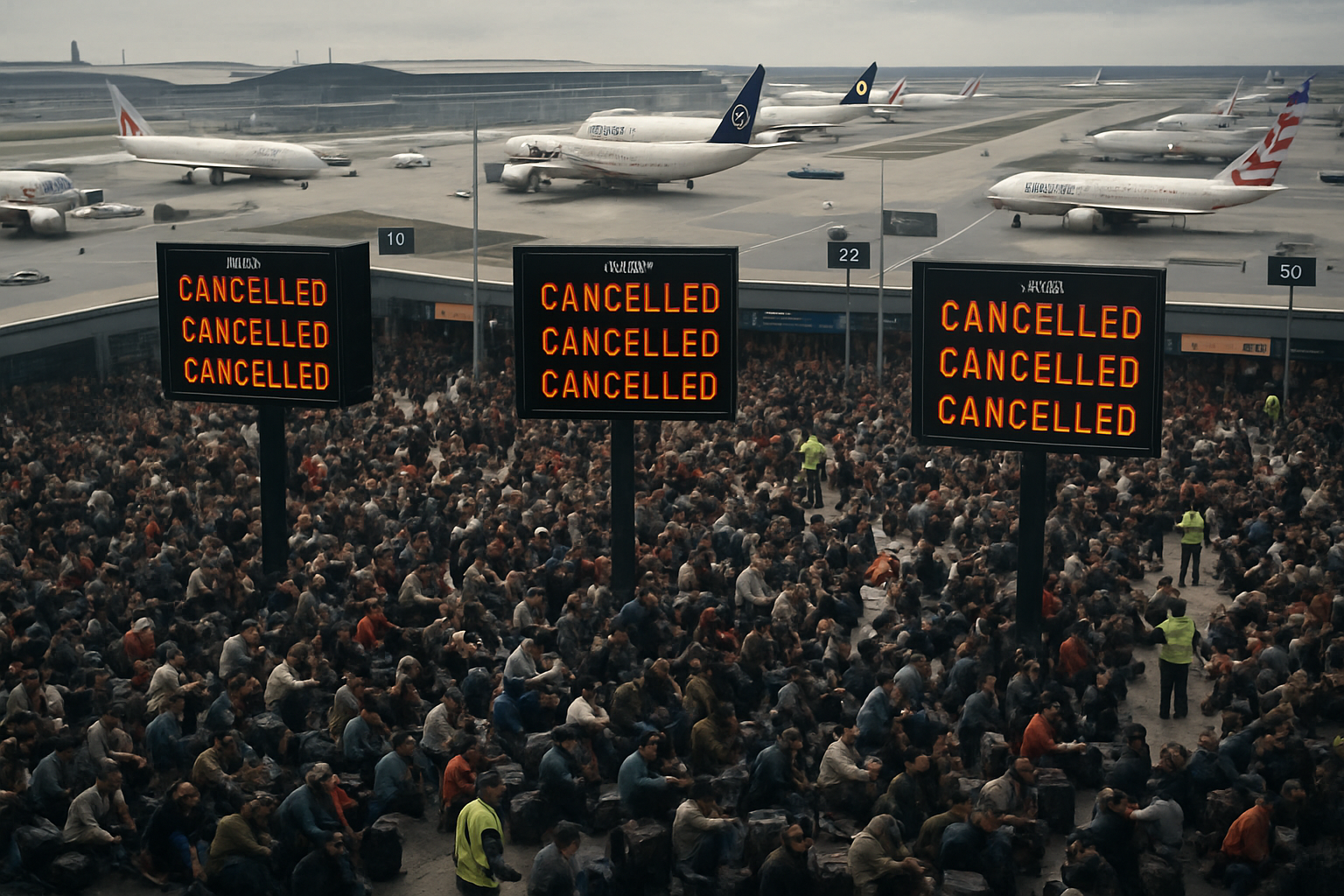
The global aviation industry is facing its worst crisis since the COVID-19 pandemic as ongoing military operations in the Middle East have triggered the cancellation of over 18,000 flights worldwide, stranding hundreds of thousands of passengers across multiple continents.
The crisis began on February 28, 2026, when Iran, Iraq, Israel, the UAE, Qatar, Syria, Kuwait, and Bahrain simultaneously closed their airspace following the escalation of the Middle East conflict. Dubai International Airport, the world's busiest international hub handling over 86 million passengers annually, has been completely shut down after sustaining missile damage during recent hostilities.
Unprecedented Scale of Disruption
According to FlightAware data, over 1,239 flights were cancelled on Monday alone, adding to the more than 5,900 cancellations recorded over the weekend. The simultaneous closure of multiple Middle Eastern airspaces has created cascading effects throughout the global aviation network, affecting routes far beyond the immediate conflict zone.
Major airlines have been forced to suspend operations to the region entirely. Emirates and Etihad Airways, the UAE's flagship carriers, face an operational crisis with their Dubai and Abu Dhabi hubs effectively cut off from international traffic. Qatar Airways has suspended hundreds of routes, while European carriers including Air France-KLM, Wizz Air, and Bulgaria Air have cancelled all flights to affected destinations through at least March 7.
"This is the most comprehensive regional aviation disruption we've seen since the pandemic. The Middle East serves as a critical Europe-Asia connecting hub, and its closure has global ramifications."
— Aviation Industry Analyst
Major Airports Affected
The crisis has particularly impacted key regional aviation hubs. Dubai International Airport, which processes millions of connecting passengers monthly, remains closed for the third consecutive day. At Cyprus's airports, 60 flights were cancelled on Monday alone, with 42 cancellations at Larnaca Airport and 18 at Paphos Airport.
Thailand's Suvarnabhumi Airport reported 47 flight cancellations on Monday, affecting eight airlines including EL AL Israel Airlines, Emirates, Qatar Airways, and Kuwait Airways. Between February 28 and March 2, a total of 108 flights were cancelled at the Bangkok hub, comprising 58 outbound and 50 inbound services.
The disruption has extended to secondary effects as well. Formula 1 teams preparing for the season opener in Australia have been forced to completely restructure their travel plans, with hundreds of F1 personnel unable to reach Melbourne via their usual Middle Eastern connections.
Passenger Impact and Humanitarian Concerns
The human cost of the crisis continues to mount as hundreds of thousands of travelers find themselves stranded worldwide. In Sweden alone, thousands of nationals are trapped in Dubai and Doha with no clear path home. The Swedish Foreign Ministry has received over 1,000 information requests from stranded citizens, but officials admit they have limited ability to provide immediate assistance.
Australia's Emily Grosser, a TikTok personality with over 500,000 followers, was forced to pay over $6,000 for alternative flights home from Paris after her original routing via Doha became impossible. Her experience reflects the financial burden many travelers now face as they seek expensive alternative routes.
Austrian authorities report that over 1,500 citizens are waiting for Emirates flights that cannot operate due to the Dubai hub closure. Similar situations have developed across Europe, with Dutch, Croatian, and Slovak governments all activating emergency protocols to assist their stranded nationals.
Economic and Energy Market Implications
The aviation crisis has coincided with broader economic disruption stemming from the Middle East conflict. Oil prices have surged 10% to $80 per barrel (Brent crude) as shipping companies Maersk and MSC suspended operations through the Strait of Hormuz, which handles 40% of global seaborne oil transit.
Natural gas prices have spiked dramatically, rising 24% in Europe and 78% in the United States. The energy market volatility adds another layer of complexity to the aviation industry's recovery efforts, as fuel costs represent airlines' second-largest expense after labor.
The Persian Gulf region serves not only as a critical aviation hub but also as a vital trade corridor for consumer goods and industrial materials. With over 150 oil and LNG tankers now anchored in Persian Gulf waters, representing billions of dollars in stranded cargo, the economic ripple effects extend far beyond transportation.
Industry Response and Adaptation
Airlines are implementing emergency protocols and exploring alternative routing strategies to maintain some level of connectivity. European carriers are establishing new stopover patterns, with Air Europa routing through Santo Domingo and Air France developing similar Caribbean contingency plans.
The industry faces significant challenges in adapting to the new reality. Aircraft must carry additional fuel to avoid refueling in affected zones, reducing passenger capacity and increasing operational costs. Complex rerouting around closed airspace adds hours to journey times and strains aircraft scheduling across global networks.
Airport authorities worldwide have deployed additional staff to assist stranded passengers, though many terminals are overwhelmed by the unprecedented volume of rebooking requests and accommodation needs.
Government and Diplomatic Responses
Governments across the globe have activated emergency response systems to assist their citizens. The European Union has issued joint statements demanding "maximum restraint" and emphasizing the need for diplomatic solutions to resolve the underlying conflict.
Kazakhstan's President Tokayev has sent personal messages to Gulf state leaders expressing solidarity and advocating for "exclusively diplomatic means" to resolve the crisis. South Korea activated its national emergency response system, with Finance Minister Koo Yun-cheol warning of "heightened market volatility" stemming from the crisis.
The UN Security Council has convened emergency sessions as Secretary-General António Guterres warned that the military actions could "trigger a chain of events no one can control in the world's most unstable region."
Historical Context and Comparison
Aviation analysts are drawing comparisons to the COVID-19 pandemic's impact on global travel, noting that this crisis represents the most comprehensive regional disruption since that period. However, unlike the pandemic's gradual spread, this crisis emerged suddenly and concentrates its impact on one of the world's most crucial aviation corridors.
The closure exceeds even the disruption caused during the 1991 Gulf War, as the current crisis involves simultaneous airspace closures across multiple countries, affecting not just military operations but all civilian aviation. The Middle East's role as a critical Europe-Asia transit hub makes the current situation particularly challenging for global connectivity.
Looking Forward: Recovery Challenges
Unlike weather-related disruptions that have predictable resolution timelines, the current crisis depends entirely on the resolution of underlying military operations and diplomatic tensions. Airlines are conducting daily operational reviews and implementing enhanced contingency planning, but the uncertainty makes long-term scheduling nearly impossible.
Industry experts warn that even when airspace reopens, the aviation sector will face weeks of recovery time to restore normal operations. The backlog of passengers, cargo, and crew positioning will create ongoing challenges well after the immediate crisis ends.
The crisis has also accelerated discussions about aviation network resilience and the risks of over-dependence on specific geographic corridors. Airlines and regulators are likely to reassess route planning and develop more robust contingency frameworks for future geopolitical disruptions.
Broader Implications
The current aviation crisis serves as a stark reminder of how quickly geopolitical events can disrupt global transportation networks. The interconnected nature of modern aviation means that regional conflicts now have immediate worldwide consequences, affecting not just travelers but global commerce and supply chains.
As the situation continues to evolve, the aviation industry faces fundamental questions about risk management, route diversification, and the balance between efficiency and resilience in network planning. The resolution of this crisis will likely influence aviation policy and planning for years to come.
For now, hundreds of thousands of passengers remain stranded worldwide, their travel plans disrupted by events thousands of miles away, highlighting the complex interdependencies of our globalized world and the vulnerability of modern transportation systems to geopolitical instability.