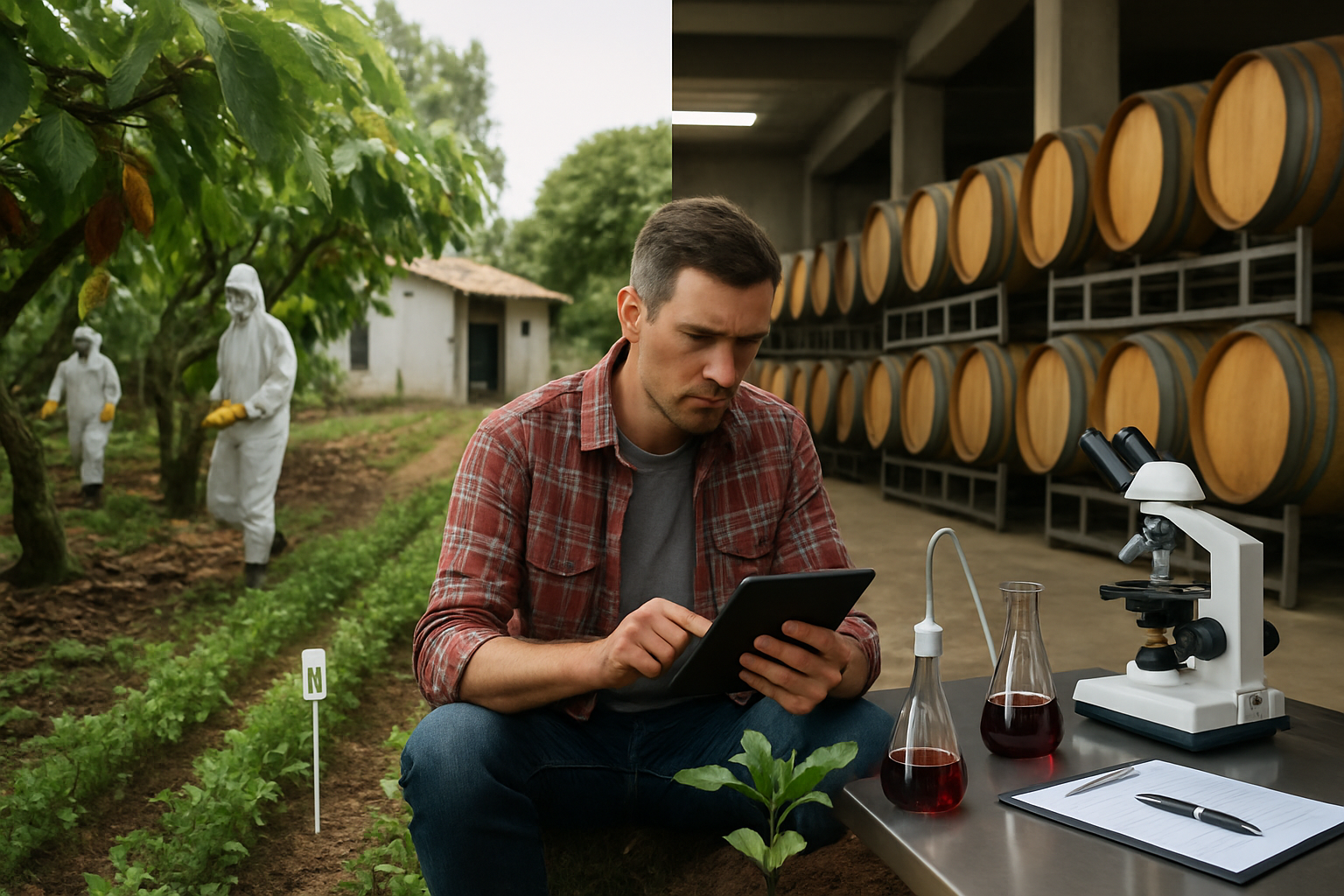
A sweeping investigation across Austria, Guyana, Italy, Romania, and Senegal has uncovered a troubling pattern of food safety violations, systemic agricultural challenges, and fraudulent practices that expose critical vulnerabilities in the global food supply chain during the 19th consecutive month of temperatures exceeding 1.5°C above pre-industrial levels.
From a massive wine fraud operation in Italy involving 2.5 million litres of mislabeled products to the contaminated meat crisis in Senegal and agricultural sustainability concerns in Romania, March 2026 has revealed the extent of food industry challenges facing authorities worldwide.
Italy's Wine Fraud Scandal Rocks Premium Market
Italian authorities have uncovered one of the most significant wine fraud operations in recent years, with the Ispettorato centrale della tutela della qualità e repressione frodi seizing 2.5 million litres of wine fraudulently marketed as DOP (Protected Designation of Origin) and IGP (Protected Geographical Indication) products.
The investigation revealed that producers were using grapes and musts that did not comply with strict regulatory specifications while selling the resulting wine under prestigious protected labels. This type of fraud undermines consumer trust and threatens the integrity of Italy's €13 billion wine industry, which depends heavily on quality certifications and geographic authenticity.
"This operation protects not only consumers but the entire Italian wine sector, which relies on the authenticity and quality of its protected designations,"
— Ispettorato centrale della tutela della qualità e repressione frodi
The scale of the seizure—equivalent to over 3.3 million standard bottles—represents a significant blow to fraudulent operations that have been exploiting the premium pricing of certified Italian wines. The case highlights the ongoing battle between legitimate producers and those seeking to profit from Italy's renowned wine reputation.
Senegal's Food Safety Emergency
In Rufisque, Senegal, authorities have arrested Omar Sall for selling meat from a deceased Ladoum sheep, exposing dangerous gaps in food safety enforcement across West Africa. The commissariat de Rufisque intercepted the illegal meat distribution network, preventing potential widespread foodborne illness in local communities.
This incident reflects broader challenges facing developing nations in maintaining food safety standards amid limited regulatory resources and informal market structures. The Ladoum breed, valued for its size and cultural significance, makes this case particularly concerning given the potential for significant public health impact.
The arrest comes amid a broader pattern of food safety violations across the continent, where rapid urbanization and limited cold storage infrastructure create ideal conditions for foodborne pathogen proliferation, especially during the current period of unprecedented global warming.
Agricultural Innovation Offers Hope in Guyana
Contrasting sharply with these enforcement challenges, Guyana is demonstrating how strategic international partnerships can transform agricultural landscapes. Minister of Agriculture Zulfikar Mustapha announced a groundbreaking collaboration with Dominican Republic firm Rizek Cacao to cultivate cocoa on 2,500 acres of private land.
The partnership will establish both cultivation operations and a processing factory, representing a significant step toward value-added agricultural production in Guyana. This initiative builds on the country's successful repositioning as the Caribbean's leading force in regional food security since 2020.
Rizek Cacao, a major player in the Dominican Republic's cocoa industry, brings essential expertise in tropical cocoa cultivation and processing technologies. The partnership demonstrates how South-South cooperation can create sustainable agricultural development models that benefit both nations while strengthening regional food security.
Romania's Agricultural Sustainability Crisis
Romanian farmer Nicolae Apopi, who operates approximately 2,700 hectares of cereals and maintains an Aberdeen Angus beef cattle farm in Timiș County, has issued stark warnings about the viability of modern agriculture under current economic conditions.
"All the benefits we had in agriculture have been eliminated, and this leads to higher costs. At today's interest rates, you cannot say you are doing profitable agriculture,"
— Nicolae Apopi, Romanian Farmer
Apopi's concerns reflect broader challenges facing European agriculture, where rising input costs, climate volatility, and regulatory pressures are squeezing profit margins. His emphasis on the importance of integrating production and direct sales to consumers highlights the growing need for agricultural value chain transformation.
The farmer's experience illustrates how financial pressures can undermine agricultural sustainability, particularly for operations that depend on external financing to manage the substantial upfront costs of modern farming equipment and inputs.
Austria Challenges Food Price Inflation Narratives
Austrian agricultural representative Strasser has challenged prevailing narratives about food price inflation, arguing that housing and energy costs, rather than food prices, are the primary drivers of cost-of-living increases.
"Anyone talking about inflation must look at housing and energy. Food is not decisive," Strasser stated, citing recent consumer surveys that appear to support this position. This perspective adds nuance to policy debates about food affordability and agricultural support programs across Europe.
The Austrian position contradicts widespread public perception that food prices are a major inflation driver, suggesting that consumer education and accurate economic analysis are crucial for informed policy development during periods of economic uncertainty.
Climate Change Amplifies Global Food System Vulnerabilities
These diverse challenges unfold against the backdrop of unprecedented climate disruption, with March 2026 marking the 19th consecutive month of global temperatures exceeding 1.5°C above pre-industrial levels. This sustained warming is fundamentally altering agricultural systems worldwide, from traditional growing seasons to pest management strategies.

The climate context amplifies every food safety and agricultural challenge. Higher temperatures create optimal conditions for pathogen growth, disrupt traditional food preservation methods, and alter agricultural productivity patterns that have remained stable for generations.
Systemic Vulnerabilities Demand Coordinated Response
The convergence of wine fraud in Italy, meat contamination in Senegal, agricultural financial pressures in Romania, and cocoa development opportunities in Guyana illustrates the interconnected nature of global food system challenges. Each incident reveals different aspects of a system under stress from climate change, economic pressures, and regulatory inadequacies.
Social media platforms are emerging as powerful tools for exposing food safety violations and accelerating regulatory responses. Consumer confidence in multinational food corporations is declining, driving a measurable shift toward local sourcing and simplified supply chains that offer greater transparency and reduced contamination risks.
The economic implications extend far beyond immediate food safety concerns. Rising insurance costs, mandatory molecular testing investments, and potential market share losses are reshaping industry dynamics, particularly in sectors like wine and premium food products where authenticity and safety are paramount.
Technology-Traditional Knowledge Integration
Successful agricultural adaptation requires sophisticated synthesis of cutting-edge technology with traditional farming knowledge. Guyana's cocoa partnership demonstrates this approach, combining modern processing capabilities with established tropical agricultural expertise.
Similarly, Romania's focus on direct-to-consumer sales reflects growing recognition that technological solutions must be coupled with traditional community-based food distribution models that reduce supply chain vulnerabilities and improve farmer economics.
International Cooperation as Essential Response
The diverse challenges documented across five nations underscore the critical importance of international cooperation in addressing global food system vulnerabilities. South-South cooperation, as exemplified by the Guyana-Dominican Republic cocoa partnership, offers sustainable alternatives to traditional North-South aid relationships.
Regional integration through agreements like the African Continental Free Trade Agreement (AfCFTA) is enabling agricultural partnerships across national boundaries, creating shared value chains and collective responses to food security challenges that individual nations cannot address independently.
Prevention-Focused Transformation Required
Industry experts identify 2026 as a critical turning point requiring enhanced international coordination, climate-adaptive food processing, and prevention-focused approaches that integrate traditional wisdom with modern safety science.
The European Food Safety Authority (EFSA) is developing standardized protocols and coordinated early warning systems, while regional initiatives are emerging through various continental frameworks to address cross-border food safety challenges more effectively.
Success requires sustained political commitment, adequate funding, and effective oversight that adapts to rapidly changing climate and social conditions during what many experts consider the critical climate action decade.
Economic Multiplier Effects
Agricultural development functions as an economic engine extending far beyond food production. Guyana's cocoa initiative creates rural employment supporting food security while generating export revenues. Romania's direct marketing approaches strengthen local economies and reduce external dependencies.
The wine fraud case in Italy demonstrates how authenticity violations can undermine entire regional economies that depend on premium agricultural branding. Protecting quality certifications becomes essential infrastructure for rural economic development.
These economic multiplier effects include substantial impacts on rural employment, transportation networks, processing capabilities, and international trade relationships that strengthen entire economic systems rather than just individual agricultural operations.
Strategic Implications for Global Food Security
The March 2026 developments provide templates for addressing global food security through quality-focused production, strategic safety protocols, integrated nutrition programs, and international partnerships that respect local autonomy while facilitating beneficial technology transfer.
The window for building resilient, equitable food systems is narrowing rapidly as climate change acceleration and population growth create additional pressures. However, the diverse experiences documented across these five nations provide multiple pathways for agricultural resilience that can be adapted to different national circumstances.
Success factors consistently include community ownership, international cooperation, technology-traditional knowledge integration, and adaptive management capabilities that can respond to rapidly changing environmental conditions while maintaining food security and economic viability.
The convergence of food safety crises, agricultural innovation opportunities, and climate adaptation requirements represents a critical juncture that may determine whether global food systems can serve growing populations while protecting environmental resources during the decades ahead.