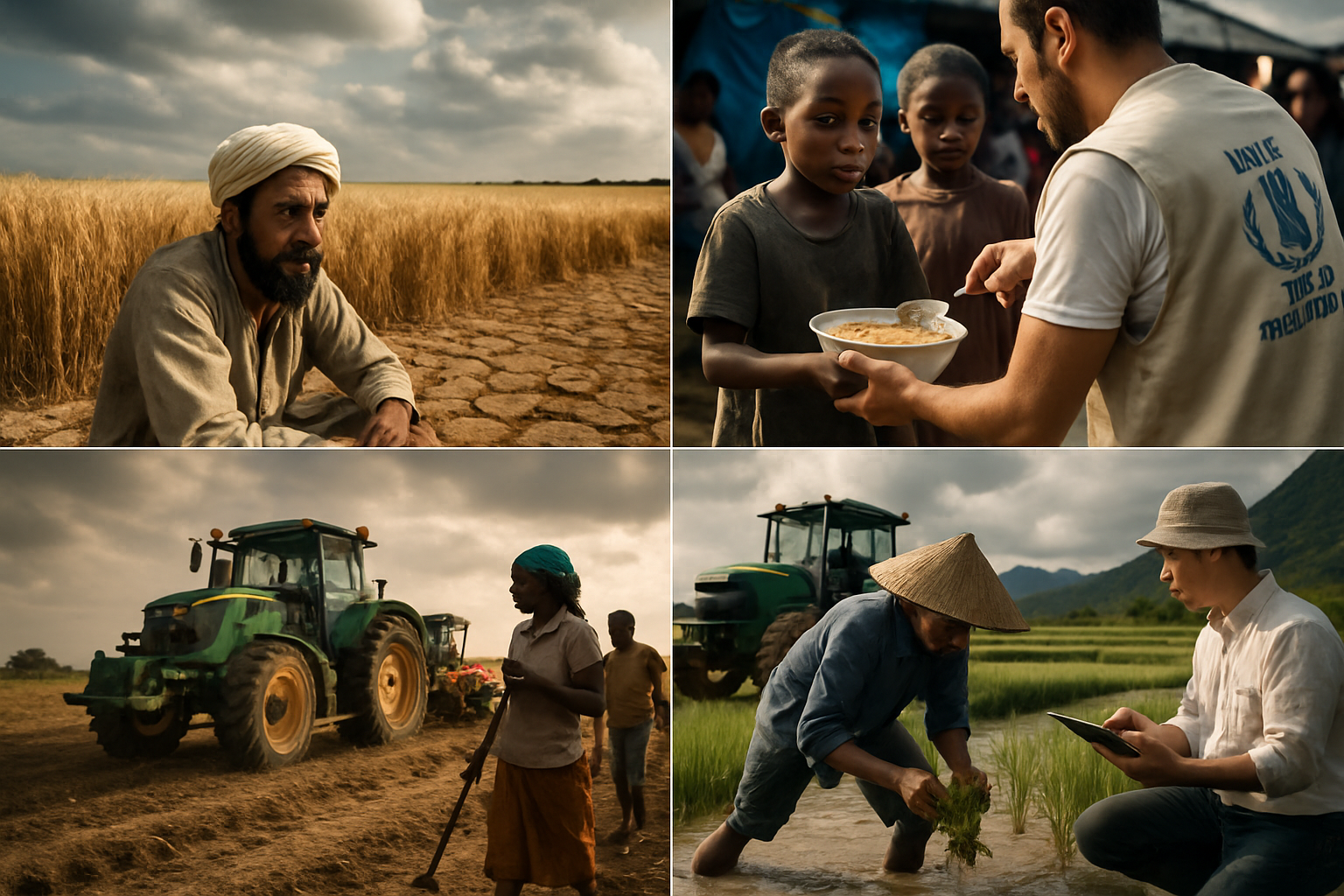
A convergence of humanitarian crises, agricultural challenges, and policy reforms across multiple continents is exposing the fragility of global food security systems, with Afghanistan facing its worst hunger crisis on record while other nations pursue innovative solutions to ensure stable food supplies.
John Aylieff, World Food Programme (WFP) Country Director in Afghanistan, delivered stark warnings about the unprecedented scale of malnutrition gripping the country, telling the Associated Press that the organization lacks capacity to assist all those in need due to devastating budget shortfalls. The crisis has reached catastrophic levels, with four million children at risk of malnutrition—the highest recorded figures in Afghanistan's history.
Afghanistan: A Humanitarian Emergency
"The cuts in aid have been devastating," Aylieff stated, revealing that WFP is now forced to turn away three out of every four hungry and malnourished children because of insufficient funding. The dire situation affects two-thirds of the country's population, representing not just individual tragedies but a systematic collapse of food security infrastructure.
This crisis unfolds against the backdrop of broader global food security challenges, with January 2026 marking the hottest month in recorded history—the 18th consecutive month exceeding 1.5°C above pre-industrial levels. The unprecedented warming is disrupting traditional agricultural cycles worldwide, forcing rapid adaptation strategies across diverse geographical contexts.
Somalia: Racing Against Time
Similar desperation characterizes the situation in Somalia, where the U.N. World Food Programme warns that life-saving food assistance could halt by April without immediate funding. An estimated 4.4 million people face crisis-level food insecurity, with nearly one million experiencing severe hunger due to failed rainy seasons, ongoing conflict, and declining humanitarian support.
"The situation is deteriorating at an alarming rate. Families have lost everything, and many are already being pushed to the brink. Without immediate emergency food support, conditions will worsen quickly."
— Ross Smith, WFP Director of Emergency Preparedness and Response
Somalia declared a national drought emergency in November following recurrent seasons of poor rainfall, mirroring patterns affecting the broader Horn of Africa region. The WFP, operating as the largest humanitarian organization globally, faces unprecedented challenges in maintaining operations amid funding constraints and access limitations.
Agricultural Innovations and Policy Responses
While humanitarian crises dominate headlines, several countries are implementing innovative agricultural policies addressing both immediate food security and long-term resilience. Ghana's government has announced ambitious plans requiring 50% of cocoa beans to be processed locally starting in the 2026/2027 season, alongside reviving the Produce Buying Company (PBC) and Cocoa Processing Company (CPC).
The cocoa policy initiative reflects broader patterns of countries seeking greater control over their agricultural value chains. As one farm manager near Mankessim in Ghana's Central Region explained while tending young cocoa plants: "If you neglect them at this stage, you lose the future harvest." This wisdom applies equally to agricultural policy development, requiring careful nurturing and sustained commitment.
France: Agricultural Sector Under Pressure
France's agricultural community faces mounting challenges as the renowned Salon de l'Agriculture prepares to open amid widespread industry concerns. The annual agricultural celebration, traditionally held at Porte de Versailles, will be marked by unusual tensions stemming from multiple crises affecting the sector.
Agricultural representatives cite a cascade of problems including recurring disease outbreaks leading to the absence of cattle and poultry at the event, climate-related disasters, global trade tensions, and inconsistent revenues. The situation reflects broader European agricultural challenges, with syndicate tensions emerging around bovine dermatosis management, European aid allocations, and controversial pesticide reintroduction policies.
Supply Chain Disruptions and Quality Concerns
In Bolivia's Beni region, citizens have initiated a 24-hour civic strike with road blockades protesting the distribution of poor-quality gasoline. The Beni Civic Committee, led by President Hugo Aponte, demands the provision of special gasoline without ethanol mixing, arguing that the current "plus" gasoline damages vehicles.
"Every time we take action, they give us special gasoline; once we stop, they send us plus gasoline again," Aponte explained. The crisis demonstrates how fuel quality issues can cascade through agricultural and transportation systems, affecting food distribution networks and rural economies.
Technology-Traditional Knowledge Integration
Successful agricultural adaptation increasingly requires sophisticated synthesis of cutting-edge technology with traditional ecological knowledge. Across continents, communities are developing approaches that respect established farming practices while incorporating beneficial innovations for climate adaptation and productivity enhancement.
Recent memory analysis reveals patterns from previous global food security initiatives, including Malaysia's agricultural transformation led by Dr. Stephen Rundi Utom in Sarawak, which demonstrated "outcome-driven delivery" approaches transitioning from routine administration to results-focused agricultural development. Similar models are emerging across developing nations, often through South-South cooperation rather than traditional North-South aid dependencies.
Climate Change Acceleration
The food security crisis occurs within the context of accelerating climate change, with environmental systems approaching critical thresholds that could fundamentally alter global agricultural capacity. The consistent temperature increases over 18 consecutive months represent unprecedented warming that overrides natural climate variability, including La Niña cooling effects.
This sustained warming affects every aspect of food production: traditional growing seasons, water availability, pest and disease patterns, and extreme weather frequency. Agricultural communities worldwide face the challenge of adapting production systems designed for historical climate conditions to rapidly changing environmental realities.
International Cooperation and Funding Challenges
The humanitarian crises in Afghanistan and Somalia highlight the critical importance of sustained international cooperation for global food security. However, funding shortfalls and competing global emergencies—including ongoing conflicts in Ukraine and Gaza—are straining the capacity of international organizations to respond effectively to multiple simultaneous crises.
The World Food Programme's forced rationing of assistance in Afghanistan represents a fundamental failure of the international community to maintain basic humanitarian support systems. When organizations must choose which hungry children to help based on budget constraints rather than need, the global food security architecture requires immediate reassessment and strengthening.
Regional Success Stories and Templates
Despite widespread challenges, several regions demonstrate successful food security interventions that could provide templates for global scaling. Kenya's Nguruman irrigation rehabilitation project has benefited over 10,000 farmers, while Rwanda has identified 417,000 hectares of irrigation potential. Algeria has pioneered date waste conversion to livestock feed, representing innovative circular economy approaches to agricultural waste management.
These initiatives share common success factors: community ownership, transparent governance, sustained political commitment, adaptive management capabilities, and integration of economic development with environmental sustainability. They demonstrate that effective food security solutions exist but require coordinated implementation and adequate resources.
Economic Development and Food Security Nexus
The relationship between economic development and food security has become increasingly complex, with some countries achieving agricultural export success while others struggle with basic food access. Argentina's agricultural sector, for example, has maintained strong export performance despite domestic economic challenges, while Ghana's cocoa sector faces the complex balance between farmer incomes and global market competitiveness.
These contrasts illustrate that food security cannot be addressed through agricultural policy alone but requires comprehensive approaches addressing infrastructure, market access, climate adaptation, and social protection systems. The economic implications extend beyond rural communities to affect national balance of payments, urban food prices, and overall economic stability.
Future Implications and Strategic Responses
The global food security crisis of February 2026 represents both a warning and an opportunity for coordinated international action. The window for building resilient, equitable food systems is narrowing rapidly as climate change accelerates and populations grow, but the tools and knowledge for effective responses exist.
Success depends on several critical factors: sustained political commitment across electoral cycles, adequate and predictable funding for both emergency response and long-term development, enhanced coordination between immediate crisis response and resilience building, and recognition of food security as a global public good requiring unprecedented international cooperation.
The human dimension remains central to all successful solutions—millions of farmers, food workers, and vulnerable communities depend on stable, fair global food systems. The crisis provides an opportunity to build more resilient approaches that balance immediate humanitarian needs with long-term sustainability, ensuring that short-term solutions contribute to rather than undermine lasting food security.
Conclusion
The convergence of humanitarian emergencies, agricultural policy reforms, and climate challenges in early 2026 demonstrates both the vulnerability and adaptability of global food systems. While Afghanistan and Somalia face immediate crises requiring urgent humanitarian response, other countries are developing innovative approaches that could serve as models for sustainable food security.
The effectiveness of the global response to these interconnected challenges will determine whether 2026 marks a turning point toward more resilient food systems or represents another step toward deeper food insecurity for the world's most vulnerable populations. The choices made in addressing these crises will have implications extending far beyond the immediate emergency response, shaping global food security for decades to come.