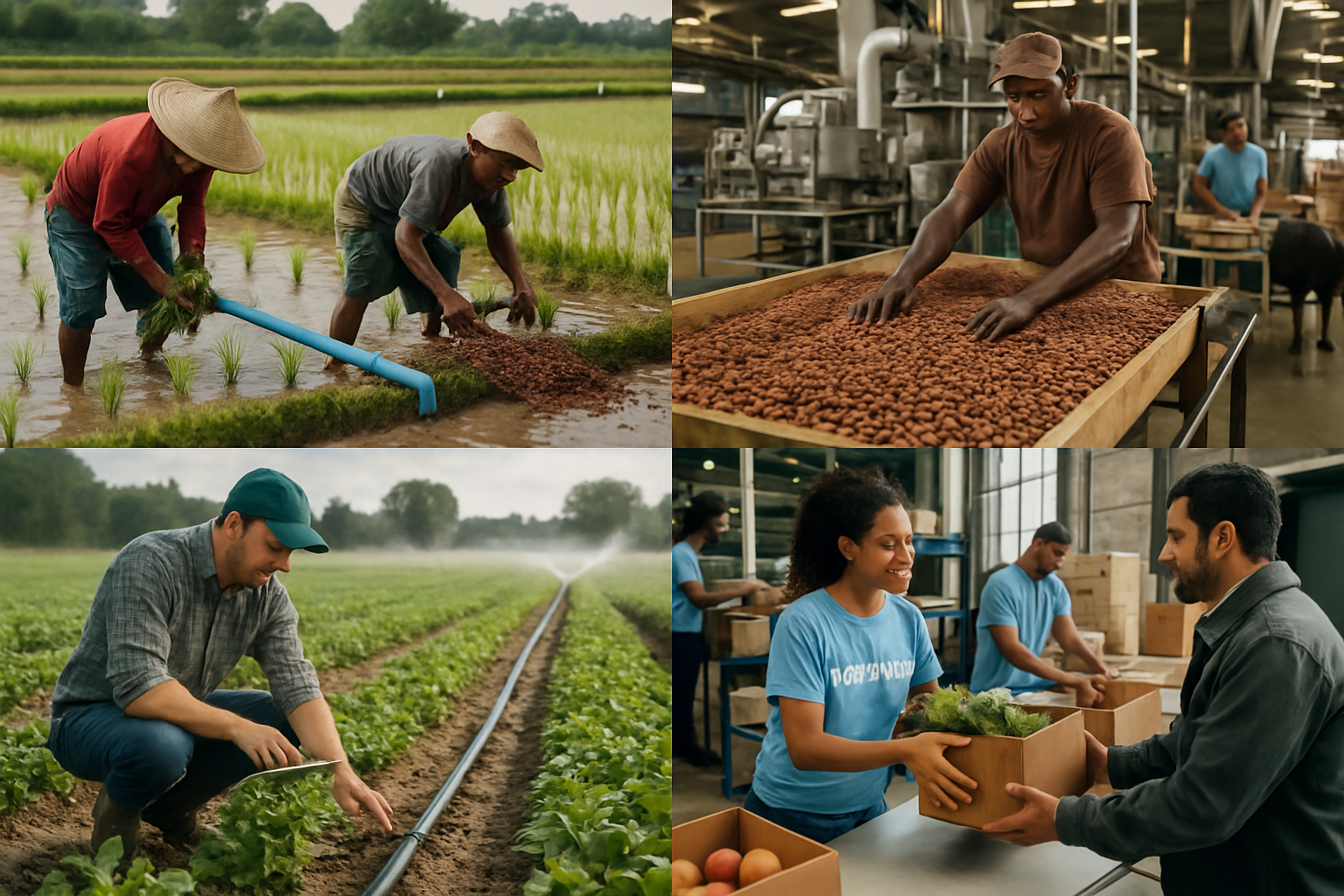
As the world grapples with the 19th consecutive month of temperatures exceeding 1.5°C above pre-industrial levels, four nations are pioneering revolutionary approaches to food security that could reshape global agricultural systems for generations to come.
Jordan, Guyana, Burkina Faso, and Algeria are demonstrating remarkable agricultural innovation and food security leadership, offering distinct yet complementary solutions to the mounting challenges facing global food systems. These initiatives represent a critical convergence of traditional knowledge with cutting-edge technology, occurring at a pivotal moment when climate pressures demand immediate and comprehensive agricultural transformation.
Jordan: Strategic Food Security and Water Infrastructure Leadership
Jordan's Civil Consumer Corporation has announced comprehensive food security measures, confirming adequate supplies of essential commodities and foodstuffs across all markets throughout the kingdom's provinces. General Manager Issam Al-Jarrah emphasized that strategic stockpiles of primary materials remain secure and meet citizens' needs.
The organization reported "reasonable and orderly purchasing movement" without any signs of overcrowding or commodity shortages, with branches continuously supplied from central warehouses to ensure sustainable availability of materials. This systematic approach to food distribution represents sophisticated supply chain management that has attracted international attention as a model for food security resilience.
Simultaneously, Algeria's irrigation minister Taha Darbal conducted inspections of water and sanitation services, emphasizing the critical role of water infrastructure in maintaining food security. His visit to the Water and Sanitation Company (SIAL) for Algiers and Tipaza provinces highlighted the government's commitment to providing quality public services, particularly during peak demand periods like Ramadan.
"This represents a comprehensive approach to food security that addresses both supply chains and the essential water infrastructure that underpins agricultural productivity."
— Regional Food Security Expert
Guyana: Climate-Smart Rice Industry Transformation
Guyana is revolutionizing its rice industry through climate-smart agricultural techniques, with particular emphasis on addressing the challenges of increasingly frequent droughts and erratic weather patterns. Agriculture Minister Zulfikar Mustapha addressed the 39th Session of the United Nations Food and Agriculture Organisation (FAO) Regional Conference for Latin America, outlining ambitious plans to strengthen the rice sector.
The government's strategy centers on developing new, improved rice varieties and implementing better post-harvest systems. This comprehensive approach recognizes that climate adaptation requires innovation throughout the entire agricultural value chain, from seed development to final processing and distribution.
Guyana's leadership position in Caribbean food security continues to strengthen through these initiatives. The country has successfully maintained regional food security leadership despite climate disruption affecting traditional growing seasons across the Caribbean basin. This success stems from sophisticated integration of traditional farming expertise with cutting-edge technology and climate-adaptive infrastructure.
Burkina Faso: Entrepreneurial Innovation in Agro-Processing
Burkina Faso showcases remarkable entrepreneurial innovation through initiatives like Wasoma Agri Farm, led by promoter Carine Aïcha Sawadogo. This enterprise specializes in transforming agricultural products into purées and natural seasonings, representing a sophisticated approach to agricultural value addition that creates employment while reducing post-harvest losses.
Sawadogo's work exemplifies the transformation occurring across West Africa, where agricultural entrepreneurs are developing innovative processing techniques that preserve nutritional value while extending shelf life. Her enterprise demonstrates how traditional agricultural knowledge can be enhanced through modern processing technologies to create products that serve both local and international markets.
This model of agricultural transformation addresses multiple challenges simultaneously: reducing post-harvest waste, creating rural employment, adding value to primary agricultural products, and developing products that meet evolving consumer preferences for natural, minimally processed foods.
Technology-Traditional Knowledge Integration: The Key to Success
All four nations demonstrate sophisticated synthesis of cutting-edge technology with traditional farming knowledge and community-based management systems. This integration represents a fundamental shift from the top-down technology transfer approaches that characterized earlier agricultural development efforts.
Jordan's supply chain management combines modern logistics with traditional market relationships, ensuring both efficiency and cultural appropriateness. Guyana's rice innovation incorporates precision agriculture with generations of rice cultivation expertise. Burkina Faso's agro-processing enterprises respect community structures while introducing beneficial technological innovations.
This technology-tradition synthesis proves more effective than purely technological solutions that ignore local traditions and community needs. The most successful agricultural adaptations consistently demonstrate this sophisticated integration approach.
Climate Context: Unprecedented Agricultural Pressures
These innovations occur during an unprecedented period of environmental stress. January 2026 marked the hottest month in recorded history, extending an extraordinary streak of 19 consecutive months exceeding the 1.5°C threshold above pre-industrial levels.
This sustained warming has fundamentally altered traditional farming cycles, water availability, and pest management patterns across all regions. The agricultural developments in these four nations demonstrate remarkable adaptability to these changing conditions while maintaining productivity and food security.
Climate change impacts include disrupted seasonal patterns, increased extreme weather frequency, altered precipitation patterns, and changing disease and pest pressures. Traditional agricultural approaches based on historical climate patterns are no longer sufficient, requiring the kind of innovative adaptation demonstrated by these pioneering nations.
International Cooperation and South-South Learning
These initiatives reflect a broader trend toward South-South cooperation in agricultural development, where developing nations share expertise through peer partnerships rather than relying primarily on traditional North-South aid relationships.
The FAO Regional Conference where Minister Mustapha presented Guyana's innovations exemplifies this approach, bringing together regional expertise to address shared challenges. Similarly, agricultural entrepreneurs like Sawadogo are increasingly connected to regional and international networks that facilitate knowledge sharing and market development.
This peer-to-peer approach proves more culturally appropriate and economically sustainable than conventional development assistance, as it builds on shared challenges and cultural understanding while respecting local autonomy and traditional knowledge systems.
Economic Implications and Rural Development
The agricultural innovations across these nations function as comprehensive economic development engines extending far beyond farm-level improvements. Jordan's supply chain efficiency supports consumer price stability while maintaining producer incomes. Guyana's rice sector transformation creates employment across transportation, processing, and export sectors.
Burkina Faso's agro-processing enterprises generate sustainable rural employment while reducing dependencies on external inputs and volatile commodity prices. Algeria's water infrastructure investments support both agricultural productivity and broader economic stability through reliable essential services.
These economic multiplier effects demonstrate how agricultural development, when properly designed and implemented, creates value throughout entire regional economies rather than benefiting only primary producers.
Implementation Challenges and Success Factors
Despite their successes, these initiatives face significant implementation challenges common to agricultural development efforts worldwide. Funding sustainability remains a critical concern for developing nations where immediate economic pressures often override long-term investment considerations.
Technical capacity building requires sustained investment in education, training, and institutional development. Climate change continues to disrupt project timelines, requiring adaptive management approaches that can respond rapidly to changing environmental conditions.
The success factors identified across these initiatives include community ownership and engagement, transparent governance frameworks, sustained political commitment, and adaptive management capabilities. International cooperation that respects local autonomy while providing beneficial technical and financial support also proves essential.
"The diversity of approaches provides resilience against single-solution dependencies while offering multiple pathways for adaptation to different national circumstances and challenges."
— International Agricultural Development Coordinator
Future Implications and Global Scaling Potential
The agricultural transformations occurring in these four nations provide valuable templates for addressing global food security challenges through diverse yet complementary approaches. Jordan's supply chain management, Guyana's climate-smart agriculture, Burkina Faso's agro-processing innovation, and Algeria's water infrastructure development offer different pathways toward agricultural resilience that can be adapted to various contexts.
The window for building resilient and equitable food systems is narrowing rapidly as climate acceleration and population growth create additional pressures on agricultural resources. However, the innovations demonstrated by these nations show that effective solutions exist when there is political will, community engagement, and appropriate international cooperation.
Success in scaling these approaches globally will require sustained international cooperation, enhanced coordination across multiple sectors and scales, and increased financial commitments that recognize food security as essential infrastructure for human prosperity and planetary sustainability.
Strategic Significance for Global Food Security
The convergence of these agricultural innovations represents a critical juncture for global food security, demonstrating both the urgency of current challenges and the remarkable capacity for innovative human responses. The diversity of approaches—from Jordan's systematic supply chain management to Burkina Faso's entrepreneurial agro-processing—shows multiple viable pathways toward agricultural resilience.
These initiatives may prove decisive in determining whether agricultural innovation can keep pace with accelerating environmental change while maintaining the effectiveness principles that ensure community benefit. The human dimension remains central to all these efforts, as millions of farmers, food workers, and vulnerable communities depend on stable and fair global food systems.
As the world confronts the reality of sustained climate change impacts on agriculture, the pioneering work of Jordan, Guyana, Burkina Faso, and Algeria offers both inspiration and practical guidance for building the resilient food systems that will be essential for global stability and prosperity in the decades ahead.