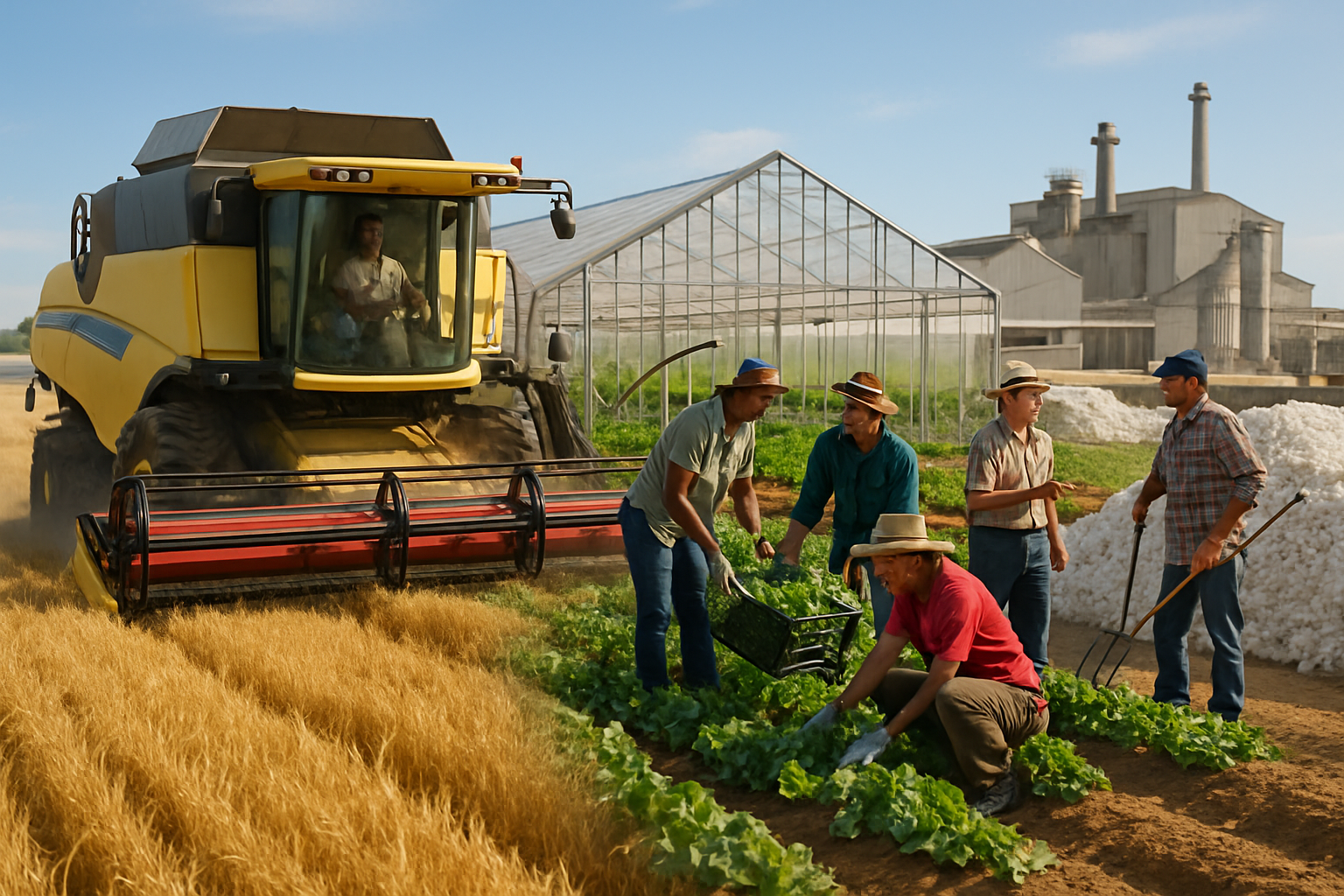
As global food security faces unprecedented challenges from climate extremes and shifting trade dynamics, two major agricultural developments this week signal a fundamental transformation in how nations approach food production and international cooperation: Guyana's emergence as the Caribbean's undisputed agricultural leader and the World Trade Organization's ambitious $5 billion investment plan for Africa's cotton processing industry.
These developments, occurring during the 18th consecutive month of global temperatures exceeding 1.5°C above pre-industrial levels, represent more than isolated policy announcements—they illustrate a comprehensive shift toward regional agricultural leadership, strategic value-addition, and South-South cooperation that could reshape international food systems for decades to come.
Guyana's Agricultural Renaissance: From Regional Player to Global Force
Minister of Agriculture Zulfikar Mustapha's assertion that Guyana has "successfully repositioned itself as the leading force in regional food security since 2020" reflects a remarkable transformation that extends far beyond traditional export statistics. During a recent appearance on the 'Starting Point' podcast, Mustapha strongly rejected opposition criticisms of the agricultural sector's performance, presenting compelling evidence of systematic achievements that position Guyana as a template for agricultural modernization in developing nations.
The minister's confidence stems from quantifiable successes across multiple agricultural sectors. Guyana's agricultural transformation represents a sophisticated integration of traditional farming expertise with cutting-edge technology, climate-adaptive infrastructure, and strategic international partnerships. This approach has enabled the nation to maintain food security leadership even as climate change disrupts traditional growing seasons across the Caribbean region.
"Guyana's regional leadership in agriculture is trusted because it's built on proven results, not empty promises."
— Minister Zulfikar Mustapha, Guyana Ministry of Agriculture
The timing of Guyana's agricultural ascendancy coincides with broader Caribbean food security challenges. Small island developing states across the region face mounting pressures from irregular rainfall, temperature extremes, and supply chain vulnerabilities exposed during the COVID-19 pandemic. Guyana's success in maintaining agricultural productivity and regional food supply stability has elevated its status from participant to leader in Caribbean food security initiatives.
WTO's Historic $5 Billion African Cotton Investment: Transforming Raw Materials into Value-Added Industries
The World Trade Organization's announcement of efforts to attract $5 billion in private investment for Africa's cotton processing industry represents one of the most ambitious agricultural value-addition initiatives in international development history. This comprehensive program, championed during WTO Director-General Ngozi Okonjo-Iweala's recent visit to Maputo, addresses a fundamental challenge in global agricultural trade: the persistent export of raw materials rather than processed goods from developing nations.
The WTO's commitment extends beyond simple investment mobilization. "The WTO has been committed to supporting African countries, encouraging efforts to add value to the harvest and develop the cotton value chain for the textile industry and for governments," Okonjo-Iweala emphasized during the Maputo meetings. This statement signals a paradigm shift in international trade policy, moving from traditional market access negotiations toward comprehensive industrial development support.
Africa's cotton industry currently faces a classic development paradox: the continent produces significant raw cotton but exports most of it unprocessed, then imports finished textile products at substantially higher values. The $5 billion investment framework aims to establish processing facilities, technical training programs, and market linkages that would enable African nations to capture more value from their agricultural production.
Mozambique's Strategic Position in Global Agricultural Trade Negotiations
The agricultural policy discussions extending beyond cotton processing reveal deeper structural challenges in global trade relationships. Mozambique Prime Minister Benvinda Levi's call for Africa to "advocate fairness in agricultural negotiations to correct distortions harmful to producers" during the Meeting of African Trade Ministers in Maputo reflects growing continental awareness of agricultural trade inequities.
Prime Minister Levi's emphasis on digital inclusion in e-commerce represents recognition that modern agricultural competitiveness requires sophisticated technology integration. African countries participating in the 14th Ministerial Conference must balance traditional agricultural strengths with 21st-century digital capabilities to compete effectively in global markets.
The convergence of agricultural development and digital technology creates opportunities for leapfrogging traditional development stages. Countries can potentially move directly from subsistence agriculture to precision farming without intermediate industrialization phases, provided adequate infrastructure investment and technical capacity building accompany policy reforms.
Climate Context: Agricultural Innovation Under Unprecedented Environmental Pressure
These agricultural developments occur during the most sustained period of global warming in recorded history. January 2026 marked the hottest month ever recorded, continuing an unprecedented 18-month streak of temperatures exceeding 1.5°C above pre-industrial levels. This sustained warming has fundamentally altered agricultural systems worldwide, forcing rapid adaptation in crop selection, irrigation methods, and harvest timing.
Guyana's agricultural leadership has been tested by these climate realities. The nation has demonstrated remarkable resilience in maintaining food production stability while other Caribbean nations struggle with drought, flooding, and irregular growing seasons. This success stems from strategic investments in climate-adaptive infrastructure, diversified cropping systems, and international partnerships that provide access to climate-resilient seeds and farming technologies.
Similarly, the WTO's African cotton investment acknowledges that climate change is reshaping global agricultural production patterns. Processing facilities must incorporate climate-adaptive technologies, renewable energy systems, and water conservation methods to remain viable as environmental conditions continue changing. The $5 billion framework specifically includes provisions for climate-resilient infrastructure that can maintain operations despite increasing weather volatility.
Technology-Traditional Knowledge Integration: The New Agricultural Paradigm
Both Guyana's success and the African cotton initiative demonstrate sophisticated understanding that effective agricultural modernization requires careful integration of cutting-edge technology with traditional farming knowledge. This approach contrasts sharply with earlier development models that often displaced traditional practices without adequate consideration of local conditions and community ownership.
Guyana's agricultural transformation has preserved traditional ecological knowledge while incorporating precision agriculture, advanced irrigation systems, and digital monitoring capabilities. Farmers retain decision-making authority over their operations while accessing technical support, market information, and climate adaptation resources that enhance productivity without undermining cultural practices.
The African cotton processing initiative similarly emphasizes community-based management alongside industrial development. Processing facilities will integrate with existing farming communities rather than displacing them, creating employment opportunities and technical training that build on traditional skills while developing new capabilities essential for global competitiveness.
South-South Cooperation: Emerging Alternative to Traditional Aid Models
The agricultural developments across Guyana and Africa reflect broader trends toward South-South cooperation that bypasses traditional North-South aid relationships. Developing nations increasingly share expertise, technology, and resources through peer partnerships that respect sovereignty while enabling mutual learning and capacity building.
Guyana's regional leadership role exemplifies this trend. Rather than dependent on external assistance, Guyana has become a technology and expertise provider for other Caribbean nations facing similar agricultural challenges. This evolution from aid recipient to cooperation partner represents a fundamental shift in international development relationships.
The WTO's African cotton initiative similarly emphasizes African ownership of development priorities while facilitating international investment and technical support. Private investors work within frameworks designed by African governments rather than imposing external development models, creating partnerships that serve both commercial interests and national development objectives.
"We must advocate fairness in agricultural negotiations to correct distortions harmful to producers, while ensuring e-commerce promotes digital inclusion."
— Prime Minister Benvinda Levi, Mozambique
Economic Implications: Agricultural Development as Strategic Infrastructure
The economic dimensions of these agricultural developments extend far beyond farm-level productivity improvements. Guyana's agricultural leadership has created multiplier effects throughout the economy, supporting rural employment, export earnings, and food price stability that benefits both urban and rural populations.
The nation's success in maintaining affordable food prices while increasing agricultural exports demonstrates sophisticated policy coordination between production incentives, market regulation, and international trade management. This balance has enabled Guyana to serve regional food security objectives without compromising domestic consumer welfare.
The African cotton processing initiative represents even more ambitious economic transformation potential. Processing facilities could generate substantial employment, foreign exchange earnings, and industrial capacity that supports broader economic diversification. Success would demonstrate that agricultural development can serve as a foundation for comprehensive economic modernization rather than remaining isolated in rural sectors.
International Trade Architecture: Bilateral Partnerships and Regional Integration
These developments occur within a rapidly evolving international trade architecture that increasingly emphasizes bilateral partnerships and regional integration over multilateral frameworks. The WTO's role in facilitating the African cotton investment while Guyana pursues deepened regional cooperation reflects adaptation to changing global economic realities.
Regional integration through initiatives like the African Continental Free Trade Area (AfCFTA) provides frameworks for scaling agricultural development across national boundaries. Cotton processing facilities in multiple African countries can share technical expertise, coordinate production schedules, and jointly access international markets with greater efficiency than isolated national efforts.
Similarly, Caribbean agricultural cooperation enables Guyana's expertise to support food security across multiple island nations facing similar climate challenges. Regional partnerships create redundancy and mutual support that enhance overall agricultural resilience while maintaining national sovereignty over development priorities.
Implementation Challenges: Funding, Capacity, and Coordination
Despite promising frameworks, both initiatives face substantial implementation challenges that will determine their ultimate success. The WTO's $5 billion African cotton investment requires unprecedented coordination between international investors, national governments, local communities, and technical institutions across multiple countries and time zones.
Private investors must balance commercial returns with development objectives, requiring innovative financing mechanisms that align profit incentives with community benefits. Technical capacity building demands sustained educational investment, institutional development, and knowledge transfer that extends far beyond initial capital deployment.
Guyana's continued agricultural leadership requires sustained political commitment across electoral cycles, adequate infrastructure investment, and adaptive management responding to rapidly changing climate conditions. Success has created expectations that must be maintained through consistent policy implementation and resource allocation.
Global Food Security Templates: Scaling Successful Models
The convergence of Guyana's regional leadership and the WTO's African investment represents potential templates for addressing global food security challenges through comprehensive approaches that integrate production, processing, trade, and climate adaptation.
Successful scaling would require careful adaptation to diverse geographical, cultural, and economic contexts while maintaining core principles of community ownership, technology-traditional knowledge integration, and sustainable resource management. No single solution exists for complex food security challenges spanning biological, physical, and human systems.
The window for building resilient, equitable food systems is narrowing rapidly as climate change accelerates and population growth increases food demand. Success with current initiatives may determine whether agricultural innovation can keep pace with environmental change while serving growing populations during the critical climate action decade ahead.
Future Implications: Strategic Significance for Global Agriculture
The strategic significance of these developments extends decades beyond immediate implementation outcomes. Success would establish precedents for agricultural development that prioritizes local ownership, value-addition, and regional cooperation over traditional models emphasizing export of raw materials to developed nations.
Failure would reinforce existing patterns that limit developing nations' ability to capture value from agricultural production, potentially undermining food security and economic development objectives essential for political stability and international cooperation.
The human dimension remains central to sustainable solutions. Millions of farmers, food workers, and vulnerable communities depend on stable, fair global food systems that provide adequate nutrition while supporting rural livelihoods. Agricultural policies must serve both immediate humanitarian needs and long-term sustainability requirements that protect ecological foundations of food production.
As Minister Mustapha emphasized regarding Guyana's achievements, agricultural leadership must be "trusted" through proven results rather than promises. The test for both Guyana's continued success and the African cotton initiative will be their ability to deliver tangible benefits that enhance food security, economic opportunity, and environmental sustainability for the communities they serve.
The coordination of immediate crisis response with long-term resilience building remains critical for global food systems confronting accelerating environmental change. February 2026's agricultural developments provide templates for this essential balance, but their ultimate value will be determined by implementation effectiveness and adaptability to future challenges that cannot yet be fully anticipated.