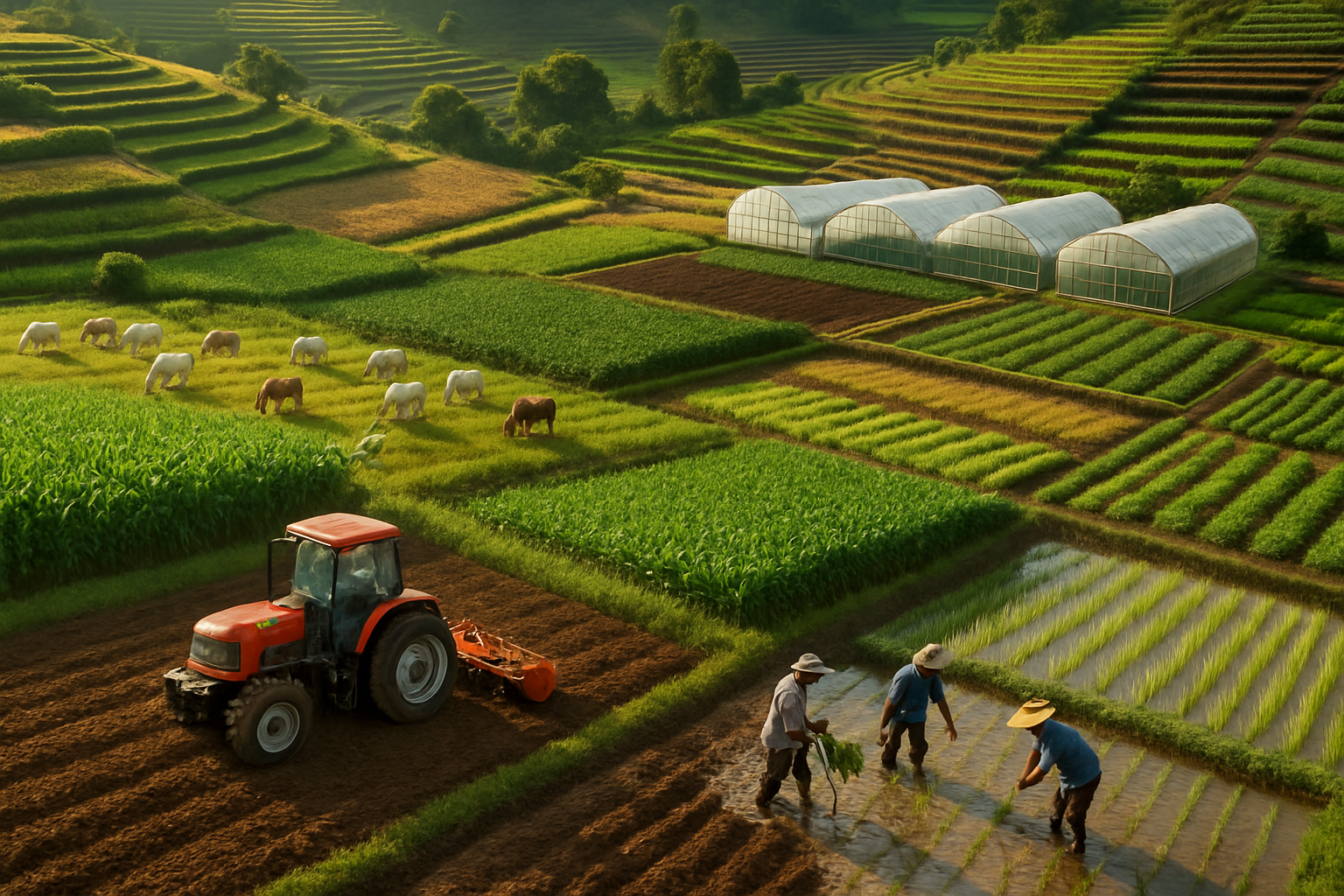
A sweeping agricultural transformation is underway across continents as nations from Egypt to Zimbabwe implement comprehensive policy reforms and production improvements to address mounting food security challenges, marking the most significant coordinated response to global agricultural pressures in decades.
The convergence of agricultural initiatives spans diverse approaches, from Egypt's ambitious livestock expansion program to Portugal's critical irrigation infrastructure repairs, Uganda's market access struggles, and Zimbabwe's strategic agricultural partnerships. These developments emerge during unprecedented environmental stress, with climate conditions continuing to challenge traditional farming methods and food distribution systems worldwide.
Egypt's Livestock Revolution
Egypt's Ministry of Agriculture and Land Reclamation has launched one of the most comprehensive livestock development programs in the region, issuing 916 operating licenses in February alone for livestock, feed, and poultry projects. The initiative represents a fundamental shift toward agricultural modernization under the presidential "Haya Karima" rural development program.
Tarek Suleiman, head of the Livestock and Poultry Development Sector, confirmed that 264 permits were specifically allocated for cattle rearing among small breeders, with strict biosecurity and biosafety controls implemented in coordination with the General Organisation for Veterinary Services. The National Veal Project alone approved EGP 297.36 million in disbursements during February, supporting 425 beneficiaries to raise and fatten 4,251 head of cattle.
"This represents the largest expansion of livestock infrastructure in Egypt's modern agricultural history,"
— Agricultural Policy Expert, Regional Food Security Institute
The program's scope extends beyond immediate production goals, with total financing reaching EGP 10.35 billion, benefiting 45,353 beneficiaries including small breeders, young graduates, and women entrepreneurs to raise 526,760 head of cattle across rural villages. This comprehensive approach addresses both food security and rural economic development simultaneously.
Portugal's Infrastructure Crisis
In stark contrast to Egypt's expansion, Portugal faces a critical agricultural infrastructure emergency that threatens the entire Baixo Mondego region. Agricultural cooperatives have issued urgent warnings to the Parliamentary Committee on Agriculture and Fisheries that repairs to the Mondego irrigation canal must be completed by early May to prevent agricultural collapse in the region.
The crisis represents a broader challenge facing European agricultural infrastructure, where aging irrigation systems struggle to meet the demands of modern farming while adapting to increasingly unpredictable weather patterns. The Baixo Mondego region, traditionally one of Portugal's most productive agricultural areas, could face complete agricultural shutdown if the canal repairs are not completed before the critical planting season.
Uganda's Market Access Struggles
Uganda's coffee farming sector illustrates the complex challenges facing agricultural producers in accessing reliable markets. Coffee farmers in Gomba District have launched sharp criticism of officials in the Ministry of Agriculture, Animal Industry and Fisheries, along with agencies responsible for trade and export promotion.
The farmers accuse government officials of neglecting their duty to secure reliable markets, leaving many producers counting significant losses after harvest. This situation reflects broader patterns across Africa where small-scale farmers struggle to connect with international markets despite producing high-quality agricultural products.
The Gomba District crisis highlights the critical gap between production success and market access, demonstrating that agricultural development requires comprehensive approaches addressing not just farming techniques but also trade infrastructure, market connections, and export facilitation.
Zimbabwe's Strategic Partnerships
Zimbabwe represents a different model of agricultural development through strategic partnerships and private sector engagement. The signing of a Memorandum of Understanding between the World Food Programme (WFP) and the Zimbabwe Investment and Development Agency (ZIDA) positions the private sector as a critical partner in strengthening the country's food security.
This partnership approach reflects Zimbabwe's evolution from aid recipient to active participant in regional food security initiatives. The country has demonstrated this commitment through practical actions, including donating 370 metric tonnes of maize to Malawi amid worsening food shortages across southern Africa.
Zimbabwe's tobacco sector is also preparing for the 2026 marketing season launch, with farmers, contractors, and stakeholders anticipating what industry experts describe as a promising agricultural year. This dual focus on food security and cash crop production illustrates sophisticated agricultural planning that balances immediate food needs with economic development objectives.
Technology Integration and Innovation
Across these diverse agricultural initiatives, a common theme emerges: the integration of modern technology with traditional farming knowledge. Egypt's biosecurity protocols combine advanced veterinary science with established livestock management practices. Portugal's irrigation challenges require both engineering solutions and adaptive water management techniques rooted in regional agricultural traditions.
This technology-tradition synthesis represents a maturation of agricultural development approaches, moving beyond simple technology transfer toward comprehensive systems that respect local knowledge while incorporating beneficial innovations. The approach has proven essential for sustainable agricultural transformation that serves communities while building resilience against climate volatility.
Climate Adaptation Imperative
These agricultural developments occur during a period of unprecedented environmental stress. The sustained pattern of extreme weather conditions has fundamentally altered traditional farming cycles, creating additional pressure on agricultural systems already facing economic and logistical challenges.
Portugal's irrigation crisis exemplifies how climate unpredictability can threaten entire regional agricultural systems. Uganda's market access problems are complicated by weather-related transportation disruptions. Even Egypt's livestock expansion must account for changing temperature patterns and water availability.
The agricultural transformations across these nations demonstrate sophisticated understanding of climate adaptation requirements, with programs designed to provide resilience against environmental volatility while maintaining productive capacity.
Regional Cooperation Models
Zimbabwe's maize donation to Malawi represents an emerging model of South-South agricultural cooperation that bypasses traditional North-South aid relationships. This regional solidarity approach enables countries to share resources, expertise, and risk management strategies based on shared challenges and cultural understanding.
The model contrasts with conventional development assistance by emphasizing peer-to-peer cooperation, where countries facing similar agricultural challenges collaborate on solutions rather than receiving top-down technical assistance. This approach has proven more sustainable and culturally appropriate than traditional aid models.
Economic Development Engine
Modern agricultural development increasingly functions as an economic development engine rather than merely a food production sector. Egypt's livestock program creates sustainable rural employment while supporting food security. Zimbabwe's tobacco sector generates foreign currency earnings that support broader economic stability.
Even Uganda's market access challenges highlight agriculture's economic potential when properly connected to international trade networks. The agricultural sector's economic multiplier effects extend through rural employment, transportation networks, processing industries, and export revenues.
Policy Coordination Challenges
The diverse experiences across these nations highlight both the potential and challenges of comprehensive agricultural policy coordination. Egypt's coordinated approach between multiple ministries and agencies demonstrates the benefits of integrated planning, while Uganda's struggles illustrate the costs of inadequate coordination between production and market development agencies.
Portugal's crisis reveals how infrastructure neglect can undermine even successful agricultural production, emphasizing the need for comprehensive policy frameworks addressing production, infrastructure, and market access simultaneously.
Future Implications
The agricultural transformations underway across these nations provide templates for addressing global food security challenges through diverse but complementary approaches. Egypt's livestock expansion, Portugal's infrastructure focus, Uganda's market development needs, and Zimbabwe's partnership model offer different pathways toward agricultural resilience.
Success factors consistently include community ownership, international cooperation, technology-tradition integration, economic development beyond farm-level production, and adaptive management responding to changing environmental conditions. The diversity of approaches provides resilience against single-solution dependencies while offering multiple adaptation pathways for different national circumstances.
These developments represent a critical juncture for global food security, demonstrating both the urgency of agricultural challenges and the capacity for innovative human responses. The agricultural renaissance occurring across continents may determine whether food production can keep pace with environmental change while serving growing populations during humanity's critical climate action decade.
The coordination of immediate crisis response with long-term resilience building across these diverse national contexts provides grounds for optimism that agricultural innovation can rise to meet the challenges ahead, provided that political commitment, community engagement, and international cooperation remain aligned in service of global food security objectives.