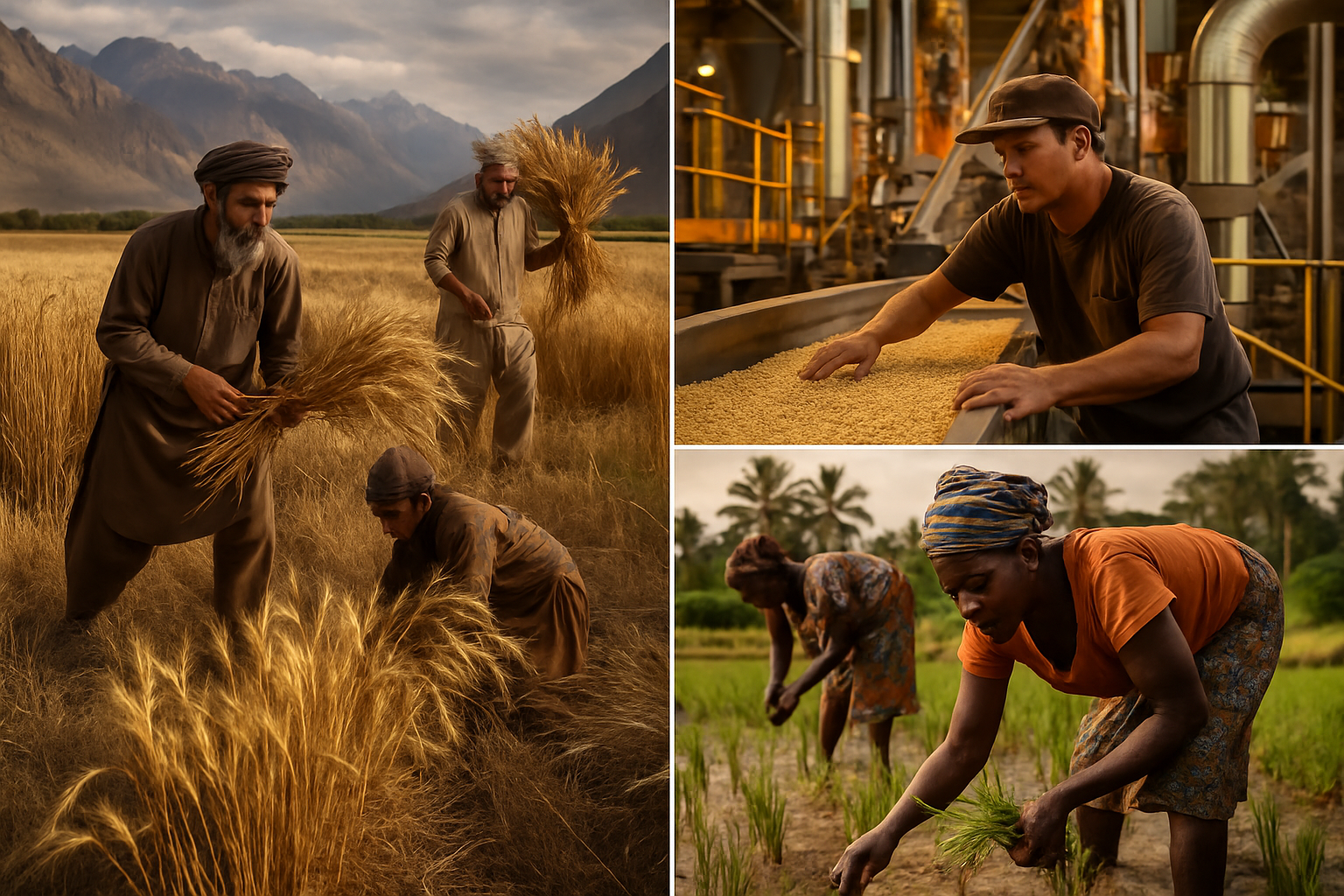
As global temperatures continue to exceed critical thresholds for the 18th consecutive month, a stark pattern emerges across three continents: countries are implementing desperate agricultural initiatives while grappling with worsening food security crises that threaten millions of lives.
From Afghanistan's devastating malnutrition emergency affecting 4 million children to Bolivia's emergency soy import measures and Sierra Leone's innovative community-led agricultural transformation, February 2026 has revealed the complex intersection of climate change, economic pressures, and food system vulnerabilities on a global scale.
Afghanistan's Deepening Malnutrition Crisis
The World Food Programme has issued its starkest warning yet about Afghanistan's deteriorating food security situation, with John Aylieff, head of the WFP in Afghanistan, confirming that funding cuts are placing four million children at serious risk of malnutrition.
Speaking to the Associated Press on February 19, Aylieff described how devastating aid reductions are forcing the agency to make impossible choices. "We are now forced to cut assistance when people need it most," he explained, highlighting how the international community's reduced financial commitment is directly translating into increased child mortality rates.
"The scale of this crisis cannot be overstated. We're watching four million children face serious malnutrition at a time when global attention and resources are stretched thin across multiple crises."
— John Aylieff, WFP Afghanistan Director
The situation represents a continuation of Afghanistan's food security collapse following the Taliban's return to power, with international sanctions and frozen assets severely limiting the country's ability to import essential food supplies or maintain agricultural infrastructure. The timing is particularly critical as Afghanistan enters its traditional planting season, when food assistance could help bridge families until the next harvest.
Bolivia's Emergency Agricultural Trade Measures
In a stark contrast to Afghanistan's aid-dependent situation, Bolivia has taken proactive economic measures to address food security challenges through trade policy. On February 19, the Bolivian government published Decreto Supremo 5547 in the official gazette, eliminating tariffs on soy grain imports for the remainder of 2026.
The decree, which entered into force immediately, reduces the tariff rate to zero percent for soy grain imports under tariff subheading 1201.90.00.00, representing a significant policy shift aimed at strengthening domestic soy processing capabilities and ensuring adequate raw material availability for Bolivia's national industry.
According to the decree's preamble, the measure specifically targets the strengthening of soy by-product production and guaranteeing greater availability of raw materials for national industry. This approach demonstrates how middle-income countries are using trade policy tools to address agricultural supply chain vulnerabilities.
The timing of Bolivia's policy change reflects broader pressures on global agricultural commodity markets, where climate-related disruptions and supply chain challenges have created price volatility that affects both producers and consumers. Bolivia's soy processing industry, crucial for livestock feed and cooking oil production, requires stable access to raw materials to maintain food security for the domestic market.
Sierra Leone's Community-Driven Agricultural Renaissance
Perhaps most encouraging among the three case studies is Sierra Leone's innovative approach to agricultural transformation in Falaba District, where women and youth are leading a quiet revolution in food production through community-based farming initiatives.
In the inland valley swamps of Danyoro village, Mongo Chiefdom, a transformation is taking place that exemplifies how local innovation can address global food security challenges. At the center of this change is Adama Manasaray, a mother of five who serves as chairlady of her farmers' group and has witnessed firsthand the power of collective agricultural action.
"Before the project, we worked on individual farms, mostly upland," Manasaray explains, standing at the edge of a five-hectare swamp that now produces significantly higher rice yields. "We always struggled—with money, with labour, and with low yields."
The transformation began when inland valley swamp (IVS) farming was introduced with support from the World Food Programme and Sierra Leone's Ministry of Agriculture and Food Security. This represented the first time that farmers like Manasaray were organized to work collectively, sharing resources, knowledge, and labor in ways that dramatically improved both productivity and economic outcomes.
Global Climate Context and Agricultural Adaptation
These three distinct approaches to food security challenges are unfolding against the backdrop of January 2026 being confirmed as the hottest month in recorded history—the 18th consecutive month that global temperatures have exceeded 1.5°C above pre-industrial levels. This unprecedented warming is overriding natural climate variability, including La Niña cooling effects, demonstrating how human-induced climate change has fundamentally altered atmospheric systems beyond natural recovery mechanisms.
The climate context is crucial for understanding the urgency behind each country's approach. Afghanistan's agricultural system, already severely compromised by decades of conflict, now faces additional pressure from changing precipitation patterns and extreme weather events. Bolivia's agricultural trade policy reflects the need to adapt supply chains to climate-induced production variability both domestically and internationally. Sierra Leone's community-based approach represents a climate adaptation strategy that builds resilience from the ground up.
Technology and Traditional Knowledge Integration
A common thread across successful agricultural initiatives is the sophisticated synthesis of cutting-edge technology with traditional ecological knowledge and community-based management systems. Sierra Leone's inland valley swamp farming, for example, combines modern agricultural science with traditional community resource management structures that have sustained farming communities for generations.
This integration appears increasingly critical as agricultural systems worldwide face unprecedented environmental pressures. Traditional farming knowledge provides resilience and adaptation strategies developed over centuries, while modern technology offers tools for scaling successful approaches and responding to rapidly changing conditions.
Bolivia's trade policy approach represents a different kind of integration—using modern economic tools and international trade relationships to support domestic agricultural processing that maintains food sovereignty while adapting to global market realities.
Economic Development and Food Security Nexus
The three case studies illustrate different models for how food security functions within broader economic development strategies. Afghanistan's crisis demonstrates the vulnerability of food systems dependent on international aid when geopolitical factors restrict assistance. Bolivia's approach treats agricultural supply chain security as an economic development strategy, using trade policy to support domestic industry while maintaining food access.
Sierra Leone's community-based model shows how food security can function as an engine for economic development, creating sustainable rural employment and building agricultural value chains that benefit entire communities. The success in Danyoro village, where farmers are achieving significant income increases through collective action and improved techniques, provides a template for rural economic development that enhances rather than compromises food security.
International Cooperation and South-South Learning
The February 2026 agricultural developments also highlight the evolution of international cooperation in food security. While traditional North-South aid relationships continue to be important—as evidenced by WFP operations in Afghanistan—increasingly successful initiatives involve South-South cooperation and peer-to-peer learning.
Sierra Leone's transformation builds on knowledge sharing and technical assistance that respects local knowledge systems while introducing beneficial innovations. This represents a more sustainable model than top-down technology transfer approaches that have often failed to achieve lasting results.
Regional integration efforts, including the African Continental Free Trade Agreement (AfCFTA), are creating new opportunities for agricultural partnership that enhance food security through diversified supply chains and shared value chains, reducing dependence on volatile global markets.
Implementation Challenges and Success Factors
Despite the diverse approaches represented by these three countries, common challenges emerge: funding sustainability is critical for developing nations where immediate economic pressures often override long-term considerations. Technical capacity building requires sustained investment in education, training, and institutional development. Climate change disrupts project timelines, requiring adaptive management capabilities that can respond to rapidly changing environmental conditions.
The success factors are equally clear across different contexts: community ownership ensures that agricultural initiatives serve local needs and build on existing social structures. International cooperation provides resources and knowledge sharing while respecting local autonomy. Technology-traditional knowledge synthesis creates approaches that are both innovative and culturally appropriate.
Economic viability remains essential—agricultural initiatives must provide tangible economic benefits to participants while contributing to broader food security objectives. Transparent governance and sustained political commitment create the institutional foundations necessary for long-term success.
Future Implications for Global Food Systems
The window for building resilient, equitable food systems is narrowing rapidly as climate change accelerates and global population growth continues. The experiments documented in Afghanistan, Bolivia, and Sierra Leone in February 2026 may prove crucial for global food security planning as they demonstrate different pathways for addressing fundamental challenges.
Afghanistan's crisis underscores the vulnerability of food systems dependent on external assistance and the urgent need for sustainable, locally-controlled agricultural development. Bolivia's trade policy innovation shows how middle-income countries can use economic tools to maintain food security while supporting domestic industry. Sierra Leone's community-based approach demonstrates that grassroots innovation can achieve remarkable results when properly supported.
Success in scaling these approaches will likely determine whether agricultural innovation can keep pace with accelerating climate change while maintaining the effectiveness principles that ensure community benefit. The combination of immediate crisis response, strategic policy interventions, and long-term infrastructure development represented across these three cases provides a template for comprehensive food security approaches that address multiple dimensions simultaneously.
Conclusion: Urgent Action Required
As global temperatures continue to break records and food systems face unprecedented stress, the experiences of Afghanistan, Bolivia, and Sierra Leone in February 2026 provide both warnings and hope. The Afghan crisis demonstrates the human cost of food system failure, affecting millions of children whose lives hang in the balance of international political and economic decisions.
Bolivia's proactive trade policy approach shows how governments can use available tools to maintain food security even under challenging conditions. Sierra Leone's community-driven success provides evidence that local innovation, properly supported, can create sustainable improvements in both food security and economic opportunity.
The convergence of these diverse approaches to food security challenges—crisis response, policy innovation, and grassroots transformation—offers a roadmap for global food systems that can serve growing populations while adapting to accelerating environmental change. The question remains whether the international community can coordinate action at the speed and scale required to prevent further crises like Afghanistan's while scaling successes like those emerging in Sierra Leone.
The stakes could not be higher: millions of lives depend on getting food security right, and the window for effective action continues to narrow with each record-breaking month of global warming.