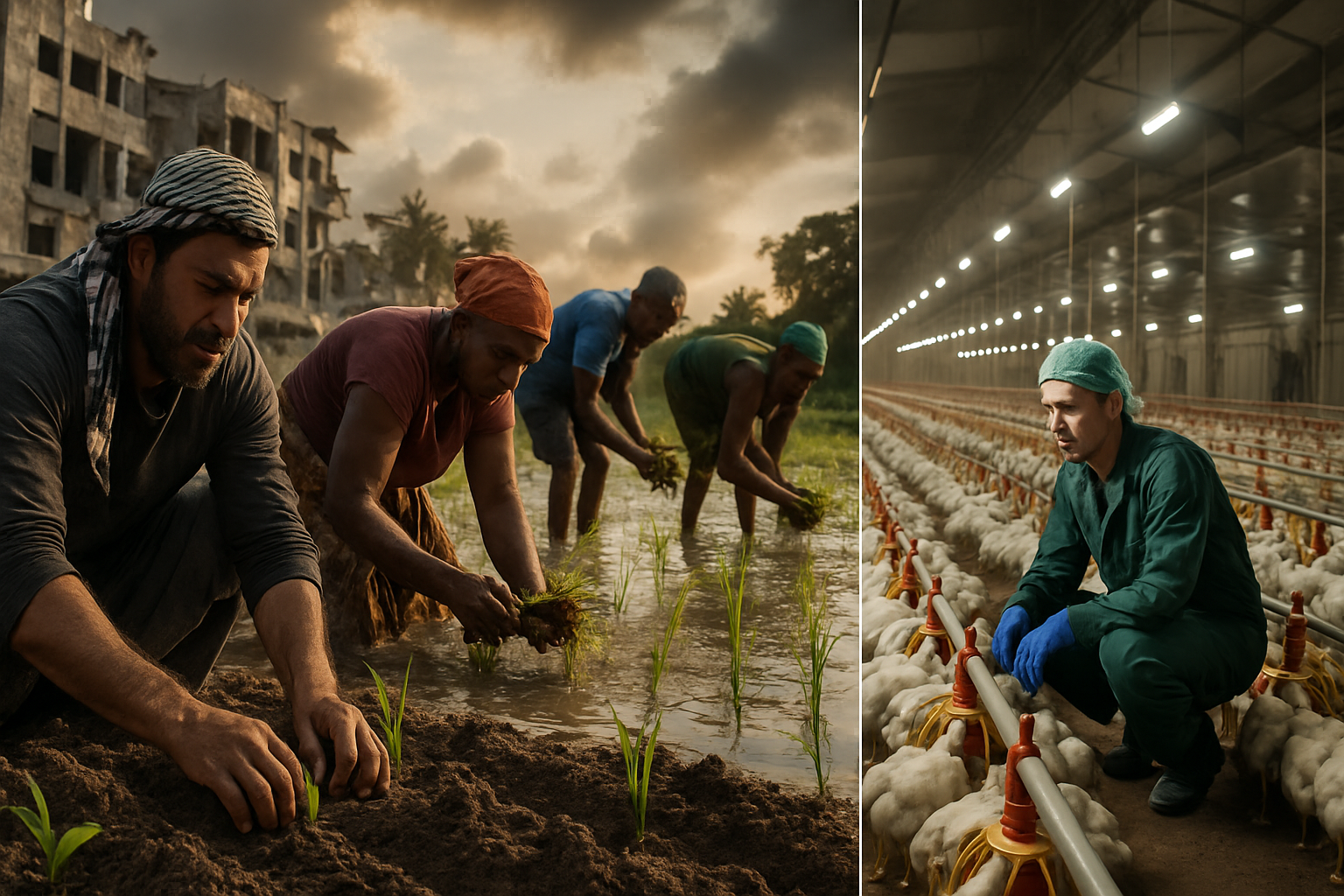
Agricultural developments across Palestine, Liberia, and Saudi Arabia illustrate the complex global food security landscape emerging in 2026, where agricultural innovation, conflict recovery, and modernization efforts converge amid the 20th consecutive month of temperatures exceeding 1.5°C above pre-industrial levels.
Gaza's Agricultural Renaissance Against All Odds
Palestinian farmer Ahmed Khudeir exemplifies extraordinary resilience, launching agricultural initiatives in northern Gaza despite devastating losses from ongoing conflict. After Israeli operations destroyed 100 dunums (approximately 25 acres) of his farmland in Beit Lahia and restricted access to his remaining plots, Khudeir has begun planting cucumber seeds and tomato seedlings, representing hope amid severe agricultural disruption.
This grassroots agricultural revival occurs as five Gaza farmers collectively combat escalating food prices, scarcity, and monopolistic practices that have plagued the territory. Their initiative demonstrates how agricultural entrepreneurship emerges even in conflict zones, providing essential food security when traditional supply chains collapse.
"The Palestinian farmer maintains the pulse of the land despite the ongoing genocide and rising costs,"
— Palestinian Information Center reporting
The Palestinian agricultural sector faces unprecedented challenges as infrastructure destruction limits access to productive farmland while population needs remain constant. These farmer-led initiatives represent critical food sovereignty efforts during humanitarian crises, building on traditional Palestinian agricultural knowledge while adapting to extraordinary circumstances.
Liberia's Persistent Hunger Challenges
Despite global agricultural advancements, Liberia remains among the countries most vulnerable to food insecurity according to the latest Global Hunger Index. This persistent vulnerability occurs as international agricultural development demonstrates remarkable success stories across Africa, highlighting the uneven distribution of agricultural progress globally.
However, new rice production initiatives offer hope for transforming Liberia's food security trajectory. Enhanced rice cultivation programs could fundamentally alter the nation's hunger vulnerability by strengthening domestic production capacity and reducing import dependence. These efforts align with broader West African agricultural renaissance patterns observed across the region throughout 2026.
Liberia's situation contrasts sharply with agricultural successes documented across neighboring countries, where innovative farming techniques, international partnerships, and climate adaptation strategies have yielded substantial improvements in food security. The potential for scaling successful models to Liberian contexts remains significant, particularly through South-South cooperation frameworks that have proven effective throughout Africa.
Saudi Arabia's Agricultural Modernization Success
Saudi Arabia demonstrates remarkable agricultural modernization through its poultry sector achievements. Deputy Minister of Environment, Water and Agriculture Eng. Mansour Al-Mushaiti confirmed the sector's stability and abundance, with production figures expected to exceed 1.5 million tons, achieving over 76% self-sufficiency in poultry products.
This success represents strategic agricultural development aligned with Saudi Vision 2030 objectives, emphasizing food security enhancement and national economic support. The achievement demonstrates how systematic investment in agricultural infrastructure, supply chain management, and modern production techniques can rapidly transform food security outcomes.
"The poultry sector in the Kingdom has achieved significant leaps and record production figures... achieving self-sufficiency of over 76 percent. This contributes to enhancing food security and supporting the national economy,"
— Deputy Minister Mansour Al-Mushaiti
Saudi Arabia's approach includes comprehensive planning for seasonal demand variations, including the Hajj pilgrimage period when food requirements surge. Strategic stockpiling, supply chain optimization, and domestic production expansion create resilience against international market volatilities while supporting rural employment and economic development.
Climate Context and Global Agricultural Transformation
These developments occur during an unprecedented climate period, with January 2026 marking the 20th consecutive month of global temperatures exceeding 1.5°C above pre-industrial levels. This sustained warming fundamentally alters agricultural systems worldwide, forcing rapid adaptation in crop selection, irrigation methods, and harvest timing.
The climate crisis functions as both challenge and catalyst for agricultural innovation. Palestine's conflict-adapted farming, Liberia's food security initiatives, and Saudi Arabia's modernization all respond to environmental pressures requiring sophisticated technology-tradition integration approaches.
Global agricultural renaissance patterns emerging throughout 2026 demonstrate remarkable human adaptability. From Algeria's date waste conversion to livestock feed, to Finland's winter raspberry cultivation breakthroughs, to Kenya's irrigation rehabilitation serving over 10,000 farmers, agricultural communities worldwide show extraordinary innovation capacity when supported by appropriate policies and international cooperation.
Technology-Traditional Knowledge Integration
Successful agricultural adaptation consistently demonstrates sophisticated synthesis of cutting-edge technology with traditional farming wisdom and community-based management systems. Palestinian farmers combine traditional cultivation knowledge with contemporary resource management under conflict conditions. Saudi Arabia integrates advanced production systems with established agricultural expertise.
This integration proves superior to purely technological solutions that ignore local traditions and community structures. Liberia's potential agricultural transformation would benefit from similar approaches, respecting indigenous farming wisdom while incorporating beneficial innovations through culturally appropriate frameworks.
The most effective agricultural development methodology has evolved beyond simple technology transfer toward comprehensive approaches that respect traditional ecological knowledge while embracing beneficial technological advances. This synthesis characterizes successful agricultural modernization across diverse global contexts.
Economic Development and Food Security Nexus
Agricultural innovations function as comprehensive economic development engines extending far beyond farm-level improvements. Saudi Arabia's poultry sector creates employment across transportation, processing, and veterinary services while reducing import costs and supporting rural economic stability.
Palestinian agricultural initiatives provide economic opportunities during crisis periods, maintaining community resilience and food access when external supplies become unreliable. These efforts demonstrate agriculture's role as essential infrastructure for both nutrition and economic stability.
Economic multiplier effects include improved rural employment opportunities, enhanced food price stability, reduced dependence on volatile international markets, and sustainable community development. Countries implementing comprehensive agricultural protection demonstrate greater economic resilience and attract sustainable investment in agricultural technology, processing capabilities, and export development.
International Cooperation and South-South Partnerships
Emerging agricultural development increasingly emphasizes peer partnerships among developing nations rather than traditional North-South aid relationships. South-South cooperation proves more culturally appropriate and economically sustainable, enabling countries facing similar challenges to share expertise directly.
Regional integration frameworks like the African Continental Free Trade Agreement enable agricultural partnerships across national boundaries, creating shared value chains and collective responses to food security challenges that individual nations cannot address independently.
This cooperation model facilitates technology sharing, capacity building, and mutual benefit relationships that respect local autonomy while providing essential technical and financial support. Success factors include sustained political commitment, community ownership, and transparent governance frameworks.
Implementation Challenges and Success Factors
Funding sustainability remains critical for developing nations where immediate economic pressures often override long-term environmental considerations. Technical capacity building requires sustained investment in education, training, and institutional development beyond initial technology deployment.
Climate change disrupts project timelines, requiring adaptive management systems that can respond to rapidly changing conditions. Success factors consistently include community ownership of development processes, transparent governance structures, sustained political commitment that transcends electoral cycles, and international cooperation that respects local autonomy.
The diversity of approaches provides resilience against single-solution dependencies, offering multiple adaptation pathways suitable for different contexts and resource availability levels. This flexibility proves essential as agricultural systems navigate accelerating environmental change alongside evolving economic and social pressures.
Strategic Global Significance
The convergence of agricultural developments across Palestine, Liberia, and Saudi Arabia represents a critical juncture for global food security. These examples demonstrate both the urgency of current agricultural challenges and the remarkable human capacity for innovative responses.
The window for building resilient, equitable food systems is narrowing rapidly as environmental pressures intensify and population growth increases demands on agricultural resources. However, the tools and knowledge exist for comprehensive responses to these challenges, as demonstrated by successful initiatives worldwide.
Success depends on sustained international cooperation, enhanced coordination across multiple sectors and scales, and increased financial commitments that recognize food security as essential infrastructure for human prosperity and planetary sustainability.
Future Implications and Decisive Choices
Agricultural developments in 2026 may prove decisive for global food security trajectories over the coming decades. The human dimension remains central—millions of farmers, food workers, and vulnerable communities depend on stable, fair global food systems.
Choices made during this critical period regarding agricultural adaptation, international cooperation, and innovation investment will determine whether food production systems can keep pace with environmental change while effectively serving growing populations during this critical climate action decade.
The stakes are unprecedented, but the demonstrated capacity for community ingenuity, technological innovation, and international cooperation provides cautious optimism for humanity's ability to build sustainable, resilient food systems that can withstand accelerating climate change while preserving cultural traditions and ensuring prosperity for agricultural communities worldwide.