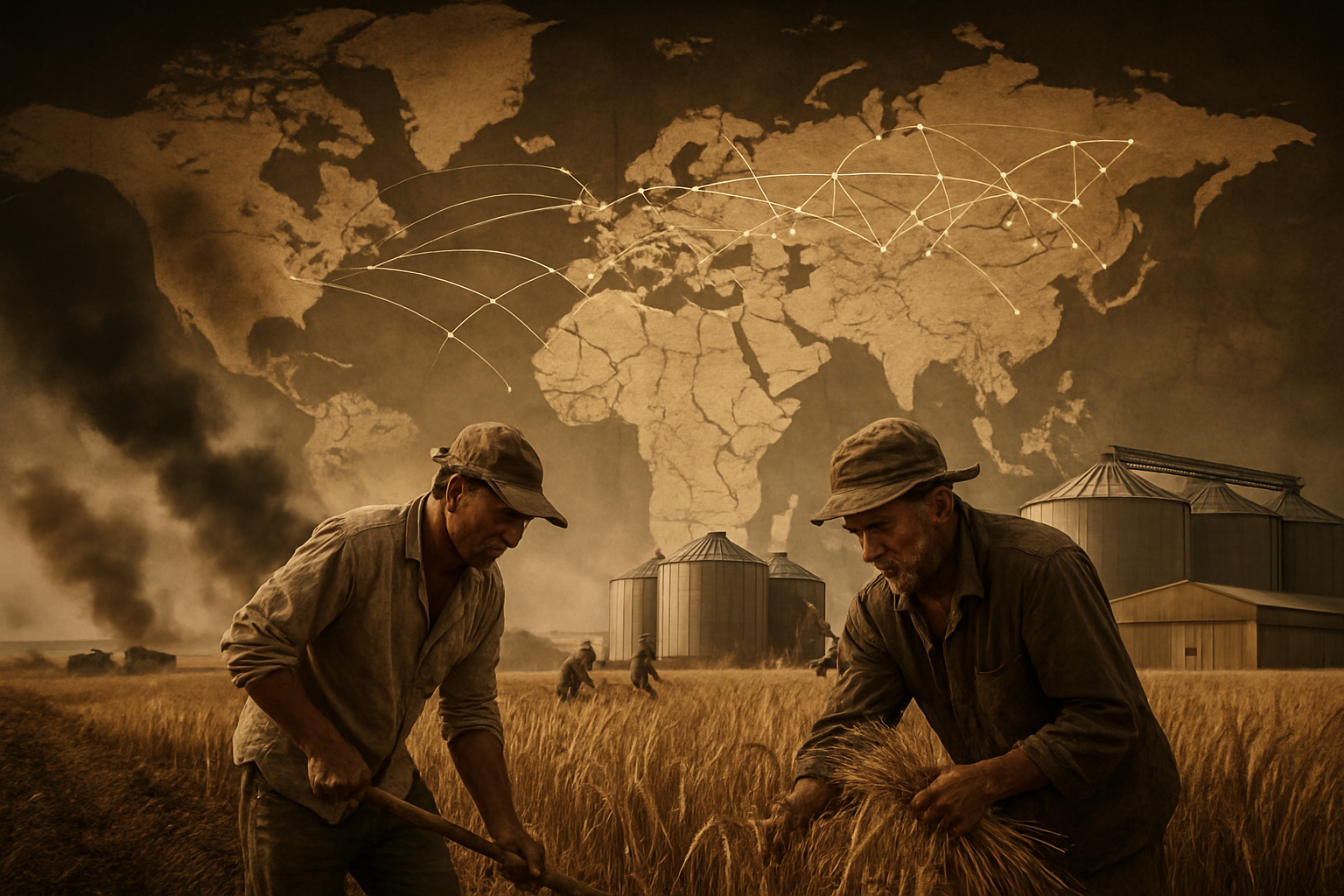
The ongoing Russia-Ukraine War has fundamentally reshaped the global food landscape, with Ukraine's role as Europe's breadbasket severely compromised while emerging regional powers step forward to address mounting food security challenges through innovative agricultural partnerships and infrastructure development.
Before the conflict erupted, Ukraine held a crucial position in global agricultural markets, supplying millions of tons of wheat, sunflower oil, and animal feed to countries across the Middle East, Africa, and Asia. The war has not only disrupted these critical supply chains but has also highlighted the vulnerability of global food systems to geopolitical shocks, forcing nations worldwide to reassess their food security strategies.
Ukraine's Agricultural Crisis Intensifies
The devastating impact of the conflict on Ukraine's agricultural sector cannot be overstated. What was once known as Europe's breadbasket now struggles to maintain basic food production and export capabilities. The systematic targeting of agricultural infrastructure, including grain storage facilities, processing plants, and transportation networks, has severely limited Ukraine's ability to contribute to global food markets.
Recent military actions have specifically targeted Ukraine's energy infrastructure, affecting not only civilian populations but also agricultural operations that depend on consistent power for irrigation systems, grain drying, and storage facilities. This systematic approach has created cascading effects throughout the food supply chain, with implications extending far beyond Ukraine's borders.
Caribbean Leadership in Food Security Innovation
While global attention focuses on the crisis in Ukraine, significant developments are emerging from the Caribbean region, where countries like Guyana are positioning themselves as leaders in regional food security initiatives. Minister Zulfikar Mustapha has been instrumental in encouraging regional collaboration to strengthen food security efforts across the Caribbean community.
Guyana's approach represents a sophisticated integration of traditional farming expertise with cutting-edge technology and climate-adaptive infrastructure. The nation has successfully maintained its position as the Caribbean's leading force in regional food security since 2020, despite climate disruption affecting traditional Caribbean growing seasons.
"Regional cooperation and strategic partnerships are essential for building resilient food systems that can withstand both climate challenges and geopolitical disruptions,"
— Minister Zulfikar Mustapha, Guyana Ministry of Agriculture
Strategic Agricultural Partnerships Emerge
The Inter-American Institute for Cooperation on Agriculture (IICA) has been facilitating a series of meetings across the Caribbean to develop strategic plans for regional agricultural development. These initiatives represent a shift toward South-South cooperation, where developing nations share expertise and resources through peer partnerships rather than relying solely on traditional North-South aid dependencies.
This approach has proven more sustainable and culturally appropriate than conventional development assistance programs. Caribbean nations are leveraging their collective knowledge and resources to create integrated agricultural systems that can respond effectively to both immediate crises and long-term challenges.
Global Context and Climate Pressures
These agricultural developments are occurring during unprecedented environmental stress, with climate change fundamentally altering traditional farming cycles worldwide. The sustained warming trends have created additional challenges for agricultural systems already under pressure from geopolitical conflicts.
The convergence of climate change and conflict-related disruptions has created what experts describe as a "perfect storm" for global food security. Traditional growing seasons have been disrupted, water availability has become more unpredictable, and extreme weather events have increased in frequency and intensity.
Technology Integration and Traditional Knowledge
Successful agricultural adaptation requires sophisticated integration of cutting-edge technology with traditional ecological knowledge and community-based management systems. The most effective approaches respect existing community structures while introducing beneficial innovations that enhance productivity and resilience.
Precision agriculture technologies, advanced irrigation systems, and digital monitoring tools are being combined with indigenous farming practices that have sustained communities for generations. This synthesis approach has proven more effective than purely technological solutions that ignore local farming traditions and community needs.
Economic Development and Food Security
Agricultural development is increasingly recognized as functioning beyond simple food production to serve as an economic development engine. Modern agricultural initiatives create sustainable rural employment, support food security objectives, and generate economic multiplier effects that benefit entire regions.
The Caribbean's approach demonstrates how agricultural development can stimulate rural economies through job creation in processing, transportation, and value-added production. This comprehensive approach addresses immediate food needs while building long-term economic sustainability.
International Cooperation and Scaling Success
The success of regional agricultural initiatives provides templates for addressing global food security through diverse and complementary approaches. International cooperation is essential for sharing successful models and adapting them to different geographical and cultural contexts.
The Caribbean experience offers valuable lessons for other regions facing similar challenges. Their emphasis on community ownership, transparent governance, and sustained political commitment has created a foundation for long-term success that can be replicated elsewhere.
Implementation Challenges and Success Factors
Despite promising developments, significant challenges remain in implementing large-scale food security initiatives. Funding sustainability is a critical concern for developing nations, where immediate economic pressures often override long-term investment considerations.
Technical capacity building requires sustained investment in education, training, and institutional development. Climate change continues to disrupt project timelines, requiring adaptive management approaches that can respond to rapidly changing environmental conditions.
Success factors consistently identified across different initiatives include community ownership, international cooperation that respects local autonomy, economic viability that provides tangible benefits to participants, and transparent governance structures supported by sustained political commitment.
Future Implications and Strategic Significance
The window for building resilient and equitable food systems is narrowing rapidly as climate change accelerates and global population growth continues. Agricultural innovation must keep pace with environmental change while maintaining effectiveness principles that ensure community benefit.
The coordination between immediate crisis response and long-term resilience building is critical for global food systems serving growing populations amid accelerating environmental change. The approaches being developed in 2026 may determine whether food production can successfully adapt to the new realities of climate change and geopolitical instability.
Success depends on sustained international cooperation, enhanced coordination across multiple scales and sectors, and increased financial commitments that recognize food security as essential infrastructure for human prosperity and planetary sustainability. The human dimension remains central to all these efforts, as millions of farmers, food workers, and vulnerable communities depend on stable and fair global food systems.