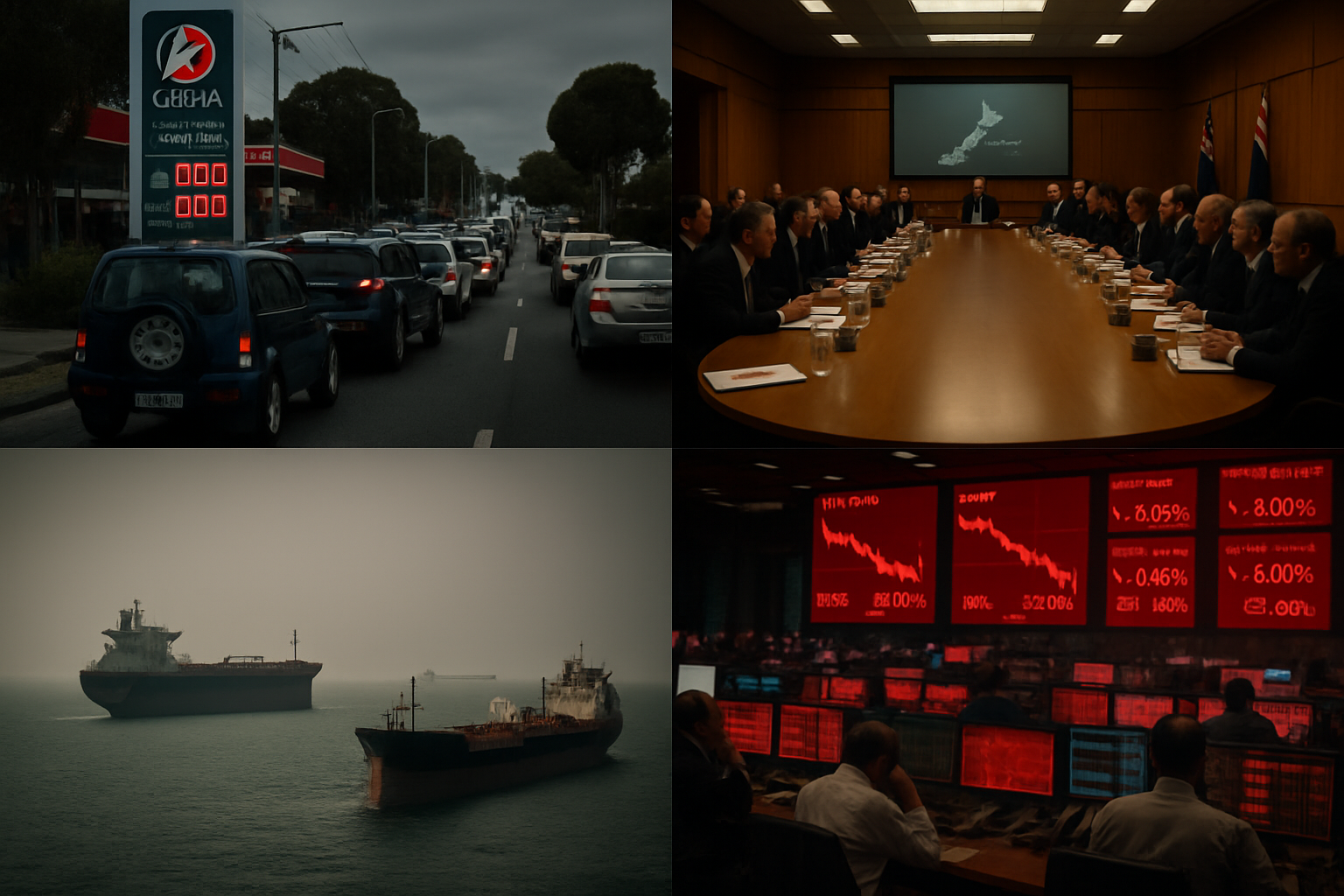
The most severe global energy crisis since the 1970s oil shocks is unfolding across multiple continents as Iran's Revolutionary Guard maintains its blockade of the Strait of Hormuz, creating unprecedented fuel shortages from Australia to Europe while triggering emergency government interventions worldwide.
Oil prices have breached $100 per barrel for the first time since 2022, with Brent crude peaking at $119.50 and WTI recording an historic 18.98% single-day jump to $108.15. Iran's declaration of the Strait of Hormuz as "unsafe for shipping" has effectively blocked 40% of global seaborne oil transit through the critical 21-mile chokepoint.
Australia and New Zealand in Crisis Mode
Australia faces its worst fuel crisis in decades, with hundreds of service stations empty across NSW, Queensland, Victoria and South Australia. Petrol prices have surged past $2.50 per liter nationally, approaching the critical $3 threshold in some regions. Queensland stations in rural areas including Texas township and Robinvale have completely run dry.
"Major suppliers are favoring bulk distributors over independents, creating severe rural shortages,"
— Lawrence Springborg, Goondiwindi Mayor
NSW Energy Minister Penny Sharpe is chairing emergency crisis talks in Sydney with transport, agriculture, mining and consumer groups, while the Australian Competition and Consumer Commission (ACCC) monitors fuel companies for price gouging. Deputy Prime Minister Richard Marles has admitted that fuel rationing remains a possibility if the Iran war continues.
Across the Tasman, New Zealand has breached the historic $3 per liter mark for petrol, with Prime Minister Christopher Luxon considering "Muldoon-era" emergency measures including car-free days and petrol sale limits - interventions not seen since the 1970s crisis. The Waitomo Group reports a 15-20% demand surge with panic buying behavior similar to the early stages of COVID-19.
European Emergency Interventions
European nations are implementing unprecedented government interventions, abandoning free-market principles to protect consumers. Ireland has cut diesel excise duty by 20 cents and petrol by 15 cents through a €235 million emergency package. Hungary imposed immediate price caps to counter "war-driven explosions," while France has deployed 500 fuel inspectors to prevent price manipulation.
Romania has outlined five emergency scenarios to prevent diesel from exceeding 10 lei per liter, with Slovakia activating strategic petroleum reserves for the first time under current protocols. Germany is strengthening antitrust laws targeting gas station price manipulation - representing significant market intervention in modern German energy policy.
The Root Cause: Strait of Hormuz Blockade
The crisis stems from Iran's Revolutionary Guard declaration that the Strait of Hormuz is "unsafe for shipping" amid the ongoing Middle East conflict. This geographic chokepoint handles 40% of global seaborne oil transit, and there are no realistic alternatives capable of handling such massive volumes.
Over 150 oil and LNG tankers remain stranded in the Persian Gulf representing billions in cargo value, while major shipping companies Maersk and MSC have suspended all operations. Iran has deployed between 2,000-6,000 naval mines, forcing the US to destroy 28 Iranian mine-laying vessels.
Historic Strategic Response
The International Energy Agency (IEA) has announced the largest strategic petroleum reserve release in its 50-year history - 400 million barrels from 32 countries, more than double the 182.7 million barrels released during the 2022 Ukraine crisis.
Japan is leading the response with 80 million barrels, marking its first deployment since the 2011 Fukushima disaster despite the country's 95% dependence on Middle East oil. Germany has confirmed participation, with the US expected to be the largest contributor. Energy Secretary Christopher Wright is considering lifting additional Russian oil sanctions to help stabilize global supplies.
Global Supply Chain Collapse
The crisis extends far beyond energy markets, with the Persian Gulf serving as a critical trade hub affecting consumer goods and industrial materials worldwide. Manufacturing in automotive, electronics and textiles faces severe disruptions due to Gulf-dependent networks.
Qatar's LNG production has halted at the Ras Laffan and Mesaid facilities following Iranian attacks, eliminating approximately 20% of global LNG exports. Natural gas prices have exploded 24% in Europe and 78% in the US, reaching €47.32/MWh - the highest levels since February 2025.
"Gulf states may declare force majeure within weeks, with oil approaching $150 per barrel threatening to bring down the economies of the world,"
— Saad Al Kaabi, Qatar Energy Minister
Aviation Industry Paralyzed
The aviation sector faces its worst crisis since COVID-19, with over 18,000 flights cancelled worldwide. Eight countries have imposed simultaneous airspace closures across Iran, Iraq, Israel, UAE, Qatar, Syria, Kuwait and Bahrain, creating an "aviation black hole" severing critical Europe-Asia corridors.
Dubai International Airport, the world's busiest with 86 million passengers annually, remains shut due to missile damage. Major carriers including Emirates, Air France-KLM, Wizz Air and Bulgaria Air have suspended operations indefinitely. Jet fuel costs have surged 122% from $85-90 to $150-200 per barrel, forcing airlines to implement emergency fare increases.
Financial Markets in Freefall
Global financial markets have crashed, with Pakistan's KSE-100 recording its largest single-day decline in history at -8.97%. South Korea's KOSPI fell 12%, triggering circuit breakers as the Korean won hit a 17-year low. PayPal's $1.1 billion IPO has been postponed indefinitely due to market volatility.
Central banks including the European Central Bank and Bank of Japan are coordinating emergency liquidity measures to prevent broader financial contagion, though traditional monetary policy tools have limited effectiveness against structural geopolitical disruptions.
Consumer Impact Across Continents
The human cost of the crisis spans continents. Bangladesh has implemented fuel rationing for 170 million people, while Pakistan faces wartime austerity measures with Rs321.17 per liter - the highest prices in South Asia. The government has implemented four-day work weeks and cabinet salary forfeits.
In Europe, Sweden faces electricity increases of 10-20 öre and gasoline rises of 1-2 kronor per liter, with the Malmö region most exposed due to continental integration. Ireland's heating oil approaches €2 per liter, prompting accusations of "brazen rip-offs." Bosnia-Herzegovina is down to just two days of gas reserves.
Nuclear Diplomacy Breakdown
The energy crisis emerged from the complete collapse of US-Iran nuclear talks despite a Geneva "broad agreement on guiding principles" - the most progress since the 2018 JCPOA collapse. Iran excluded its ballistic missiles and proxy forces as "red lines" while the US demanded comprehensive coverage of missiles, armed groups and human rights.
This led to Operation Epic Fury, the largest coordinated US-Israeli military operation since 2003, which triggered Iran's massive retaliation under "Operation True Promise 4" with the Revolutionary Guard declaring "no red lines remain."
Energy Security Transformation Imperative
The crisis exposes dangerous over-dependence on strategic chokepoints in volatile geopolitical regions. The 21-mile Strait of Hormuz represents a single-point failure in modern logistics with no realistic alternatives capable of handling diverted volumes.
"This is the most severe energy security crisis in decades, exposing single-chokepoint vulnerabilities that require fundamental restructuring,"
— Samuel Ciszuk, Energy Security Analyst
Strategic petroleum reserves provide only temporary buffers for sustained disruptions. Fundamental energy architecture transformation is needed to reduce dependence on volatile geopolitical regions, though supply diversification and renewable transitions require years to decades for implementation.
Template-Setting Crisis Management
UN Secretary-General António Guterres has called this "the greatest test of multilateral cooperation in crisis management in the modern era." The March 2026 crisis represents the most dangerous international situation since the Cold War's end, affecting regional war prevention, global energy security, nuclear governance credibility and international law enforcement simultaneously.
The recovery timeline remains uncertain, depending on military operations and diplomatic resolution rather than predictable economic factors. Unlike weather disruptions, this crisis requires political resolution of underlying conflicts affecting international stability mechanisms globally.
March 2026 represents a watershed moment in establishing new paradigms for 21st-century energy security planning, requiring fundamental transformation to reduce dependence on strategic chokepoints. The consequences of success or failure will reverberate through international relations for decades, determining whether diplomatic or military solutions become the template for future crisis management in an increasingly volatile and interconnected world.